
Summary
-
Australia's Corporations Act now requires large entities to lodge an annual sustainability report containing AASB S2 climate statements, a regime legislated in September 2024.
-
Group 1 reporting is live: 312 reports for December 2025 year-ends had been lodged by September 2026, and June 2026 year-end reports follow this year. Group 2's first reporting years began from 1 July 2026, and Group 3 follows from 1 July 2027. That deadline is closer than you think.
-
Scope 3 reporting becomes mandatory from each entity's second reporting year, covering value-chain emissions beyond a company's own operations.
-
The May 2026 Federal Budget proposed raising Group 3 entry thresholds, and Treasury consulted until 2 October 2026 on assurance settings, guidance on key terms, and supplier information requests. The legislated dates and requirements apply until any change is passed.
Australia's climate disclosures at a glance
| Regulator | The Australian Securities and Investments Commission (ASIC) administers and enforces the reporting requirements. The Australian Accounting Standards Board issues the standards; the Auditing and Assurance Standards Board sets the assurance timeline. |
| Standard | AASB S2 Climate-related Disclosures (mandatory), issued September 2024 under Chapter 2M of the Corporations Act 2001. AASB S1 (general sustainability) is voluntary. AASB S2025-1 amendments apply for years beginning on or after 1 January 2027, with early application permitted. |
| Companies in scope | Three groups phased by size. Entities already required to prepare a Chapter 2M financial report that meet two of three size tests, plus National Greenhouse and Energy Reporting (NGER) reporters and asset owners with $5 billion or more in assets. |
| Estimated population | Total reporting population: Not yet published.¹ ASIC reported in September 2026 that 312 sustainability reports had been lodged for the financial year ended 31 December 2025. |
| First reporting year | Group 1: financial years commencing on or after 1 January 2025 (first reports lodged in 2026). Group 2: on or after 1 July 2026. Group 3: on or after 1 July 2027. |
| Scope 3 required | Yes, from each entity's second reporting year. For Group 1 entities with calendar financial years, that means years commencing 1 January 2026. |
| Assurance | Phased under ASSA 5010: limited assurance over governance, the strategy risks and opportunities disclosures, and Scope 1 and 2 in year 1; limited assurance over the full report in years 2 and 3; reasonable assurance over all disclosures from year 4. The Act requires full audits for financial years commencing on or after 1 July 2030. Treasury's August 2026 consultation paper includes options to change the move to reasonable assurance (proposed). |
| Penalty regime | Corporations Act financial reporting penalties, including civil penalties for directors. During transition, "protected statements" (including Scope 3) face only criminal actions or actions brought by ASIC. |
¹ ASIC publishes lodgement counts in its sustainability reporting reviews; neither ASIC nor Treasury has published a definitive count of total in-scope entities across the three groups.
In September 2024, the Australian Parliament passed the Treasury Laws Amendment (Financial Market Infrastructure and Other Measures) Act 2024, writing mandatory climate reporting into the Corporations Act 2001.
The largest entities, Group 1, began reporting for financial years commencing on or after 1 January 2025 under AASB S2 Climate-related Disclosures, and by September 2026, 312 sustainability reports for the year ended 31 December 2025 had been lodged with the corporate regulator. The regime is set in Australia's national corporate law rather than in listing rules: it carries civil penalties for directors, phases across three size groups, and escalates to reasonable assurance over every disclosure by the fourth reporting year.
Below: what the rules require, and how to prepare.
What Australia's climate disclosure rules require
Australia's regime sits in national law: the Corporations Act sets out who reports, when and how, and AASB S2 sets out what the climate statements must contain.
-
The Corporations Act 2001, the legal architecture. Reporting entities must prepare an annual sustainability report consisting of climate statements, notes, and a directors' declaration. The report is lodged with ASIC, given to shareholders alongside the financial report, tabled at the annual general meeting, and supported by records kept for seven years.
-
AASB S2 Climate-related Disclosures, the content standard. Issued by the Australian Accounting Standards Board in September 2024 and aligned with IFRS S2, it requires disclosure of climate-related risks and opportunities across governance, strategy, risk management, and metrics and targets, including scenario analysis. AASB S1 covers general sustainability disclosure and remains voluntary.
-
GHG Protocol as the measurement standard, with an Australian relief. Emissions are measured under the GHG Protocol Corporate Accounting and Reporting Standard (2004). Entities reporting under the NGER scheme can apply jurisdictional relief to use NGER measurement methods for the parts of the business that scheme covers; the AASB S2025-1 amendments (approved December 2025) clarify that this relief applies part-by-part.
The standard's "reasonable and supportable" information threshold has teeth. In its May 2026 review of first reports, ASIC reminded entities that this includes past events, current conditions and forecast future conditions, and that disclaimers conflicting with the statutory framework are not permitted. Its September 2026 review of 40 reports found marked improvement on voluntary reporting, and flagged forward-looking disclosures and those relying on assumptions and judgements, particularly strategy and metrics, as the areas to strengthen.
Dr. Kaushik Sridhar, Founder & CEO, Orka Advisory, examines the Australian sustainability reporting landscape
How AASB S2 differs from IFRS S2
AASB S2 builds on the ISSB's IFRS S2 Climate-related Disclosures, then adapts it for the Australian market. Three differences matter most:
-
It is national law. IFRS S2 is a global baseline that each jurisdiction adopts as it chooses. Australia wrote AASB S2 into the Corporations Act 2001, making it mandatory for in-scope entities and attaching civil penalties for directors who fail to ensure compliance.
-
Industry-based metrics are excluded. IFRS S2 directs entities to refer to the ISSB's industry-based disclosure topics and metrics. AASB S2 removes that requirement, so entities disclose against the core standard without the industry-based metrics layer.
-
The timeline follows the legislated phase-in. In place of IFRS S2's single effective date, AASB S2 applies the three-group commencement schedule set by the Corporations Act, with first-year reliefs: no comparative information for the first period, Scope 3 deferred to the second year, and relief on detailed scenario analysis in the first year.
One consequence follows from the industry-metrics change: because AASB S2 omits the industry-based metrics that IFRS S2 references, meeting AASB S2 does not by itself mean an entity also complies with the ISSB standards.
Who is in scope
Reporting obligations apply to entities that already prepare a Chapter 2M financial report and meet any one of three threshold pathways, phased across three groups. Because the regime sits in the Corporations Act rather than in listing rules, it reaches large private companies on the same basis as listed ones: of the first 259 reports lodged for the year ended 31 December 2025 (counted to 6 May 2026), 225 came from unlisted entities.
A note for NGER reporters. The National Greenhouse and Energy Reporting (NGER) scheme is Australia's established system for large emitters and energy users to report greenhouse gas emissions, energy production and energy consumption to the Clean Energy Regulator. NGER status is a separate entry trigger: NGER reporters are captured by the climate reporting regime regardless of whether they meet the size tests below, and they can use NGER measurement methods for the operations the scheme covers. Companies that do not report under NGER can set this section aside.
Group 1 (reporting now)
Entities meeting two of three size tests: consolidated revenue of $500 million or more, consolidated gross assets of $1 billion or more, or 500 or more employees. NGER reporters above the publication threshold in section 13(1)(a) of the NGER Act also fall in Group 1. First reports cover financial years commencing on or after 1 January 2025.
Group 2 (from July 2026)
Entities meeting two of three size tests: consolidated revenue of $200 million or more, consolidated gross assets of $500 million or more, or 250 or more employees. Group 2 also captures the remaining NGER reporters and superannuation funds and managed investment schemes holding $5 billion or more in assets. Reporting applies to financial years commencing on or after 1 July 2026.
Group 3 (from July 2027)
Entities meeting two of three size tests: consolidated revenue of $50 million or more, consolidated gross assets of $25 million or more, or 100 or more employees. A Group 3 entity that determines it has no material climate-related financial risks or opportunities can lodge a statement explaining that conclusion in place of full climate statements. The May 2026 Federal Budget proposed lifting the large proprietary company thresholds to $100 million revenue and $50 million assets, which would move some private companies out of Group 3 entirely (proposed, subject to legislation; no commencement date has been set).
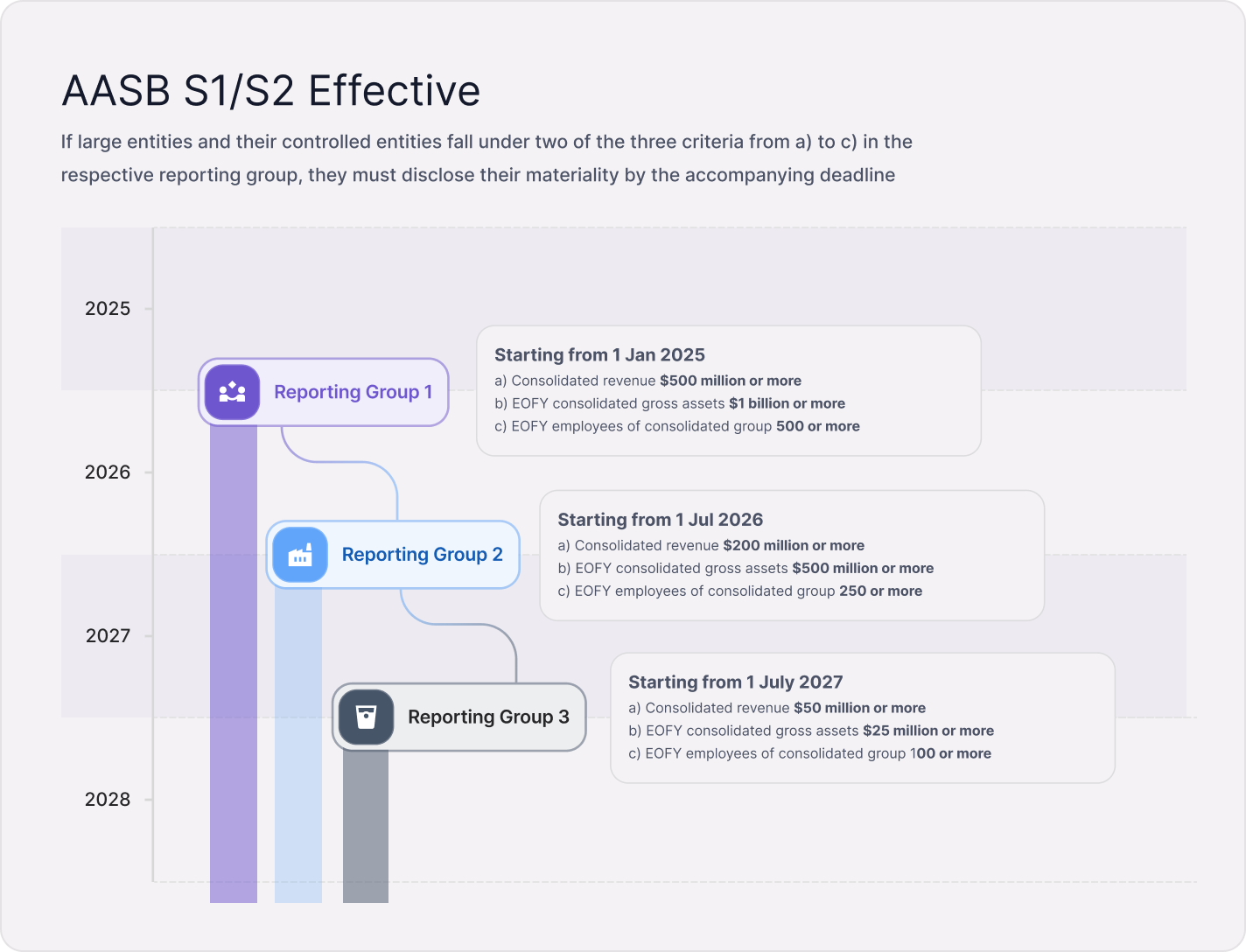 Fig. 1: Phases in timeline and criteria of the Treasury Laws Amendment (Financial Market Infrastructure and Other Measures) Bill 2024
Supply-chain reach. AASB S2 requires in-scope entities to disclose Scope 3 emissions from their second reporting year, and Treasury's consultation, which closed on 2 October 2026, includes options to reduce the burden of information requests across supply chains. The implication is that companies in the value chains of in-scope entities, including suppliers with no reporting obligation of their own, can expect requests for emissions data to support those Scope 3 disclosures.
When Scope 3 emissions reporting becomes a requirement, there will be increased demand for value chain emission data, spilling over to smaller companies, who in turn have to disclose their own emissions data.
Key dates and milestones
| Milestone | Measurement year | First reporting date |
| Group 1 reporting begins | FY commencing on or after 1 January 2025 | Reports lodged from 2026 |
| Scope 3 mandatory for Group 1 | Second reporting year (FY commencing 1 January 2026 for calendar-year entities) | Reports lodged from 2027 |
| Group 2 reporting begins | FY commencing on or after 1 July 2026 | Reports lodged from 2027 |
| Group 3 reporting begins | FY commencing on or after 1 July 2027 | Reports lodged from 2028 |
| Limited assurance extends to the full sustainability report (Group 1) | FY commencing on or after 1 July 2026 | With the FY2026-27 report |
| Reasonable assurance over all disclosures (Group 1) | FY commencing on or after 1 July 2028 | With the FY2028-29 report |
| Full audit required by the Act for all groups | FY commencing on or after 1 July 2030 | With the FY2030-31 report |
Group 1 entities with financial years commencing between 1 January and 30 June are subject to the year 1 assurance provisions twice, under the transitional design of ASSA 5010.
How companies should prepare
Group 1 entities with June year ends are lodging their first reports, and calendar-year Group 1 entities are in their second reporting year, the first with Scope 3. Group 2 entities entered their first reporting year from 1 July 2026, and Group 3 entry thresholds are under review. The preparation work holds regardless, and the deadline is closer than you think.
-
Establish your greenhouse gas inventory across Scope 1, 2 and 3. Build on the GHG Protocol Corporate Accounting and Reporting Standard (2004), and map where NGER measurement methods apply to use the jurisdictional relief deliberately.
-
Map your value-chain exposure to in-scope entities. Companies selling to Group 1 and Group 2 reporters should prepare for Scope 3 data requests from 2026 onward, with category-level data delivered through standardised inventories.
-
Build assurance-ready processes early. Limited assurance applies from the first report and reasonable assurance over everything arrives in year 4. Methodology documentation, source-to-disclosure traceability and reviewer access built now avoid retrofitting under audit pressure.
-
Build on the frameworks you already use. Existing Task Force on Climate-related Financial Disclosures reporting, GHG Protocol inventories and CDP submissions carry directly into AASB S2 readiness; the four-pillar structure is the same.
Once reporting, companies must submit an annual ‘sustainability report’ to the Australian Securities and Investments Commission (ASIC). This contains:
- The year’s climate statements;
- any accompanying notes to the climate statements; and
- the directors’ declaration about the statements and notes.
Climate statements and their notes should focus on:
- the entity’s material climate-related financial risks and opportunities;
- the entity’s metrics and targets for the financial year relating to climate that are required to be disclosed by the sustainability standards, including in relation to Scope 1, 2 and 3 emissions of greenhouse gas; and
- any information about the entity’s governance, strategy, or risk management in relation to these risks, opportunities, metrics and targets.
How Terrascope can help
Terrascope's AI-powered platform helps companies reporting under Australia's Corporations Act move from baseline emissions data to audit-ready disclosures, including Dyno Nobel, the Australian-headquartered explosives manufacturer that achieved limited assurance over its global Scope 1 and 2 emissions data one year ahead of mandate.
-
Scope 1, 2 and 3 emissions measurement. Corporate carbon footprinting pipes energy data, fuel records, procurement spend and supplier data into a GHG Protocol-aligned inventory, with full audit trail from source system to disclosed figure.
-
Audit-ready reporting. Capture methodology, factor selections and version history for every emission category, with role-based assurance-provider access matched to the ASSA 5010 phasing.
-
Supply-chain intelligence. Supplier engagement surfaces category-level Scope 3 hotspots across your supplier network before the second-year Scope 3 deadline, identifying where supplier engagement moves the disclosed number most.
-
Multi-framework alignment. Climate reporting produces an AASB S2-aligned narrative mapped to IFRS S2's disclosure requirements, with parallel output for CSRD and CDP from the same data set.
Frequently asked questions
Speak to an expert
Are you ready to get ahead of Australia's AASB S2 requirements? Speak to a Terrascope expert and see how we help companies move from baseline emissions data to audit-ready disclosures.