Executive Summary
-
The GHG Protocol's Land Sector and Removals (LSR) standard requires companies with agricultural commodities, forest products, or natural fibres to report land emissions separately from energy and industry emissions starting with 2027 inventories.
-
Companies can start reporting today by disaggregating emission factors they already use, without waiting for any supplier farm-level data.
-
Investing in bottom-up, farm-level calculations typically produces lower numbers than global averages, reflects real decarbonisation efforts, and builds the data foundation to claim carbon removals worth up to one-third of targeted reductions in land emissions.
Land-related emissions account for nearly a quarter of global greenhouse gas output, yet until recently they’ve been bundled invisibly into corporate Scope 3 inventories. The GHG Protocol’s Land Sector and Removals (LSR) standard, published in January 2026 and effective for 2027 inventories, changes that. Companies with agricultural commodities, forest products, or natural fibres in their value chains must now separate land emissions from energy and industry emissions and report them as distinct line items.
In a recent Terrascope webinar, sustainability expert Xinlu Liu walked through a practical framework for getting started when your data is still evolving. She covered disaggregating average emission factors, building bottom-up calculations from primary farm data, and illustrated both with real worked examples, including what it looks like when land use change turns out to be 80% of a commodity’s footprint.
Here are seven key takeaways.
1. LSR Is Mandatory
If your company reports a corporate GHG inventory using the GHG Protocol and has land sector activities anywhere in its operations or Scope 3 value chain, LSR applies. Agricultural commodities like palm oil, soy, coffee, dairy, and cotton all trigger it, as do forest products and bioenergy. There is no opt-out, and there is no materiality threshold (although the standard references SBTi’s 20% threshold in its FLAG Guidance as a screening tool).
Under the previous guidance, land emissions were largely bundled into Scope 1, 2, and 3 totals. LSR introduces three structural changes. First, land-related emissions must be reported separately from energy and industry (E&I) emissions. Second, land use change, land management, and biogenic product emissions each become distinct line items. Third, carbon removals, while optional, are subject to strict requirements around permanence and reversal accounting if you choose to claim them.
The LSR Standard is now part of the GHG Protocol's core standards, and compliance with the GHG Protocol means compliance with LSR for relevant companies. This applies to companies in any of the 30+ jurisdictions where IFRS S2 "Climate Related Disclosures" is now adopted or under consultation.
2. Land Use Change Is A Wild Card
Before getting into methodology, it’s worth understanding land use change (LUC) specifically. LUC can be near-zero for established farms on non-forested land, or LUC can dwarf all other emission sources for commodities with a history of deforestation or peat conversion.
When Terrascope disaggregated the emission factors for a barley grain example during the webinar, 80% of the total footprint came from a single component: carbon dioxide from soil and biomass stock changes. Energy and industry emissions, the part most companies are used to measuring, accounted for a fraction of the total.
To understand the scale of land use change, where your commodities are grown matters is as important as what you grow or purchase. A farm with no history of deforestation carries near-zero land use change emissions, while one on converted tropical forest carries carbon emissions that must be amortised over at least 20 years under LSR.
When Terrascope worked with TSE Group, a palm oil producer, to measure their full emissions profile, land-related emissions made up roughly 80% of their total Scope 1, 2 and 3 footprint, with energy and industry emissions contributing ~20%.
 How a Palm Oil Carbon Inventory Moved to Full Transparency
3. Data Maturity Determines Your Approach
The webinar was built around a three-tier data maturity model, which maps your current data to the right LSR approach.
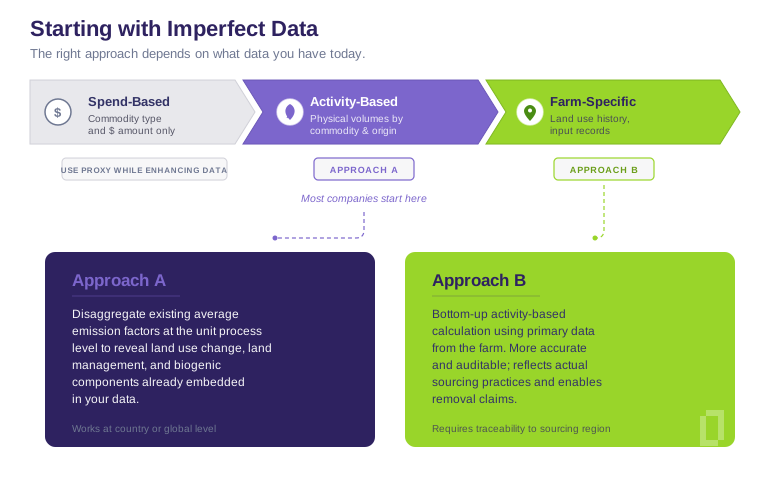
Spend data only: You know the commodity type and dollar amount. You can map spend-based emission factors to activity-based proxies, document your assumptions clearly, and work towards activity data for the next measurement cycle.
Activity-based data (Approach A): You have physical quantities and country of origin. This is where most companies sit today, and where disaggregating average emission factors can deliver an LSR-compliant breakdown without any farm-level data.
Disaggregation gives you a largely LSR-compliant inventory as a starting point, while acknowledging that emission factor databases are still evolving their methodologies to fully align with LSR requirements.
Farm-specific data (Approach B): You have access to land use history, input records (fertiliser, energy), and traceability to specific sourcing regions. This produces the most accurate and auditable results.
These approaches are complementary, not binary. Different commodities in your portfolio will sit at different maturity levels, and you can apply Approach A to some and Approach B to others within the same inventory. A hybrid approach, using primary data where you have it and secondary data to fill the gaps, is the realistic path for most companies.
4. Your Emission Factors Already Contain LSR Data
If you’re using activity-based emission factors from databases like ecoinvent, the land emission components (land use change, land management, biogenic CO₂) are already bundled inside those numbers. They’re just not broken out.
The webinar demonstrated this with barley grain. A single ecoinvent emission factor of 1.88 kgCO₂e per kilogram looks like one number. But when you examine it at the unit process level, looking at each individual input and output that contributes to the total, it reveals a tree of emission drivers showing exactly how much comes from land use change, how much from energy and industry, and how much from land management. Terrascope’s data science team calls this an "emissions factor driver tree". It’s what makes Approach A work: the emission factor database already contains the sub-components you need for LSR reporting.
The tagging work to identify and label those components has been done once across ecoinvent and other emission factor databases, applied automatically to customer measurements.
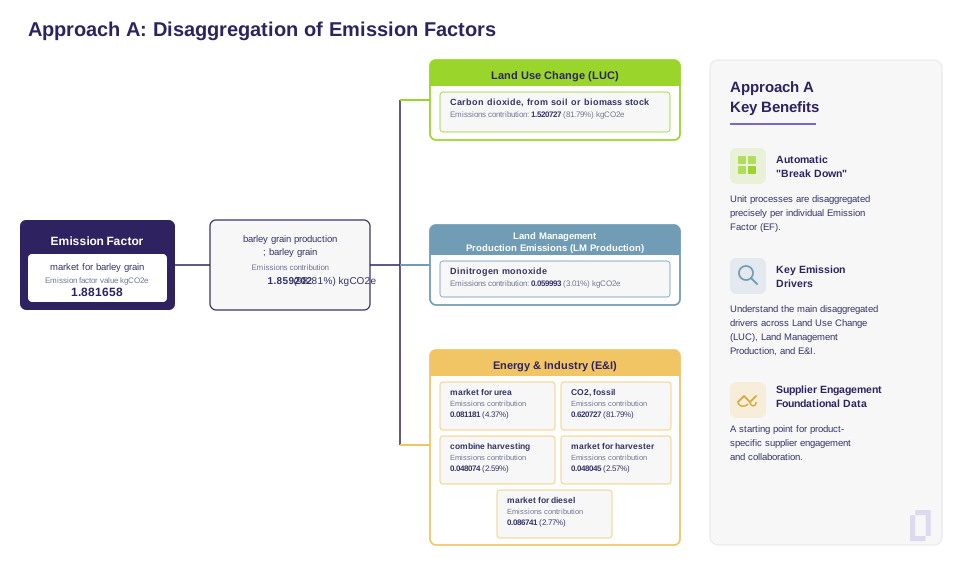
For Terrascope's customers, this means a first-pass LSR-compliant inventory breakdown is achievable using the data they already have, before any new supplier engagement begins.
There are known limitations. ecoinvent’s structure does not allow reliable separation of net biogenic CO₂ within land management (it shares a node with land use change), and not all databases model biogenic product emissions. If those categories are material to you, that’s a strong reason to move towards bottom-up calculations for those commodities.
5. “Bottom-Up” Calculations Are Less Daunting Than They Sound
Standardized, tier-based formulas are provided by the Intergovernmental Panel on Climate Change (IPCC) to estimate greenhouse gas emissions, and the formulas can seem intimidating.
However, the calculations follow a structured process using published IPCC coefficients, and only a small amount of initial data requires direct input from your supply chain. The minimum required inputs are land use history and yield data. Everything else can use standard formulas published coefficients.
With a platform that automates the calculation chain, the data ask to suppliers is must smaller than most teams initially assume.
6. More Granular Data Pays Off
A counterintuitive insight from the webinar: companies that invest in farm-level traceability and bottom-up calculations typically end up with lower emissions than global averages.
As Xinlu explained, global emission factor databases include worst-case origins in their averages. The land use change component is particularly affected: regional averages factor in high-deforestation sourcing that may not reflect your actual supply chain at all. Companies with the traceability to calculate land use change from their own sourced farms usually have lower numbers precisely because that level of supply chain visibility signals active management of deforestation risk.
There’s a second advantage: bottom-up calculations reflect your actual decarbonisation efforts. If a supplier switches to lower-nitrogen fertiliser or adopts improved land management practices, that improvement shows up in a bottom-up calculation, as long as primary data can be collected and used in the formulas. With average emission factors, those improvements stay invisible. The work required to move from Approach A to Approach B is how you make real supply chain improvements visible in your inventory.
7. Supplier Engagement Works Best When You’re Specific About What You Need
Our advice on supplier engagement: ask suppliers for the LSR categories you need upfront, so they know exactly what to provide.
-
For Approach A, this means asking suppliers who provide their own emission factors to include an LSR-compliant breakdown rather than a single aggregated number.
-
For Approach B, it means requesting specific activity data mapped to each emission source: land use history, fertiliser application rates, lime usage, energy inputs, and yield.
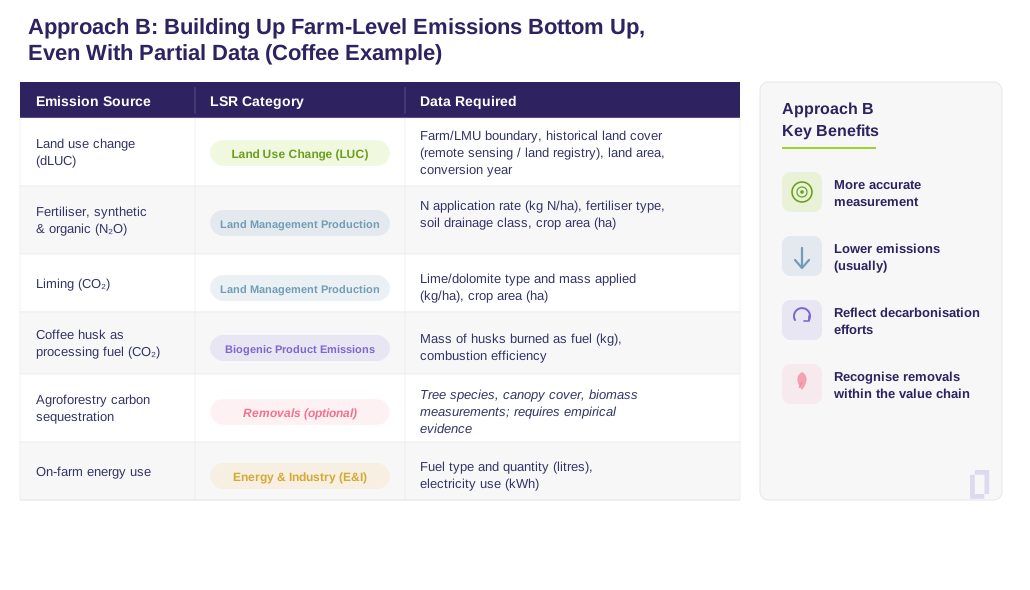
The realistic expectation is that most suppliers will provide some of this data, and you’ll build up the rest over time. That’s exactly where the hybrid approach becomes practical. You might calculate land use change bottom-up using a supplier’s GPS coordinates and land registry data, while using disaggregated database factors for fertiliser emissions until the input records become available. Each measurement cycle, you replace another secondary data point with a primary one.
The Payoff: Removals Are Where the Strategic Value Lives
Everything above gets you to LSR compliance. But there’s a reason to keep building beyond it. Carbon removals, including agroforestry sequestration, reforestation, and soil carbon restoration, are unique to the land sector, and SBTi estimates that up to one-third of the mitigation needed to meet FLAG targets will come from removal opportunities.
Claiming removals requires the kind of supply chain traceability and farm-level data that Approach B delivers. Average emission factors from databases like ecoinvent will not qualify. That’s the real case for starting where you are and building from there.
What To Do Next
Watch the full webinar. See the barley driver tree, the coffee bottom-up walkthrough, and live Q&A with Sustainability Expert Xinlu Liu.
Complimentary 30-minute discussion with an LSR expert. Our team will map your data maturity to the right starting point.