Skip to content

The GHG Protocol Land Sector Removals Standard is out.

Is your measurement data and supply chain data ready?

flag-splash-v2

The Global Leading Platform Built for Food & Beverage Complexity

Most F&B companies take 6-12 months to build a FLAG and Land Sector Removals inventory that passes SBTi review. Terrascope gets you there in 4-6 weeks with 200k+ emission factors from 10 years inside Olam's global supply chain.

Frame 3965620
Princes_Group_Logo

“From measurement all the way through to target submissions, Terrascope made it easy for Princes to secure our SBTI-validated FLAG targets in only a matter of months.”

David McDiarmid

Corporate Relations Director, Princes Group

4-6 Weeks

vs. 6-12 months traditional typical FLAG submission time frame.

100% Pass Rate

for audit and SBTi Approvals

600M+

tonnes of CO₂ measured across customers

92%

Accuracy vs. actual supplier
data when estimating

200K+ 
Emission 
Factors

with FLAG, LUC, & LM breakdowns

80%

reduction in measurement cycles

50x Faster

than traditional LCAs 
for product emissions

5x Faster

faster measurement and savings of up to USD160k

10 years

of sustainability experience Terrascope is an Olam venture.

  Before Terrascope After Terrascope
Time to FLAG baseline 6-12 months 4-6 weeks
Scope 3 accuracy 50-60% 92%
Data Collation and Ingestion Chasing spreadsheets AI-powered transformation to detect data gaps,
anomalies and enrich poor quality raw data
Supplier Engagement 1-3 years Supplier Portal to add structure and traceability to data collation
Emission factors ~50k generic 200k+ proprietary
SBTi validation outcome Uncertain 100% pass rate
Disaggregation Manual Automated disaggregation into LUC, LM breakdowns

Easily collect, measure, and decarbonize in weeks, not months

Get audit-ready measurement and supplier-level intelligence to drive reductions, fast.

Scope 3.1

Be submission-ready in weeks

While competitors treat FLAG as an add-on, it's core to our DNA. Move from fragmented inputs to a clear, defensible inventory and target workflow.

✔ Farm-level emissions and land use change
✔ SBTi FLAG screening and target setting
✔ GHG Protocol Land Sector Removals Guidance compliant
✔ Proprietary emission factors for agricultural commodities unavailable elsewhere
✔ Custom and dynamic emission factor matching

* Pokka measured 5000 SKUs in 3 weeks

Strategy

What-If Simulation & 
Scenario Planning

Test reduction initiatives before implementing. Understand trade-offs with precision.

✔ Model ingredient swaps and recipe changes
✔ Supplier and process alternatives
✔ MACC curves to align actions with ROI

* MUI Group: 5-10% emissions + 56% cost reduction

Insights

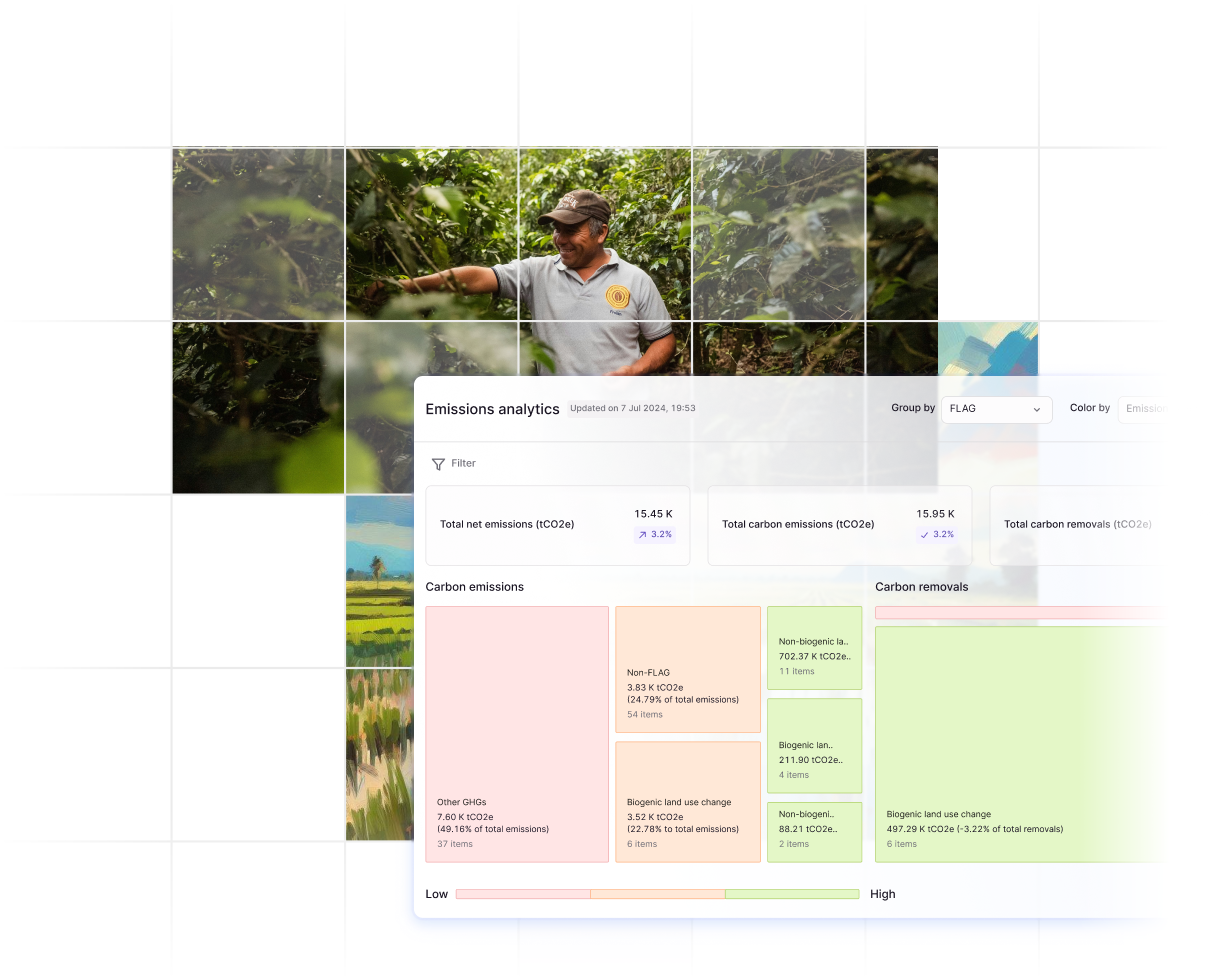
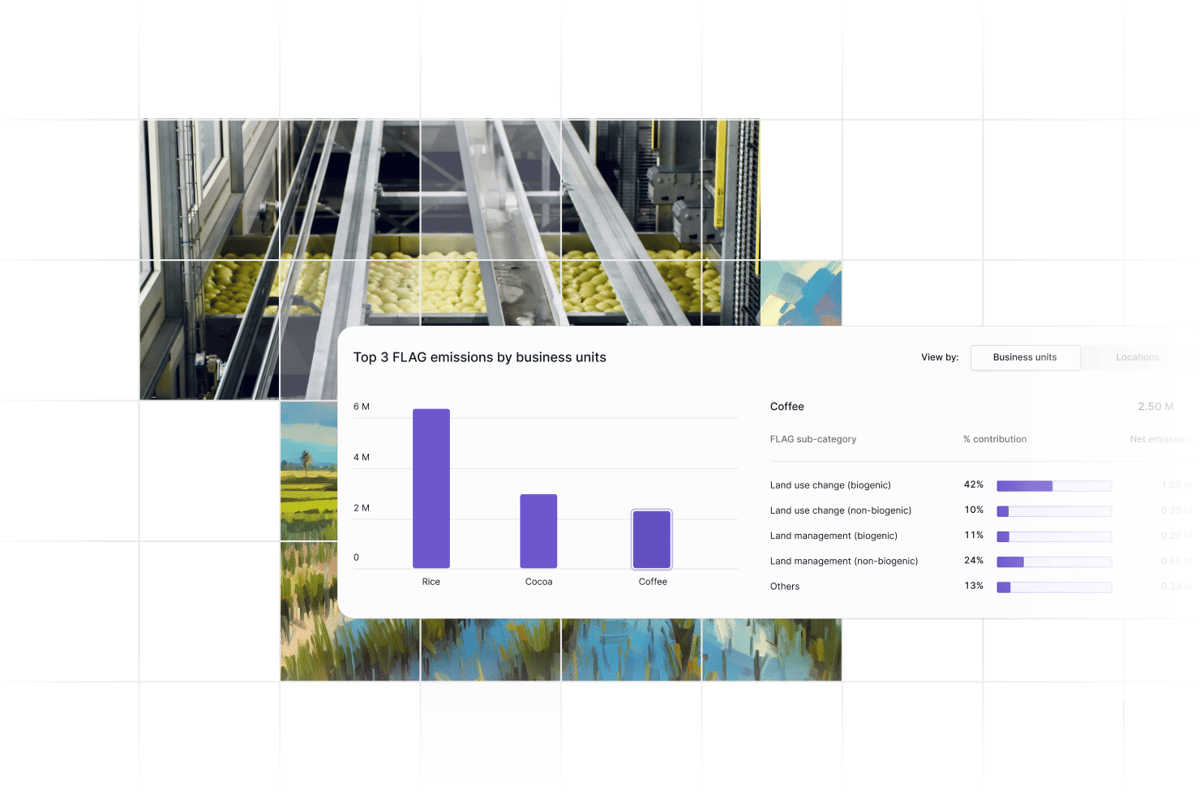
Hotspot Detection & Analytics

Visualize emissions drivers —by commodity, category, supplier, and activity—and prioritize high-impact reduction opportunities.

✔ Carbon Driver Tree analysis
✔ Facility, supplier, and geography drill-down
✔ Activity lineage to trace drivers and track YoY change

Supply Chain

Supplier Engagement Portal

Scale supplier data collection with structured requests and progress tracking.

✔ Supplier onboarding at scale with templates
✔ Scorecards and benchmarking dashboards
✔ Track supplier progress toward science-based target

Data Campaigns

AI-Powered Data Ingestion

Eliminate manual data entry. Process diverse formats 5x faster.

✔ PDFs, invoices, spreadsheets, ERP exports
✔ Automated validation and error detection
✔ 80% reduction in measurement cycles

* Princes Group processed 130K line items in 2 weeks with 92% accuracy vs. actual supplier data

Tailored solutions for different company profiles

If you Have Data,
But Need Compliance

"We measured Scope 3 with industry averages or third-party tools. Now LSR regulations require land-specific breakdowns we don't have."

Land Sector EF Disaggregation

  • Auto-tagging of proprietary emissions factor databases into LSR-specific requirements
  • Monthly office hours with LSR Expert
Enquire now →

Facing Customer/SBTi Pressure

"Customers want product-level carbon footprints. broken out by land emissions categories. Our industry-average numbers make us look worse than competitotrs with farm-level data."


"We need to quantify progress vs our SBTi targets."

Farm-level emissions calculation to prove lower impact and win contracts

  • Proprietary, commodity-specific templates for farm-level data collection
  • Scalable across owned farms and suppliers
  • Monthly expert office hours included
  • Monthly office hours with LSR Expert
Enquire now →

vitasoy-white

16% Lower Emissions vs Industry Benchmark Custom EF development

princes-white

130K line items in 
2 weeks at 92% accuracy

pokka-white

Measured 5,000 SKUs in 100 minutes

Regulatory Requirements for Agriculture Companies

See which regulation applies to your jurisdiction, and what it means for your business.

Europe

Standard Description
EU AI Act First comprehensive AI law. Prohibited systems banned Feb 2025, high-risk rules Aug 2026. Fines up to EUR 35M or 7% revenue.
CSRD Corporate Sustainability Reporting Directive. Mandatory for large companies reporting FY2024 emissions. Requires auditable energy and carbon data.
ISSB International Sustainability Standards Board. Global baseline for sustainability disclosure, widely adopted in EU and APAC.

America

Standard Description
NIST AI RMF AI Risk Management Framework. Voluntary but widely adopted. Safe harbor provision in Colorado, Texas, California state laws.
Colorado AI Act First comprehensive US state AI law. Requires impact assessments, prohibits algorithmic discrimination, mandates disclosures.
SEC Climate Requires climate disclosures from public companies including Scope 1, 2, and material Scope 3 emissions.

Asia

Standard Description
IMDA AI Verify Singapore government AI testing toolkit. 11 ethics principles, 180+ members including AWS, Google, IBM, Microsoft. Global AI Assurance Pilot launched Feb 2025.
Japan AI Guidelines Version 1.1 published 2025. Agile governance approach with non-binding guidance for development, deployment, and use.
ASEAN Roadmap Responsible AI Roadmap for 2025-2030. Regional governance priorities for Southeast Asia.
India AI Guidelines Seven principles from MeitY. Sectoral regulatory model with hard rules for synthetic media labeling.
ASEAN Roadmap Responsible AI Roadmap for 2025-2030. Regional governance priorities for Southeast Asia.

Global Standards & Frameworks

Standard Description
ISO/IEC 42001 AI management system standard. Safe harbor in US state laws (Texas, California) for companies implementing it.
FLI AI Safety Index Independent assessment of AI company safety. Winter 2025 evaluates 35 indicators across 6 domains. No company above C+.
Hugging Face Model Cards Open standard for AI model documentation including CO2 emissions, training energy, location, hardware.
GHG Protocol Corporate standard for Scope 1, 2, 3 emissions accounting. Required basis for CSRD and ISSB disclosures.
TCFD / CDP Climate risk disclosure frameworks. Investor-driven, widely required by financial institutions.
SBTi Science Based Targets initiative. Validates corporate emission reduction targets.
CoE AI Treaty Council of Europe - First legally binding international AI treaty. Entered into force 2025.

Emerging Regulations (Watch List)

Standard Description
UK AISI AI Safety Institute expected to become legal entity in 2026. Moving from voluntary to binding mandate.
Brazil AI Bill Bill 2338/2023 passed Senate. Prohibits high-risk systems, creates regulatory body, civil liability.
South Korea AI Act passed. Light-touch compared to EU, focused on transparency and accountability.
China Strict labeling for AI content (March 2025). Global AI Governance Action Plan proposed.

Frequently Asked Questions


Do we need supplier data to start?


No. You can begin with LCA/PCF estimates without supplier data and reach 70% accuracy, then prioritise which suppliers and SKUs to engage first.


How quickly can we be ready for FLAG submission?

Terrascope supports FLAG submission in 4–6 weeks, with built-in dashboards, breakdowns, and separate land-based reporting.


Can we explain year-on-year emissions changes?

Yes. Activity lineage helps you trace changes back to drivers—so you can defend results internally and externally.

Get your free LSR/FLAG assessment