Skip to content

The GHG Protocol Land Sector Removals Standard is out.

Is your measurement data and supply chain data ready?

flag-splash-v2

Powered by 10+ years of Proprietary Agricultural Data and Expertise

Generic platforms use the same emission factor for all palm oil, all cocoa, and all coffee. Terrascope knows the difference between Indonesian and Malaysian palm, irrigated vs.rainfed crops, and 10,000+ origin-commodity combinations.

flag-splash-v2
gpcotton-logo

“With Terrascope’s outstanding data methodologies, Prime Cotton can confidently distinguish itself as a producer of sustainable cotton.” 

John Simpson

Chairman, GP Cotton Holdings

4-6 Weeks

vs. 6-12 months traditional typical FLAG submission time frame.

100% Pass Rate

for audit and SBTi Approvals

600M+

tonnes of CO₂ measured across customers

92%

Accuracy vs. actual supplier
data when estimating

200K+ 
Emission 
Factors

with FLAG, LUC, & LM breakdowns

80%

reduction in measurement cycles

50x Faster

than traditional LCAs 
for product emissions

  Before Terrascope After Terrascope
Emission factor granularity Country-level averages Farm and origin-specific
Land use change data Not included Full LUC and LM breakdowns
Commodity coverage Generic categories 10,000+ origin-commodity combinations
Deforestation tracking Manual, incomplete Satellite-verified, automated
Supplier engagement Spreadsheet chaos Pre-filled templates, 80% less work

Easily collect, measure, and decarbonize in weeks, not months

Get audit-ready measurement and supplier-level intelligence to drive reductions, fast.

Strategy

Emissions Driver Tree 
& Farm Modeling

Automated calculations with 200k proprietary emission factors and sector-specific pathways for palm, livestock, dairy, soy, and rice.

✔ With FLAG, LUC, and LM breakdowns
✔ Suitable for sector-wide and commodity-specific pathways
✔ Farm-level emissions modeling detail, supporting 1000s of individual farms at scale
✔ What-if modeling for land use and agricultural practice changes
✔ Cost-benefit analysis for investment prioritization

* Prime Cotton: 7,000+ farmers across 45,000 hectares measured

Sourcing

Custom Emissions Factors 
& Product Carbon Footprinting

Custom emission factors for key commodity value chains, PCF with 70% accuracy of LCAs even without supplier data.

✔ Portfolio analysis at product level, product SKU, or supplier level
✔ Cradle-to-gate and cradle-to-grave emissions calculations
✔ Commodity benchmarking and competitive positioning
✔ Quality assurance support for audit, certification, and labeling


* MC Agri Alliance: Combined proprietary data with AI-powered analysis to identify 25% emissions reduction opportunity in supply chain operations

Data Campaigns

AI-Powered Data Ingestion 
& Processing

Eliminate manual data entry. Process diverse formats and scales 5x faster with automated validation.

✔ PDFs, invoices, spreadsheets, ERP exports
✔ Shorten measurement cycles by up to 80 vs. traditional benchmarks
✔ Automated error detection and correction
✔ Unified inventory with FLAG vs non-FLAG split

* Prime Cotton: Handled 45,000 hectares of multi-format farm data seamlessly

Supply Chain

Supplier & Farm 
Engagement Portal

Scale primary data collection with structured requests, progress tracking, and supplier scorecards.

✔ Onboarding workflows for farms and suppliers
✔ Benchmarking and performance dashboards
✔ Track progress toward science-based targets

Tailored solutions for different company profiles

If you Have Data,
But Need Compliance

"We measured Scope 3 with industry averages or third-party tools. Now LSR regulations require land-specific breakdowns we don't have."

Land Sector EF Disaggregation

  • Auto-tagging of proprietary emissions factor databases into LSR-specific requirements
  • Monthly office hours with LSR Expert
Enquire now →

Facing Customer/SBTi Pressure

"Customers want product-level carbon footprints. broken out by land emissions categories. Our industry-average numbers make us look worse than competitotrs with farm-level data."


"We need to quantify progress vs our SBTi targets."

Farm-level emissions calculation to prove lower impact and win contracts

  • Proprietary, commodity-specific templates for farm-level data collection
  • Scalable across owned farms and suppliers
  • Monthly expert office hours included
  • Monthly office hours with LSR Expert
Enquire now →

Regulatory Requirements for Food & Beverage Companies

See which regulation applies to your jurisdiction, and what it means for your business.

Europe

Standard Description
EU AI Act First comprehensive AI law. Prohibited systems banned Feb 2025, high-risk rules Aug 2026. Fines up to EUR 35M or 7% revenue.
CSRD Corporate Sustainability Reporting Directive. Mandatory for large companies reporting FY2024 emissions. Requires auditable energy and carbon data.
ISSB International Sustainability Standards Board. Global baseline for sustainability disclosure, widely adopted in EU and APAC.

America

Standard Description
NIST AI RMF AI Risk Management Framework. Voluntary but widely adopted. Safe harbor provision in Colorado, Texas, California state laws.
Colorado AI Act First comprehensive US state AI law. Requires impact assessments, prohibits algorithmic discrimination, mandates disclosures.
SEC Climate Requires climate disclosures from public companies including Scope 1, 2, and material Scope 3 emissions.

Asia

Standard Description
IMDA AI Verify Singapore government AI testing toolkit. 11 ethics principles, 180+ members including AWS, Google, IBM, Microsoft. Global AI Assurance Pilot launched Feb 2025.
Japan AI Guidelines Version 1.1 published 2025. Agile governance approach with non-binding guidance for development, deployment, and use.
ASEAN Roadmap Responsible AI Roadmap for 2025-2030. Regional governance priorities for Southeast Asia.
India AI Guidelines Seven principles from MeitY. Sectoral regulatory model with hard rules for synthetic media labeling.
ASEAN Roadmap Responsible AI Roadmap for 2025-2030. Regional governance priorities for Southeast Asia.

Global Standards & Frameworks

Standard Description
ISO/IEC 42001 AI management system standard. Safe harbor in US state laws (Texas, California) for companies implementing it.
FLI AI Safety Index Independent assessment of AI company safety. Winter 2025 evaluates 35 indicators across 6 domains. No company above C+.
Hugging Face Model Cards Open standard for AI model documentation including CO2 emissions, training energy, location, hardware.
GHG Protocol Corporate standard for Scope 1, 2, 3 emissions accounting. Required basis for CSRD and ISSB disclosures.
TCFD / CDP Climate risk disclosure frameworks. Investor-driven, widely required by financial institutions.
SBTi Science Based Targets initiative. Validates corporate emission reduction targets.
CoE AI Treaty Council of Europe - First legally binding international AI treaty. Entered into force 2025.

Emerging Regulations (Watch List)

Standard Description
UK AISI AI Safety Institute expected to become legal entity in 2026. Moving from voluntary to binding mandate.
Brazil AI Bill Bill 2338/2023 passed Senate. Prohibits high-risk systems, creates regulatory body, civil liability.
South Korea AI Act passed. Light-touch compared to EU, focused on transparency and accountability.
China Strict labeling for AI content (March 2025). Global AI Governance Action Plan proposed.

Frequently Asked Questions


How does Terrascope handle the complexity of FLAG (Forest, Land & Agriculture) emissions in agriculture supply chains?

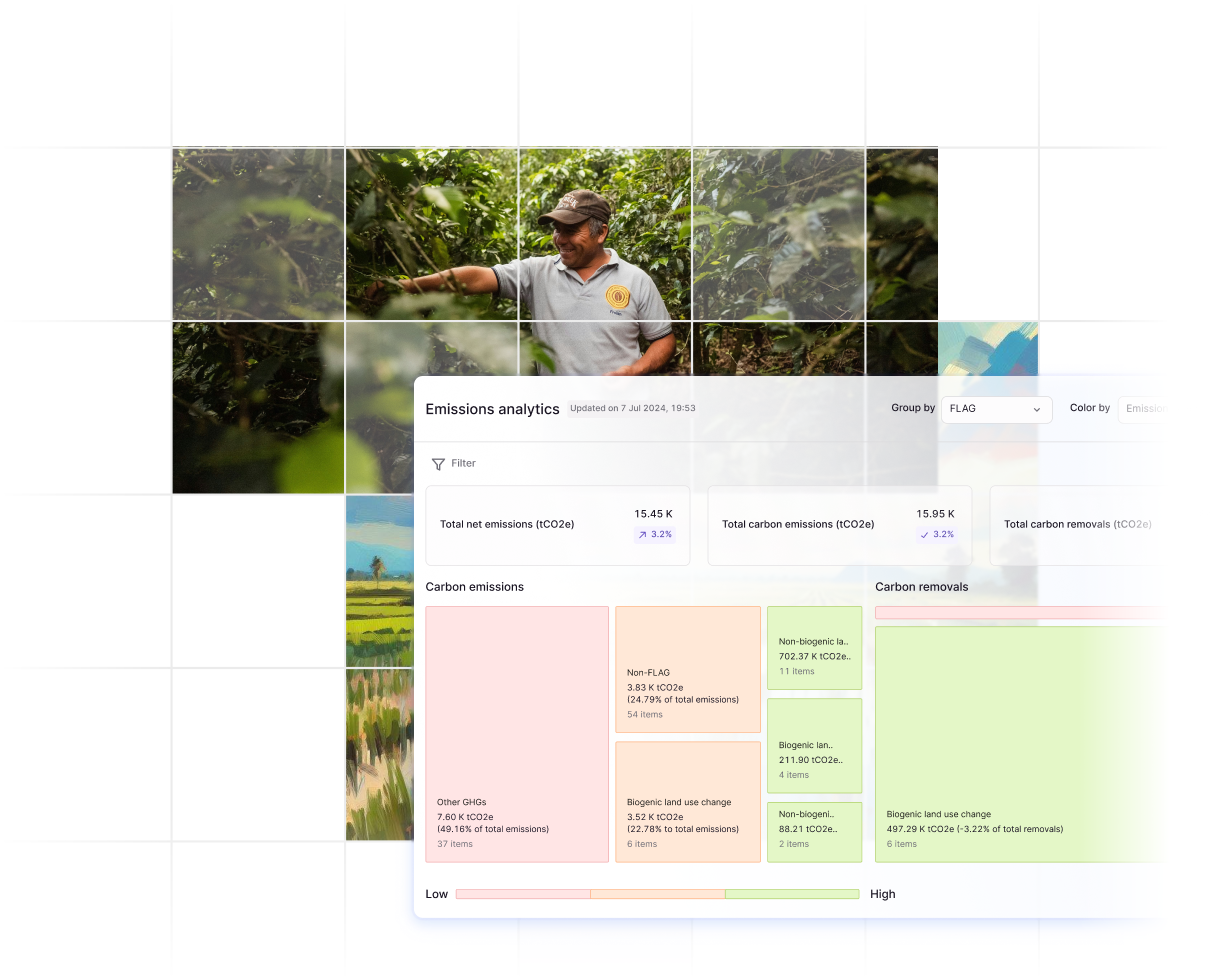
Terrascope applies IPCC-aligned land-use classifications, use higher-accuracy Tier 2/3 emission factors where available, and provide clear guidance on when removals can be credibly claimed (including monitoring, permanence, and reversal considerations). Terrascope also supports full FLAG coverage (including biogenic emissions and organic waste pathways) and SBTi-aligned workflows that separate FLAG from energy/industrial emissions for target-setting.


We have hundreds of contract growers, smallholders, or third-party suppliers. How can we measure Scope 3 without direct farm-level data?

Terrascope uses a tiered approach where the aim is to baseline fast: Start with spend or aggregated volume data, strengthened with region-specific factors and modeling using parameters you already track (e.g., livestock counts, feed conversion, energy benchmarks).

Next is to engage strategically: Prioritize the top suppliers driving most emissions, using simplified, pre-filled templates. Lastly, Scale over time: Automate via procurement integrations, enable supplier submissions through a portal, and reuse calculated product footprints through a PCF library.



Our teams use different systems (ERP, spreadsheets, consultants). How does Terrascope simplify the data chaos?

Terrascope ingests data in multiple formats (files or API connectors), then centralize everything into one platform with version control, role-based access, validation checks, and audit-ready documentation. You get a single source of truth for Scope 1–3, emission factors, and calculation traceability, reducing manual consolidation and speeding up reporting cycles.

Get your free LSR/FLAG assessment