
Executive summary
-
Sustainability teams aren't just asking what LSR is anymore, they're asking whether their existing targets will hold up under scrutiny.
-
Four patterns keep surfacing: ineligible reductions or removal claims, targets set before method constraints were understood, underestimated disclosure requirements, and timing misalignment with SBTi FLAG validation.
-
The fix starts with knowing which calculation methods your current traceability actually supports, before commitments are locked in.
"This webinar really helped me to understand what is coming up and how the new regulation applies to us." — Group Sustainability Manager at a food manufacturing supplier in Switzerland
The GHG Protocol published its Land Sector and Removals (LSR) standard on 30 January 2026, with companies expected to align their reporting by 2027. For organizations in food, agriculture, retail, and consumer goods, this is the most significant update to carbon accounting in over a decade.
LSR requires companies to prove their ambition is defensible.
In our executive webinar, audience Q&A showed that many sustainability teams are navigating a gap between what they've already committed to publicly and what they can actually evidence under the new standard.
The Q&A Pattern
Many companies have now set out their climate ambition. The breakdown happens when they try to evidence it.
Under LSR, value chain claims are increasingly constrained by:
-
Which calculation methods their traceability actually supports
-
Whether their supplier data is sufficient for direct vs. statistical approaches
-
How land-use change, land management, biogenic emissions, and removals are disaggregated and reported separately
The webinar Q&A reflected this shift. Executives weren't asking what LSR is. They were asking operational questions:
Can we make Scope 3 claims from value chain removals issued as carbon credits?
Can certifications justify reduced land use change emissions?
What happens if we move from statistical LUC to direct LUC and our numbers change - do we re-baseline?
Can we disclose aggregated FLAG numbers, or do we need to show the full breakdown?
Do we need to use LSR for our SBTi FLAG submission right now?
These are questions about delivery risks that become visible after commitments are made public.
1. Claiming Reductions
Several questions focused on removals, certifications, and what constitutes a valid Scope 3 claim. The underlying assumption: teams believe that investing in projects, sourcing certified materials, or aggregating numbers gives them the right to claim reductions.
LSR is stricter than that assumption. The standard requires alignment between the activity, the accounting method used, and the reporting structure. If that chain breaks, the commitment may remain public, but the claim won't survive scrutiny from auditors or investors.
For example, one executive asked whether removals issued as carbon credits can be claimed as Scope 3 reductions if an organization invests in the project or carves out exclusive volume. Under LSR, this depends on how the removal is characterized and monitored, and whether it meets the criteria for value chain attribution, not just whether money changed hands.
Another asked whether certifications alone justify reduced statistical land-use change. The short answer is that certifications may be necessary but not sufficient. LSR's land-use change accounting requires demonstrable changes in land cover or management practices that can be traced to specific suppliers or jurisdictions, not just certification status.
LSR links the claims you can make to your traceability,
and requires the most accurate approach your data can support
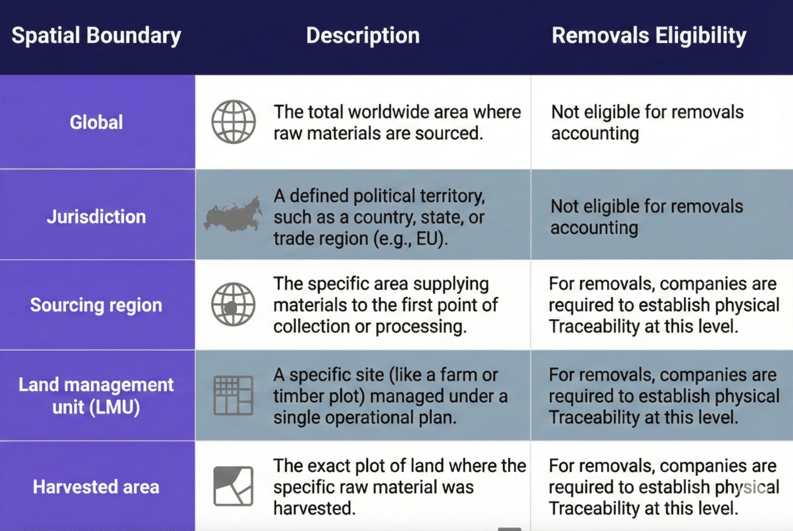
This is where the gap emerges. Public commitments are phrased as outcomes ("deforestation-free," "net zero land footprint"). LSR evaluates eligibility at the method and evidence level.
2. Setting Targets
Another cluster of questions centered on moving from statistical LUC (sLUC) to direct LUC (dLUC), and what that means for baselines and progress tracking.
Statistical land-use change calculations require less effort but tend to overestimate emissions. Direct calculations require proof of traceability and more effort to collect supplier-level data—but they show lower, more accurate emissions.
This creates a deliverability problem for targets set before understanding which method your traceability can actually support.
Many commitments are set assuming:
-
Secondary datasets
-
Broad emission factors
-
Limited traceability to the jurisdictional or supplier level
When improved traceability later forces a methodological shift, reported emissions can move—usually down, because more accurate data corrects for the estimation built into global approaches. One executive asked how to account for reductions when moving from sLUC to dLUC—noting that more granular data might lower their land-use change emissions.
The question: is that a real reduction, or an artifact of better data?
LSR addresses this in its guidance on re-baselining and methodological changes, but the core tension remains. Companies commit to targets assuming one calculation approach, then discover their supply chain traceability only supports a more conservative method—or can't yet support the method they need to demonstrate progress credibly.
3. Underestimating New Disclosures
Several managers asked whether they could continue reporting under Scopes 1-3 only, or whether they could disclose aggregated FLAG emissions without the full land-sector breakdown.
This reflects a misunderstanding about what LSR changes: it doesn't replace Scopes 1, 2, and 3. It adds a parallel reporting layer. Companies will still report under the scope framework, and they will now also report emissions categorized as:
-
Energy & Industrial (E&I)
-
Land-related
Within land-related emissions, there are further disaggregation requirements for:
-
Land-use change
-
Land management
-
Biogenic product emissions
-
Removals (if claimed) and reversals
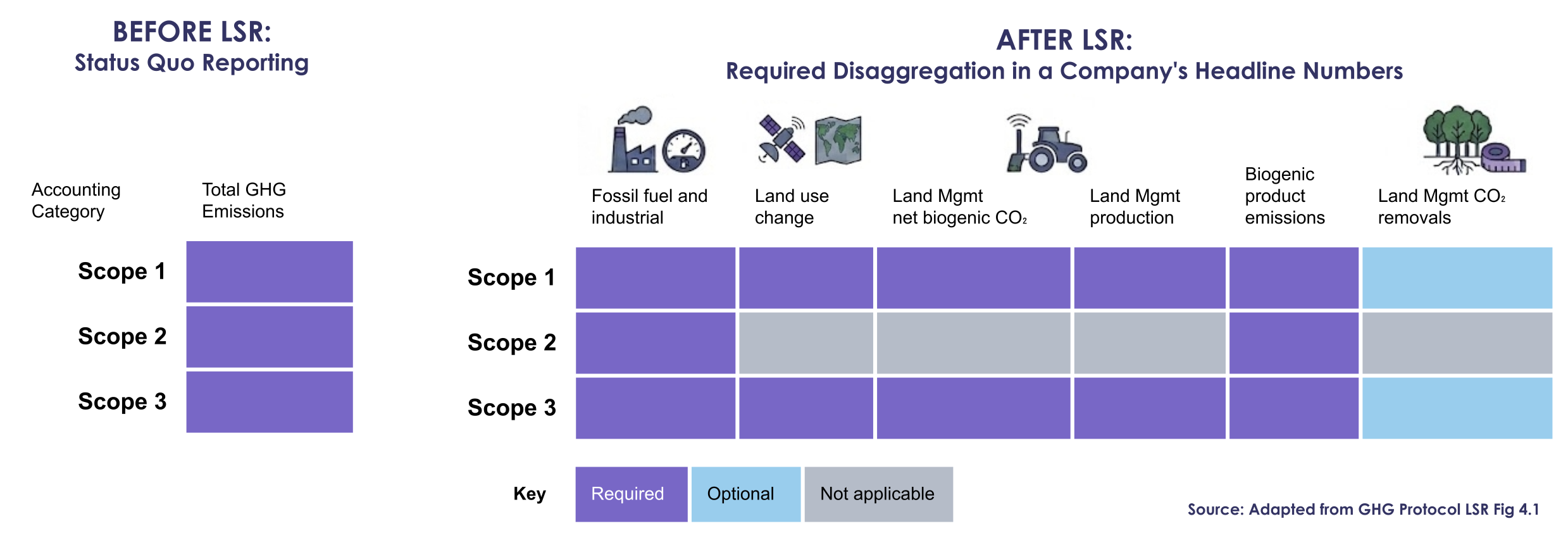
Additionally, land occupation and land carbon leakage are required tracking metrics for companies, to be reported alongside Scope 1/2/3 headline numbers.
Teams asking about aggregated disclosure were likely hoping for flexibility to report a single FLAG number without exposing the underlying components. Under LSR, that flexibility is limited. If land emissions are material, a detailed breakdown is expected - an "enormous reporting burden," as one participant noted.
This matters because commitments made at a high level ("reduce FLAG emissions by X%") become more complex when disclosures require showing which categories contributed to that reduction, and how each was calculated.
4. Committing Given Uncertainty
One of the most direct questions we received was: "If we're submitting our SBTi FLAG target and roadmap right now, do we need to follow the LSR standard?"
This reflects broader uncertainty about timing. LSR was published on January 30, 2026. Companies are expected to align by January 1, 2027. But SBTi's FLAG guidance predates LSR, and while SBTi has indicated it will update its validation criteria, that timeline isn't yet finalized.
The risk is making commitments without a clear plan on how to revise them when validation criteria change.
Several companies in our network have already had to recalibrate FLAG measurement approaches mid-stream. For example: Princes secured SBTi-validated FLAG targets within months by automating FLAG disaggregation early, avoiding manual rework later. Kagome strengthened its SBTi validation by improving country-level specificity in its land-related emissions before submission. Mandai proactively conducted an independent review of its FLAG methodology against the LSR standard to stay ahead of expected changes.
In each case, the priority was ensuring methodological alignment with targets.
What Worries Companies
Looking across the Q&A from both sessions, the pattern is clear:
Claims and eligibility: Are our stated commitments defensible under the standard, or will we need to walk them back?
Data feasibility: Do we have the traceability depth and supplier-level data to support the methods we assumed we could use?
Method transitions: If we improve our data and shift from statistical to direct approaches, how do we handle baseline adjustments and comparability?
Disclosure friction: Will we face audit challenges if we report land emissions in aggregate, or do we need full land-sector breakdowns?
Timing and validation: Are we moving too early, or too late, relative to SBTi updates and other external validation timelines?
That clarity is what's needed right now: a clear view of where the requirements are tightening and what that means for commitments already in motion.
Avoid Undeliverable Commitments
If your commitment requires demonstrating progress across land-use change, land management, and removals separately, your internal reporting systems and data collection processes need to support that level of granularity. This affects finance, procurement, and operations.
Why This Matters in 2026
With LSR now published, land-sector emissions are a core reporting concern for food, agriculture, retail, and consumer goods companies - and any company with "significant" land emissions.
The companies navigating this well are the ones treating LSR as a forcing function to improve the quality and traceability of their supplier data now, as targets are set or commitments are made public.
For sustainability teams with limited resources, this means focusing on the right sequence:
-
Understand which methods your current data supports
-
Identify where you need to invest in traceability to unlock more credible approaches
-
Align your commitments with what you can actually evidence and defend
We've worked with clients who have had to adjust their FLAG target timelines, recalibrate scope, or improve supplier engagement specifically to close this gap. In every case, the teams that addressed it early avoided more painful adjustments later.