“We’ve always believed backing Australian farmers and local manufacturing is better for the environment - we just needed the proof. Terrascope gave us the data to quantify it, showing locally sourced products can deliver a meaningfully lower carbon footprint.”
Nick Bartram
General Manager, Sales, Category & Marketing
Vitasoy Australia


PRODUCT IMPLEMENTED
Food & Beverage
Plant-Based Dairy
HQ
Wodonga, Victoria, Australia
TERRASCOPE SOLUTION
Product Carbon Footprint (PCF)
SCOPE
Cradle-to-Gate Analysis
- Challenge: Vitasoy believed their Australian sourcing and local manufacturing delivered environmental benefits, but lacked quantified data to substantiate the environmental benefits of their local sourcing strategy.
- Solution: Terrascope conducted cradle-to-gate product carbon footprinting across Vitasoy's Barista's Choice range (soy, oat, and almond milks), including development of custom emission factors for Australian soybean production.
- Key finding: Australian-grown soy produces up to 90% lower emissions than global averages, primarily due to the absence of deforestation-linked land use change that dominates global soy production. Likewise, Vitasoy's use of Tetra Pak's plant-based Helicap packaging contributed to packaging emissions reductions of approximately 17% for oat and almond products compared to industry benchmark packaging.
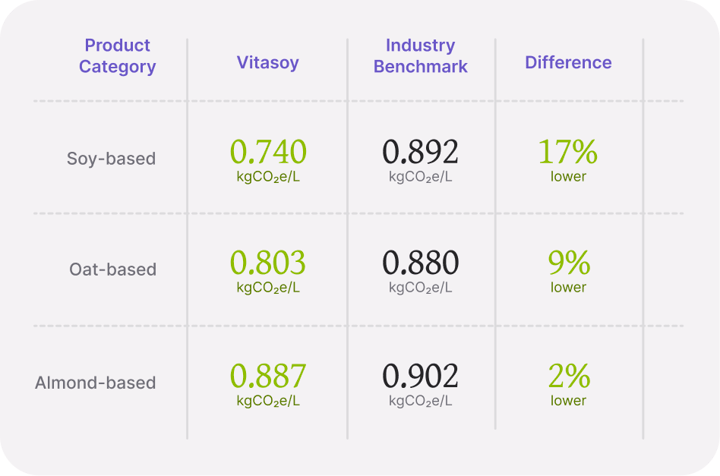
- Results: All three Vitasoy product categories demonstrated emissions at or below industry benchmarks—soy-based products showed a 17% lower footprint, oat-based 9% lower, and almond-based 2% lower.
- Business value: Vitasoy now has quantified product-level emissions data to inform B2B customer conversations, support customers' sustainability reporting needs, and establish a baseline for tracking future improvements.
About Vitasoy Australia
Vitasoy Australia is a leading plant-based milk manufacturer with a commitment to being "the conscious choice" for Australian consumers. Manufacturing from their facility in Wodonga, Victoria, Vitasoy sources Australian-grown soybeans, almonds, and oats to produce their Barista's Choice range—a popular dairy alternative for cafés across Australia.
Their customer base includes major structured café chains and foodservice operators. As sustainability increasingly factors into procurement decisions across the industry, Vitasoy sought to validate whether their local sourcing strategy delivered measurable environmental benefits—moving from brand narrative to verified data.
The Challenge: Quantifying Local Sourcing Benefits
Vitasoy's brand positioning centers on supporting Australian farmers and rural communities. They believed their local supply chain should translate to environmental benefits compared to products manufactured overseas or using globally-sourced ingredients. However, this belief needed rigorous validation.
The challenge was threefold:
- Establish a credible baseline of their product carbon footprints using recognized methodology
- Understand how their emissions compared to industry benchmarks for similar products
- Identify opportunities to further reduce their environmental footprint
The Discovery: Australian Soy's Environmental Advantage
Standard global emission factors for soybeans are heavily influenced by production in regions where deforestation-driven land use change accounts for approximately 80% of total emissions. Vitasoy's soybeans, however, come from Casino and Berrigan in New South Wales—established Australian farmland with no recent deforestation impact.
Recognizing that applying global averages would misrepresent the actual environmental profile of Vitasoy's products, Terrascope developed custom emission factors specifically for Australian soybean production. This approach accounted for local farming practices, irrigation systems, and the absence of land use change impacts.
The analysis revealed a significant difference:
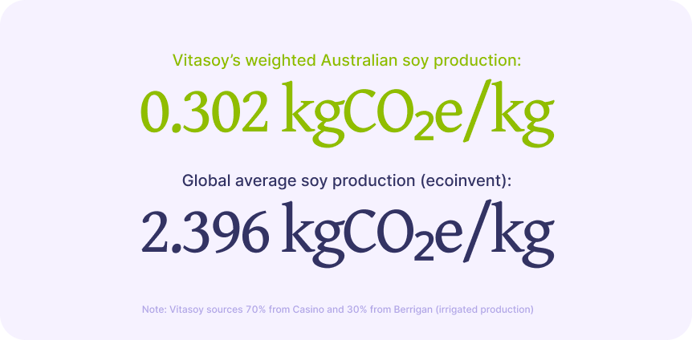
This insight—that Australian-grown soy can have up to 90% lower emissions than global averages—provided concrete data on the emissions benefits of Vitasoy's local sourcing approach.
The Solution: Cradle-to-Gate Product Carbon Footprinting
Terrascope conducted a comprehensive product carbon footprint analysis of Vitasoy's Barista's Choice range, covering soy, almond, and oat milk products. The assessment used methodology aligned with the principles of ISO 14067 and ISO 14044, analyzing emissions across three lifecycle stages:
- Raw material production and distribution (ingredient sourcing, farming, inbound logistics)
- Product manufacturing (on-site energy, processing, waste)
- Distribution and storage (transport to warehouse, storage)
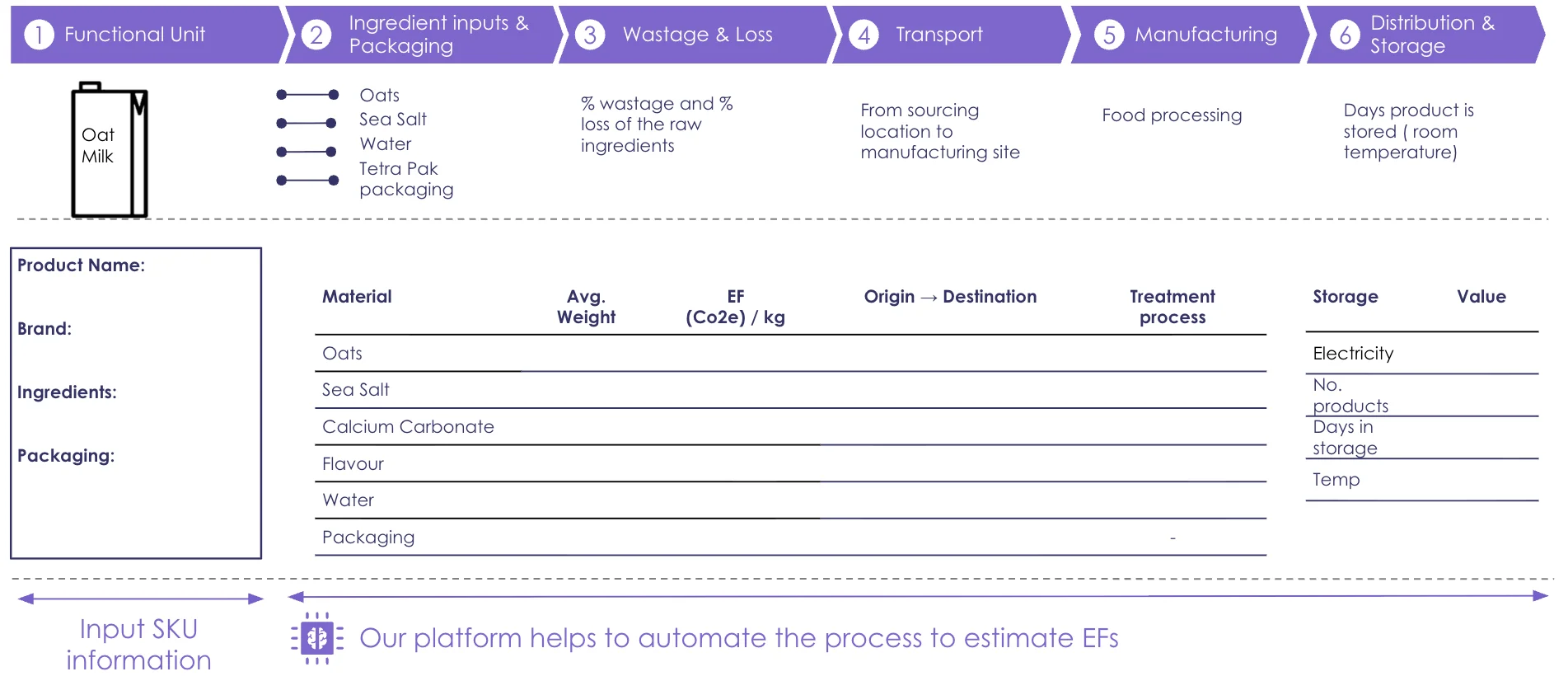
The diagram below illustrates how Terrascope's platform captures the SKU-level data collection process across the product lifecycle to estimate emissions:
To provide context for Vitasoy's results, Terrascope developed industry benchmarks based on publicly available information about typical manufacturing locations, ingredient sourcing patterns, and packaging formats for similar products in the market.
Results Across Product Categories
Key Factors Contributing to Lower Emissions
Australian-sourced soybeans: Vitasoy sources from Casino (70%) and Berrigan (30%) in NSW, avoiding the land use change emissions that significantly impact global soy averages.
Plant-based packaging: Use of Tetra Pak's plant-based Helicap packaging delivers up to 20% lower (cradle-to-gate) packaging emissions compared to conventional alternatives.
Local manufacturing: Production in Wodonga, Victoria reduces transportation emissions compared to products manufactured overseas.
Regional supply chain: Sourcing ingredients from Australian suppliers further reduces inbound logistics emissions.
The Business Value: Validated Sustainability Credentials
• Quantified footprint: Product-level emissions data now available to inform sustainability communications
• Customer conversations: Ability to share verified product-level emissions data with B2B customers focused on their own sustainability goals
• Baseline for improvement: Established foundation for tracking emissions reductions over time
• Supply chain insights: Data revealed further optimization opportunities (e.g., consolidating almond paste sourcing locally)
Importantly, as Vitasoy's B2B customers increasingly set their own Scope 3 reduction targets, having verified product carbon footprint data enables Vitasoy to support their customers' sustainability journeys—creating shared value across the supply chain.
Why Terrascope
Key elements of the Terrascope approach:
Looking Ahead
With baseline measurements established, Vitasoy is positioned to:
• Track emissions performance over time as they optimize supply chain decisions
• Expand carbon footprinting across additional product lines
• Pursue decarbonization opportunities identified during analysis
• Continue using verified sustainability data to support customer conversations