Summary
-
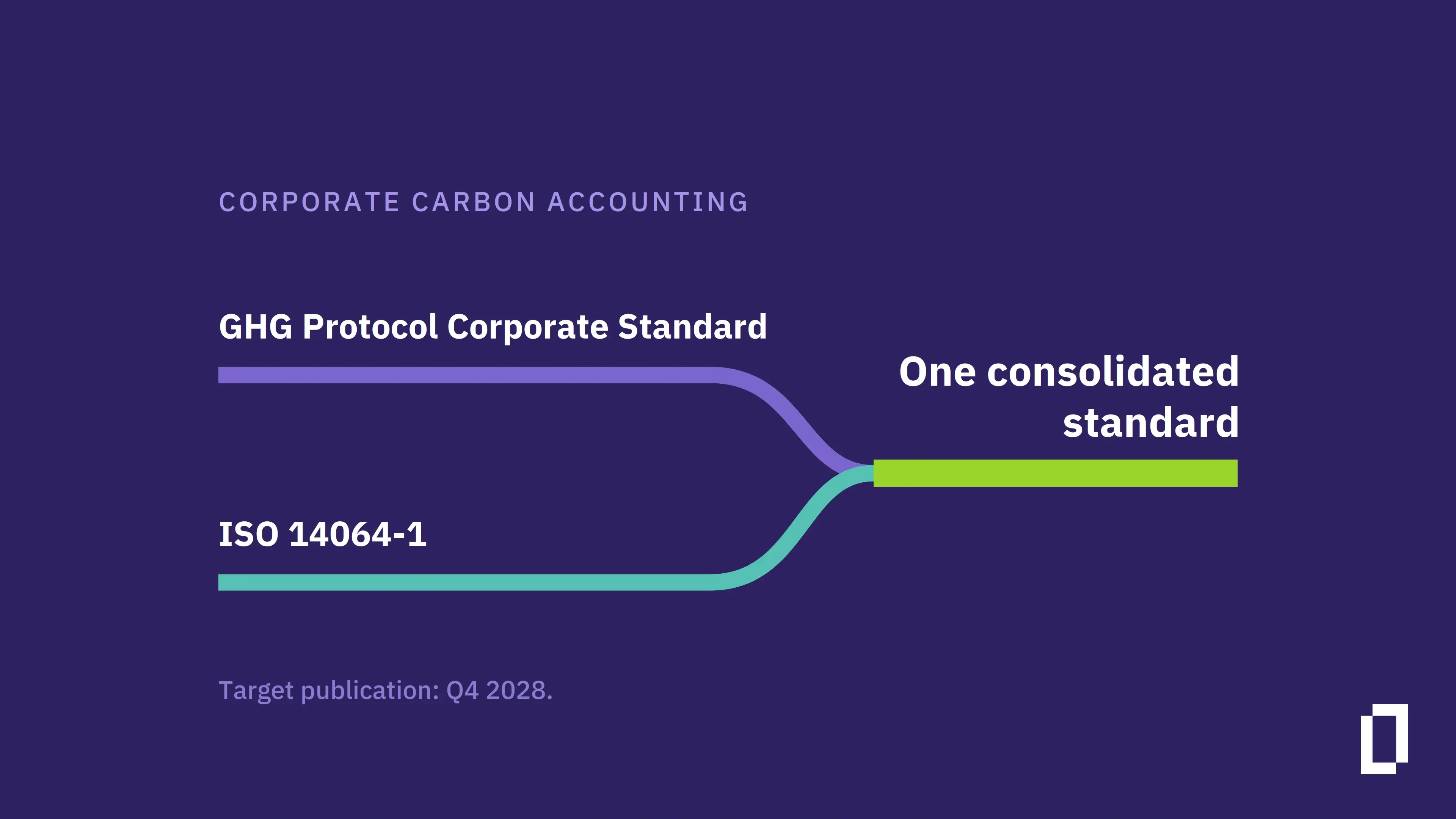
On 29 July 2026, the Greenhouse Gas Protocol said it will merge its corporate standards (Scope 1, Scope 2, Scope 3 and market instruments) with the international standard ISO 14064-1 to make one global standard carrying both organisations' names.
-
The draft goes out for public comment in the second quarter of 2027. The GHG Protocol aims to publish the final standard at the end of 2028. Until then, the current standards apply, according to the GHG Protocol.
-
Scope 2 is a heated debate. The two key issues are hourly matching, which asks whether clean electricity purchases must line up with the hours in which you consume power, and deliverability, which asks whether that electricity must plausibly be able to reach your sites.
-
The standalone Scope 3 revision has now been absorbed into the consolidated process. Scope 3 proposals will change how you justify exclusions and report supplier data. We cover the Scope 3 proposals in detail here.
-
Keep measuring, and keep getting audit-ready under today's rules.
Almost every corporate carbon footprint is calculated using rules written by one organisation: the Greenhouse Gas (GHG) Protocol. On 29 July 2026, that organisation announced the first complete overhaul of its corporate standards since the first Corporate Standard appeared in 2001.
If your company reports under the GHG Protocol Corporate Standard, as 97% of S&P 500 companies disclosing to CDP did in 2023, this announcement shapes how your emissions are calculated from 2028 onwards.
Keep calm, and keep measuring. The GHG Protocol states that its existing standards stay in effect until it says otherwise. Your 2026 inventory is valid, your auditor will test it against today's rules, and your reporting deadlines are unchanged.
What the GHG Protocol announced
In July 2026, the GHG Protocol published a progress update and a development plan. Here are three things you should know. A fourth change, the revision of the Scope 3 Standard, is running inside the same process and gets its own article.
1. Five documents become one
Four GHG Protocol documents, namely the Corporate Standard (2004), the Scope 2 Guidance (2015), the Scope 3 Standard (2011) and a new workstream on Actions and Market Instruments, will merge with one ISO standard: ISO 14064-1, the international standard for measuring an organisation's emissions. The result is one standard in two parts: Part 1 covers your physical emissions inventory, Part 2 covers the actions and instruments you use to reduce or offset it. The GHG Protocol notes that this structure may still change.
The work has already started. ISO experts joined the GHG Protocol's drafting groups in early 2026, and both organisations must approve the final text. Tim Mohin, who runs the GHG Protocol, called the merger "a significant step toward integrating and harmonizing greenhouse gas accounting across the world."
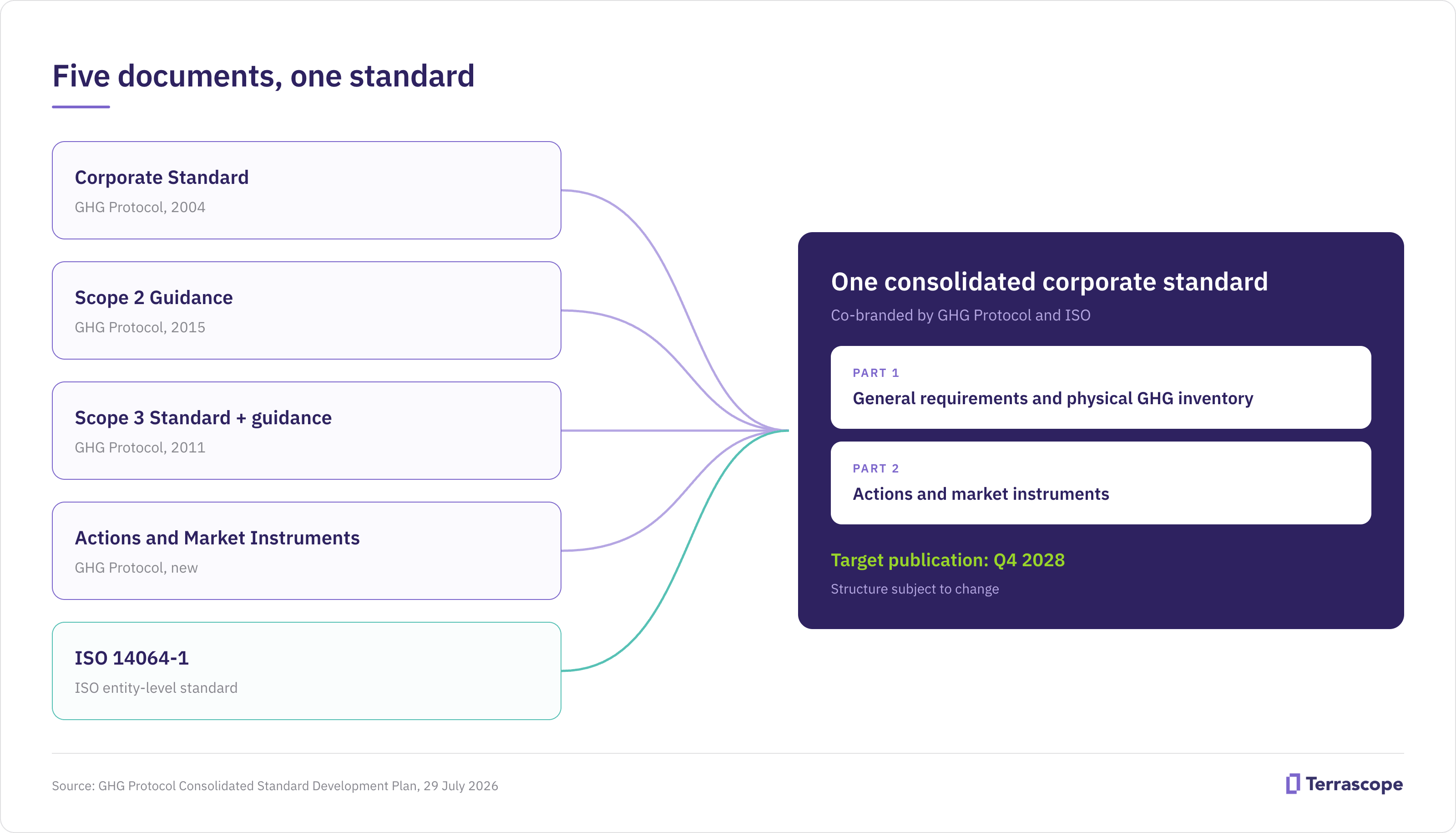
Five documents merge into one co-branded corporate standard. Source: GHG Protocol Consolidated Standard Development Plan, 29 July 2026.
2. Electricity accounting is the heated debate
The GHG Protocol asked for comment on Scope 2, the emissions from the electricity you buy, in October 2025. Nearly 1,100 respondents from 56 countries replied. They agreed that electricity accounting should be more accurate and more comparable. They disagreed sharply about renewable electricity purchases. The question underneath: when a company buys clean power through a certificate or a long-term contract, how much of its grid emissions can it subtract from the Scope 2 figure it reports?
The consultation proposed two new conditions on those purchases. Hourly matching would require large companies to match their clean electricity purchases to the hours in which they actually consume power, instead of matching totals across a whole year. Deliverability would require the purchased electricity to be plausibly able to reach the location where it is consumed. Both drew low support, most of it from companies and industry groups. Two easing measures drew broad support: exemptions from hourly matching for most organisations, and a legacy clause that protects existing long-term contracts. In July 2026, the GHG Protocol's standards board directed the drafting group to develop several reporting approaches rather than settle on one.
If your company holds renewable energy certificates or power purchase agreements, the rules that decide what the certificates are worth in your reported emissions are being written right now.
3. Proposal to split physical emissions from purchased instruments
Some of this separation already exists in today's rules. Since 2015, companies report two Scope 2 totals: a location-based figure using grid averages, and a market-based figure reflecting their electricity contracts and certificates. And carbon credits already sit outside the inventory: the Corporate Standard requires companies to report total Scope 1 and 2 emissions independent of any credit purchases or trades, so credits are disclosed separately rather than subtracted from the scopes.
What the GHG Protocol proposes is to extend that logic across the whole inventory and make it uniform. Companies would report three parallel statements. The first is the physical inventory: the emissions their operations and suppliers produce. The second is a market-based statement covering contractual instruments across all three scopes, not just electricity: commodity certificates for goods such as green steel or low-carbon coffee would count here, under defined chain-of-custody rules. The third is an impact statement: the estimated emissions effect of specific actions, such as a project a company financed, compared with what would have happened without them.
The statements would sit side by side, with no netting between them. A reader could see how much a company reduced, how much it purchased, and what its actions achieved, each on its own line
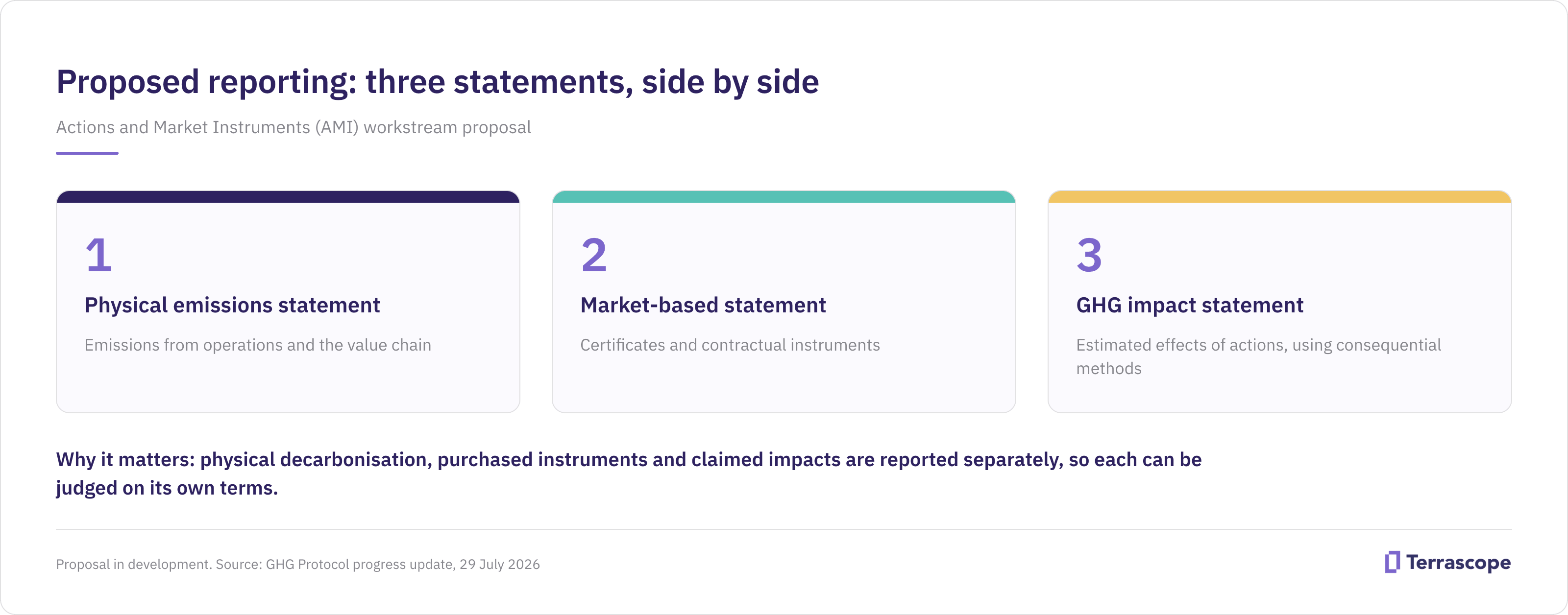
The proposed multi-statement reporting model under the Actions and Market Instruments workstream.
Why now
When the Corporate Standard first appeared in 2001, carbon reporting was voluntary, and one document was enough. Today, Australia, Japan, the EU, California and a growing list of jurisdictions write GHG Protocol methods into their disclosure rules. A sustainability team reporting under several of those regimes works from four GHG Protocol documents plus ISO 14064-1, in different versions, each read slightly differently. Updating, maintaining and reconciling different standards, and different versions of those standards, across jurisdictions was cumbersome.
Carbon accounting is going through a consolidation and simplification phase, part of the broader shift from voluntary commitments to accountability. Fewer, clearer documents. More transparent methods. Consistent, comparable, accountable outcomes. The merger of the GHG Protocol's corporate standards with ISO 14064-1 is that consolidation applied to the corporate rulebook, and it gives every regulator the same page to point at.
The road to 2028
The GHG Protocol will publish a draft for public comment in the second quarter of 2027, with ISO's committee reviewing it at the same time. It aims to publish the final standard by the end of 2028, and the guidance documents after that.
Whether companies get a transition period, and how long it runs, has not yet been decided. Regulators will set their own adoption dates.
IFRS S2, the global climate disclosure standard that countries like Australia and Japan build their national rules on, requires companies to measure emissions using the GHG Protocol Corporate Standard as issued in 2004, with relief where a jurisdiction requires a different method. The IFRS Foundation's standards board, the ISSB, has stated in writing that it will reference a revised GHG Protocol standard only after it has assessed the effects of the changes and consulted publicly. Jurisdictions then update their national rules on their own timelines.
So even after the merged standard publishes at the end of 2028, the rules you report under today remain the legal reference until the ISSB and your regulators complete their own processes.
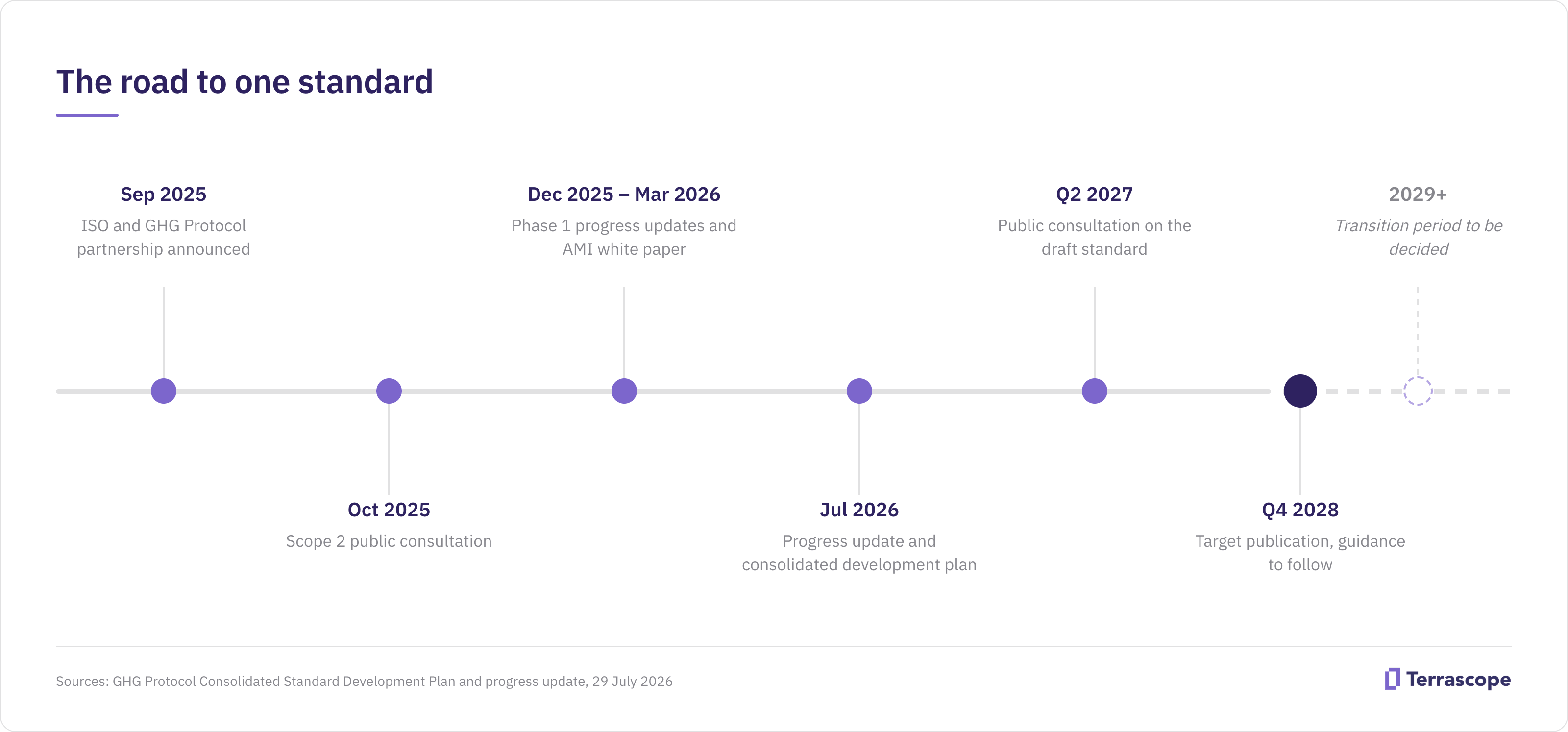
Key milestones from the September 2025 ISO partnership to the Q4 2028 target publication.
What stays, what changes
The GHG Protocol's own wording is unambiguous: "Until Greenhouse Gas Protocol communicates otherwise, the existing GHG Protocol standards and guidance stay in effect." Your inventory stands. Your assurance engagement proceeds. The Land Sector and Removals Standard, published separately in January 2026, still governs companies with land emissions and removals. The merger covers the corporate standards and leaves that one alone.
What it means for your sector
Food and agriculture. Your hardest problems, land-use change, on-farm emissions and suppliers four tiers deep, sit under the Land Sector and Removals Standard, which for now remains unchanged. The merger reorganises how you present an inventory; the cost and time of collecting the data behind it, which is where your budget goes, stays exactly as it was. Spend 2026 and 2027 on traceability and primary data, and the 2028 standard arrives with your hard work already done.
Retail and consumer goods. Purchased goods and services usually dominates your footprint, and the merger leaves that problem exactly as difficult as it was. Product footprints and supplier data pipelines carry forward into any version of the standard. Watch the market instruments proposal too, if you make climate claims on products or brands, because it would set out how those claims get reported.
Industrial and manufacturing. The Scope 2 review is your live issue if you hold renewable certificates or power purchase agreements. Ask your finance team for one number today: the gap between your location-based and market-based Scope 2 figures. That gap measures what you stand to lose or keep, whichever way the GHG Protocol rules. Meanwhile, mandatory assurance in Australia and the EU arrives well before 2028, so audit readiness under today's rules stays the nearer problem.
What to do now
Keep reporting under current standards. Your deadlines are unchanged, and the GHG Protocol has confirmed today's rules apply.
Get audit-ready before assurance tightens. Australian and EU rules will test inventories built under today's standards. A clean, documented, assured inventory is also the best thing to carry into any transition.
Size your Scope 2 exposure. List your renewable electricity contracts and certificates, calculate the gap between your two Scope 2 figures, and watch the electricity workstream, so that the procurement decisions you make this year survive the new rules.