Summary
-
The Greenhouse Gas Protocol (GHG Protocol) published the Land Sector and Removals (LSR) Guidance on 30 June 2026: the 518-page how-to manual for the LSR Standard, which is effective as of 1 January 2027.
-
The Standard sets the rules: 32 requirements for land emissions and CO₂ removals. The Guidance shows how to meet them, with equations, decision trees, worked examples and case studies from Mars, PepsiCo and General Mills.
-
Terrascope helps companies turn the Guidance's methods into an audit-ready inventory, from 20-year land use change calculations to SBTi-ready Forest, Land and Agriculture targets.
This article assumes you know the LSR Standard. If the Standard is new to you, we recommend starting here: Does the Land Sector and Removals Standard apply to your company?, a five-minute check on whether the rules reach you, and The Land Sector and Removals Standard: a new rulebook for land emissions, which explains the four land emission subcategories, the traceability ladder and the other ideas this article builds on.
What is the LSR Guidance?
The GHG Protocol published the LSR Standard in January 2026: the first global rulebook for counting emissions and CO₂ removals from agriculture. The Standard tells you what to do. The Guidance, published on 30 June 2026, tells you how.
The document describes its own job plainly. It "complements the Standard by providing users with comprehensive guidance on implementing the requirements in the Standard, including examples, case studies, and calculation guidance", and it "is intended to be used alongside the Standard". It runs to 518 pages, takes effect with the Standard on 1 January 2027, and rests on pilot tests by 71 companies and reviews from more than 300 stakeholders.
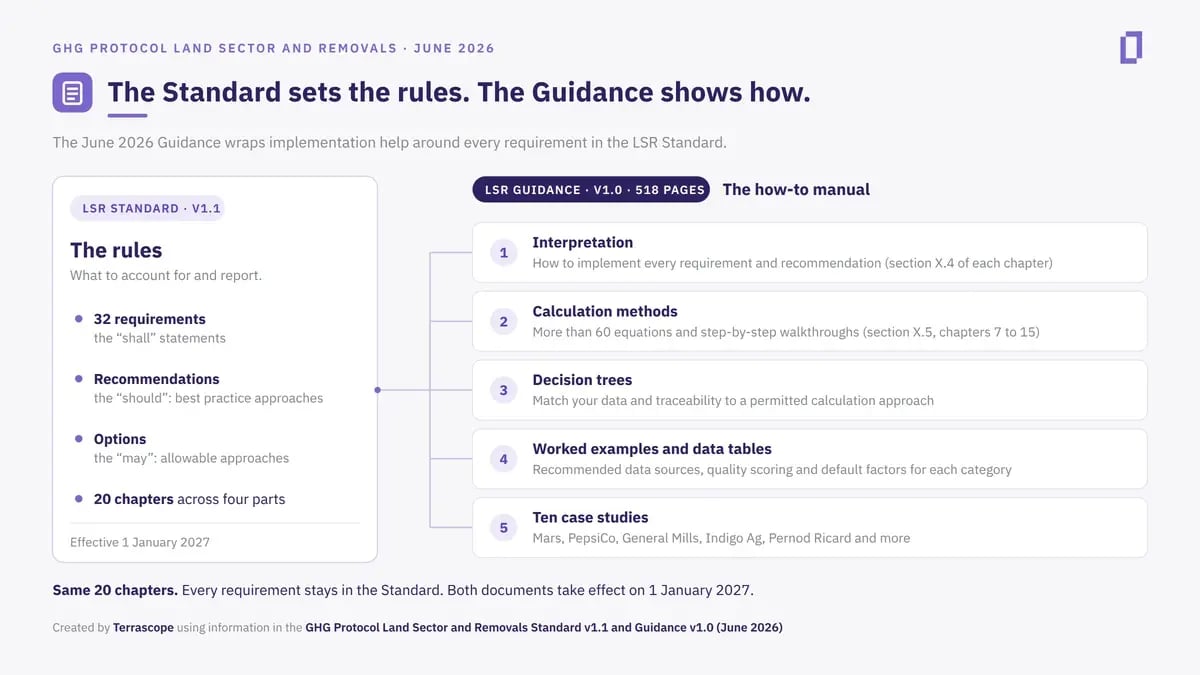
LSR Standard vs LSR Guidance: how they fit together
The two documents share one skeleton: the same 20 chapters across four parts. Chapter 7 of the Standard (land use change emissions) pairs with chapter 7 of the Guidance. The Standard's sections in each chapter state the rules; the Guidance's sections add the interpretation and, in the accounting chapters, the equations, data tables and worked examples.
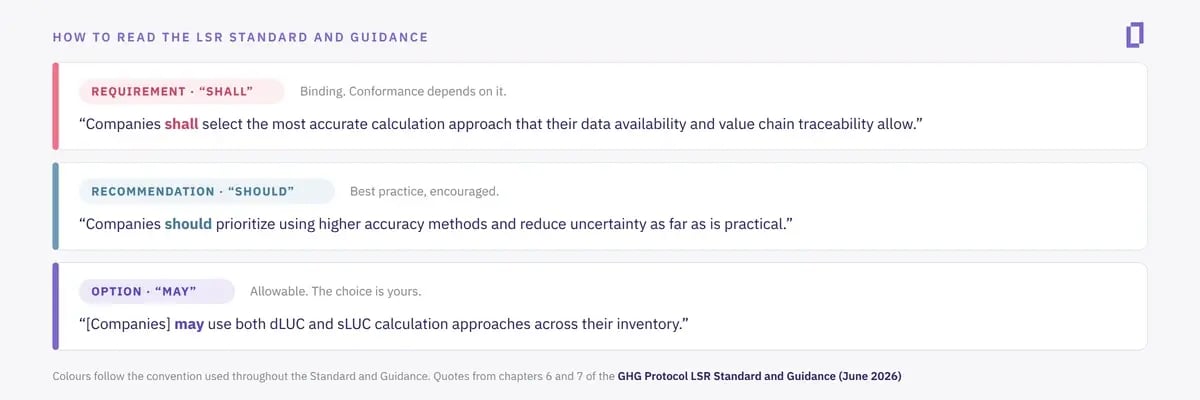
In practice you open one document. The published Guidance reproduces the Standard's requirements in full, under the formal title "LSR Guidance Version 1.0, including requirements from LSR Standard Version 1.1". Colour coding tells you what is binding as you read:
One line ties the pair together for conformance. Requirement 1 says companies with significant land sector activities "shall follow the Land Sector and Removals Standard and Guidance". The approved methods live in the Guidance, so, in practice, a conformant inventory is one built with this manual.
Why the LSR Guidance matters
The guidance presents the maths behind the Standard's outcomes. The Standard requires land use change emissions to be spread over 20 years by linear amortisation. The Guidance supplies the factor table (9.75% of a conversion's emissions in year one, falling to 0.25% in year 20), more than 60 equations, and step-by-step walkthroughs for each accounting category. If your team is the one turning requirements into calculations, the Guidance is the document you will keep open.
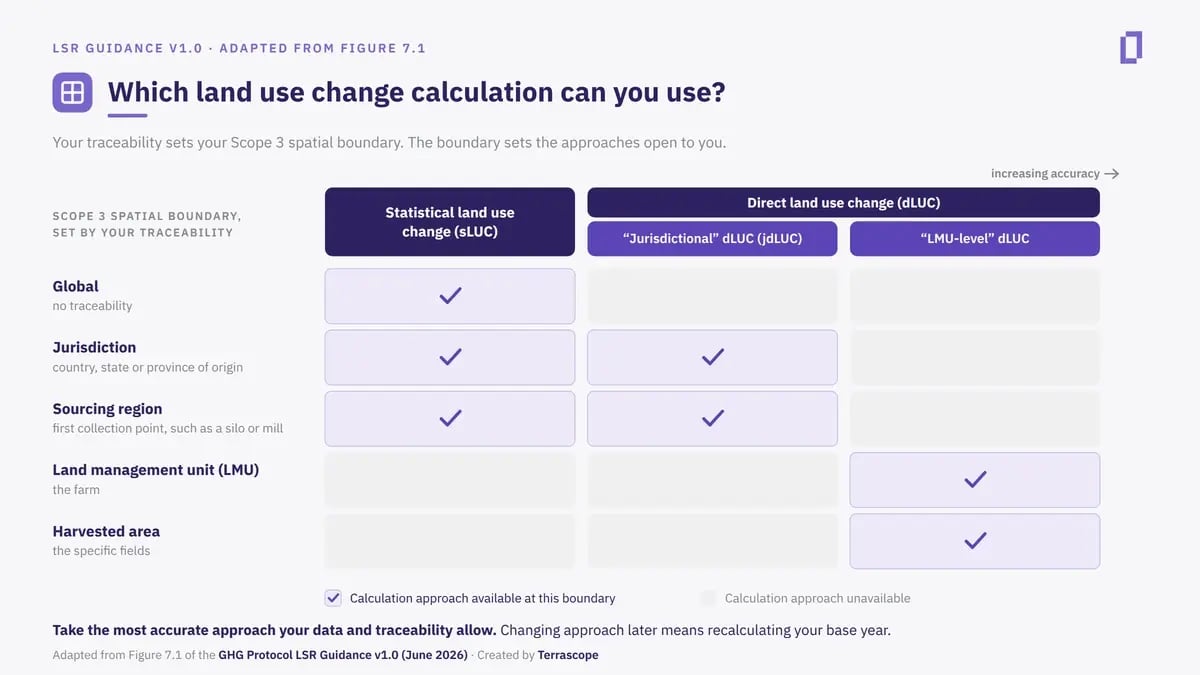
The Guidance also answers the question that stalls most land inventories: what can we calculate with the data we have? Each accounting chapter carries a decision tree that routes you from your traceability position to a permitted calculation approach. The chapter that matters most to CPG brands and retailers is chapter 7, land use change, often their largest source of land emissions.
And it shows the work of named peers, through ten case studies. Mars mapped land use change for its Brazilian soy down to municipality level: emission factors ranged from 0.072 to 10.02 kg CO₂e per kilogram, against a country average of 0.915. A single national factor hides that spread. PepsiCo sources 99% of its palm oil under RSPO mass balance, meeting the Standard's traceability test. General Mills defined sourcing regions for its US crops from supplier mill locations and satellite data. For a CPG or retail team weighing feasibility, these are companies with supply chains like yours, already doing it.
Your assurance provider will work from the same 518 pages. When an auditor asks why you chose a calculation approach or a proxy dataset, the strongest answer is a page reference.
What to look for inside
The Guidance is a reference manual, built for selective reading. It maps chapters to company types and recommends starting from your business goals. For a company that buys, processes or sells agricultural products, the core is Parts 1 and 2, chapters 1 to 11: boundaries, traceability, data and methods, then the four land emission subcategories. Add chapters 12 and 13 if you plan to report removals. Four elements repay attention:
- The navigation aids. Chapter 1 carries an intended-audience table and a chapter map by company type. Ten minutes with it narrows 518 pages down to your share of them.
- The data guidance. Chapter 6 shows how to prioritise collection (by emissions, volume or spend), how to score data quality, when proxy data is acceptable, and the rule that ties it together: where uncertainty exists, choose values likely to overestimate emissions and underestimate removals.
- The shortcuts. Most companies calculating statistical land use change at country level can pick an emission factor from an LCA database that follows the Guidance's method and, in its own words, "skip ahead to step 5". Knowing which steps you may skip is worth as much as knowing the steps.
- The edges of the document. The choice of tools and datasets stays with you; the Guidance helps you evaluate them instead of prescribing them. The reporting template and requirements checklist sit on the GHG Protocol website. Forestry waits for a future version, with a request for information due in 2026.
What this means for your company
For years, companies could point to missing methods as a reason to wait. The methods are now in print, midway through the reporting year they govern. The Standard applies from 1 January 2027, which for calendar-year reporters makes 2026 the year the data must come from. The same date matters for targets: from 1 January 2027, the Science Based Targets initiative requires FLAG base year emissions to follow the Standard, and the 2022 draft Guidance retires as a target-setting basis.
Three moves make good use of the rest of 2026:
- Confirm your chapters. The applicability check and your business goals settle which parts of the document are yours, and whether the removals chapters join the list.
- Run your top commodities through the decision trees. Take your three biggest against the traceability you can prove today, and record where each tree stops you. Every stopping point is a data gap with a name.
- Put the nearest case study in front of your data and procurement teams. A worked example from Mars or General Mills lands better in a cross-functional meeting than a requirement number.
How Can Terrascope help
Reading the Guidance shows you what conformance takes. Terrascope gets you there:
- LSR-ready measurement. The platform measures Scope 1, 2 and 3 emissions for land-heavy supply chains and calculates land use change over the required 20-year lookback, by commodity and scope, with an audit-ready trail behind every figure.
- SBTi FLAG, built in. FLAG base years, targets and tracking run as a ready module inside the platform, following the methods the Guidance sets out, rather than as a bespoke consulting exercise.
- Traceability, organised. Structured supplier data campaigns, with templates by supplier type, move your top commodities up the traceability ladder and unlock more accurate accounting at every rung.
- Experts built in. Terrascope pairs the platform with climate and carbon specialists who guide you from data collection to audit. Our customers hold a 100% SBTi validation success rate.
If land emissions are the largest and least understood part of your footprint, the fastest first step is knowing your gap.
Curious how to turn LSR Standard + Guidance compliance into a strategic advantage? Speak to us today. Learn how you can build trust with investors, unlock capital, and accelerate your transition to net zero.
Frequently Asked Questions