
Summary
- The principle. The mitigation hierarchy sets the order of a credible decarbonisation strategy: cut real emissions at the source first.
- The proof point. This is no longer just good practice. SBTi's Corporate Net-Zero Standard V2.0 builds the same source-first logic into its implementation hierarchy, which orders action across three levels: direct activity, shared systems, and the wider sector.
- How they fit. The mitigation hierarchy sets out what kind of action to take, from prevention through to substitution. While the implementation hierarchy sets out at what level a company is allowed to take it. At each level a company works through the options and does everything it can before stepping down to the next.
- Beyond reductions. Removals and compensation sit outside the implementation hierarchy. Removals take residual carbon back out of the atmosphere; compensation funds climate action beyond a company's own targets. Both matter, but neither counts towards reduction targets and neither replaces cutting emissions at the source.
What is the mitigation hierarchy?
Every company building a transition plan has to decide in what order to tackle its emissions. The mitigation hierarchy sets that order. It is a rule of sequence used in environmental management: cut real emissions at the source first, and treat market instruments and carbon credits as separate actions that support the work rather than stand in for it.
The principle itself is long established; what has changed is where it now sits. In June 2026 the Science Based Targets initiative (SBTi) built the same source-first logic into Version 2.0 of its Corporate Net-Zero Standard, the standard most large companies use to set net-zero targets, in what it calls the implementation hierarchy. The mitigation hierarchy sets out what kind of action to take. The implementation hierarchy sets out at what level a company is allowed to take it.
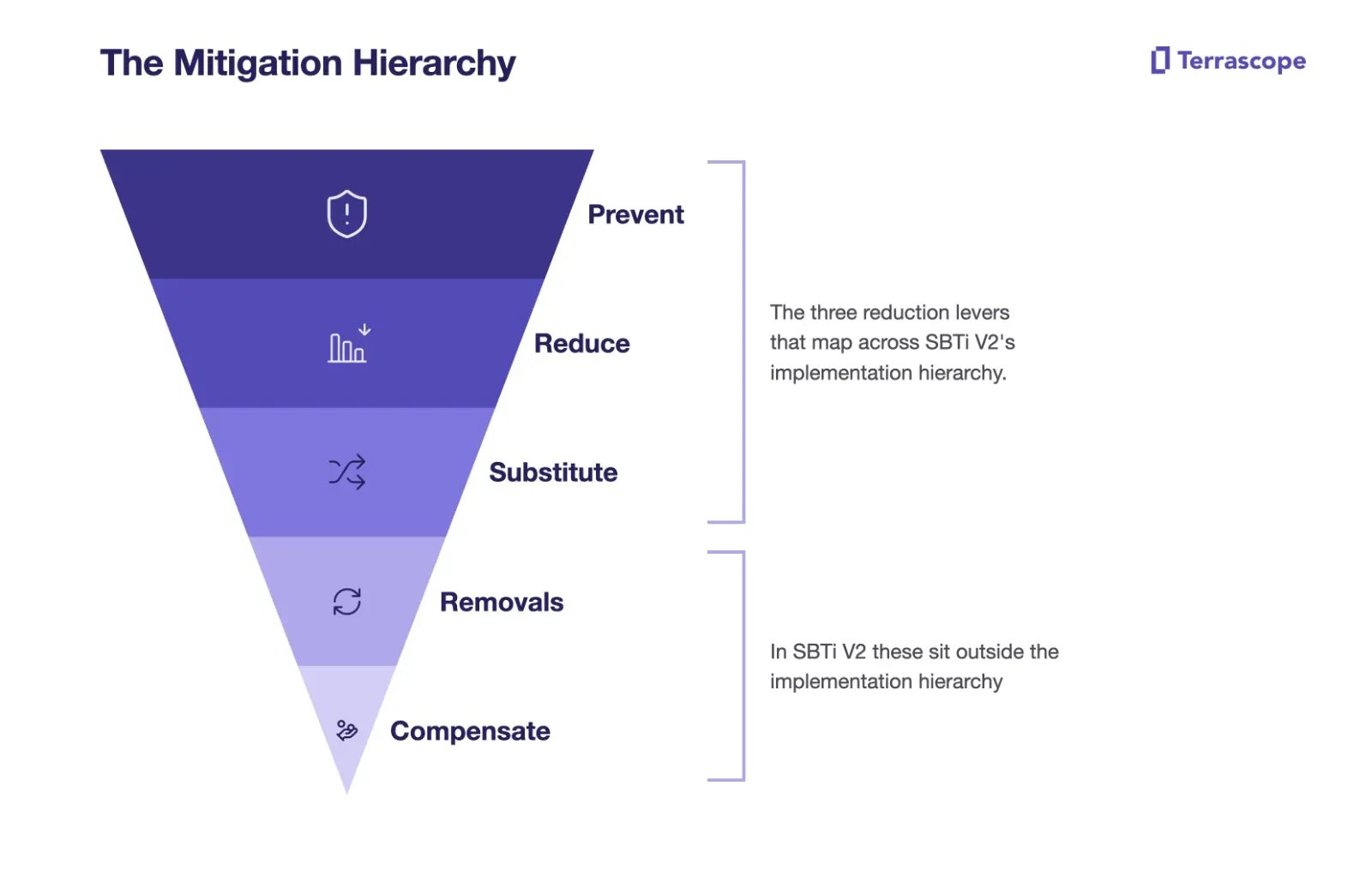
How the two fit together
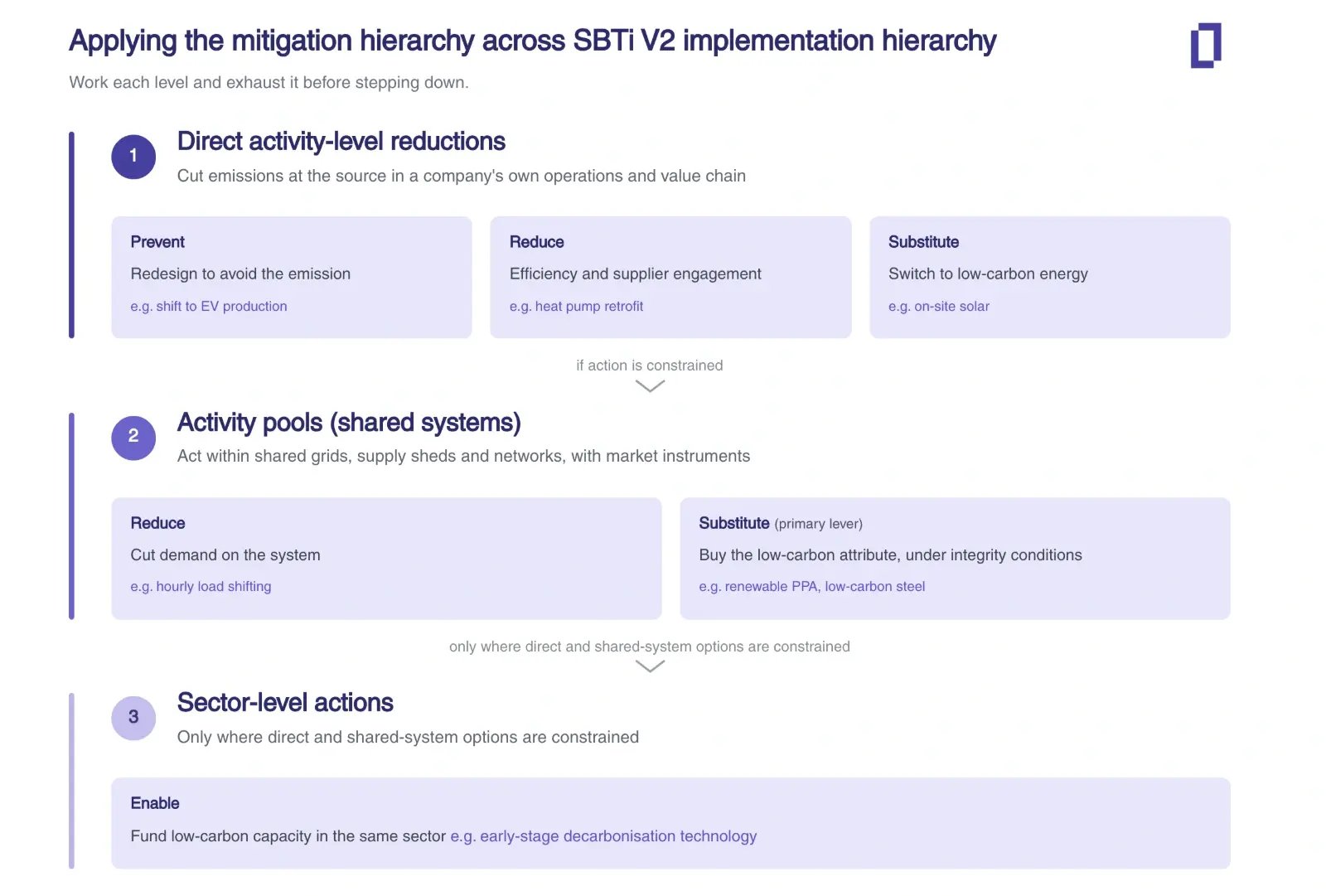
The two hierarchies work on different axes, which is why they combine rather than compete. The mitigation hierarchy runs through five steps in order: prevent, reduce, substitute, removals and compensate. It is the three reduction steps that map onto the implementation hierarchy. The implementation hierarchy sorts actions by how close to the source they happen: directly in a company's own operations and value chain, within the shared systems it draws on, or at the level of its sector. Together, the two produce a single practical rule. At each level, a company works through the mitigation options and does everything it can before moving on. Only when those options are genuinely exhausted does it step down to the next level, where influence is more indirect and the rules on what can be claimed grow tighter. The diagram below shows how the two map onto each other.
Level 1: Direct activity-level reductions
The first level covers the emissions inside a company's own operations and value chain, where it has the most control. This is where all three reduction levers apply, and where SBTi expects most of the work to happen. Prevent means designing the emission out from the start, for example by shifting production towards products that emit less in use, as a carmaker does when it moves from combustion engines to electric vehicles. Reduce means cutting the emissions that remain, through energy efficiency, better logistics, and engagement with the suppliers behind a company's Scope 3 footprint. Substitute means switching the energy itself, from fossil fuels to on-site renewables or low-carbon electricity. Because these actions change a company's physical emissions, they are the only ones that count as reductions against its targets.
Level 2: Activity pools (shared systems)
Some emissions come from systems a company shares with others and cannot decarbonise on its own, such as the electricity grid, a gas network, or the supply shed behind a commodity. Here the main lever is substitution, carried out through market instruments: a company buys the low-carbon attribute of the system it draws on, for example through a renewable power purchase agreement or a certificate for lower-carbon steel. Reduction still has a role, through cutting or shifting demand on the system, but substitution does most of the work. SBTi allows this only under strict conditions, and this is where the standard earns its keep. A market instrument counts only if the underlying action is additional, credibly tracked, and uniquely attributed, so the same reduction cannot be claimed twice. The standard also draws a hard line on claims: a direct cut at the activity level supports an emissions reduction claim, but a market instrument at the activity-pool level supports only a system contribution claim, reported separately. Buying a certificate does not let a company report the reduction as if it had made the cut itself. That distinction is what stops the shared-system level becoming a shortcut.
Level 3: Sector-level actions
Sometimes the first two levels are blocked, because the technology is not yet available at scale or the infrastructure is not there. In those cases a company can act at the level of its sector, provided the action supports the same activity in a relevant market. The aim is to enable future reductions, for example by funding early-stage decarbonisation technology, rather than to offset emissions elsewhere. SBTi treats this as a last resort and requires companies to document the constraint that pushed them to it.
Beyond reductions
Removals. Cutting emissions can only go so far. Some residual emissions remain even after a company has worked through every level of the hierarchy. Removals deal with that remainder by taking carbon back out of the atmosphere, through nature-based or technological means. V2 sharpens this in two ways. First, it is no longer only an end-point activity. Companies must still neutralise all residual emissions at the net-zero year, but V2 also requires them to start supporting removals from 2035, rising over time. Removals now build up during the transition, not all at once at the end. Second, V2 tightens how they are reported. Gross emissions and carbon removals must be tracked separately, in line with the GHG Protocol Land Sector and Removals Standard, and never netted against each other. A tonne removed does not cancel a tonne emitted. That is why removals sit outside the implementation hierarchy rather than within it.
Compensate. Compensation means funding climate action beyond a company's own targets while it is still emitting, for example through climate contributions to projects elsewhere. SBTi houses this in its voluntary Ongoing Emissions Responsibility programme, under strict integrity conditions. Like removals, it counts for nothing against reduction targets and replaces none of the cuts. It is a way of taking responsibility for ongoing emissions on the path to net-zero, not a substitute for reducing them.
The takeaway
The order holds whether or not a company sets SBTi targets: cut real emissions at the source first, use shared-system and sector actions only where direct cuts are genuinely constrained, and keep carbon credits in their own lane. Most of the effort falls in Scope 3, which for many companies is the large majority of the footprint. And where action is not yet possible, V2 asks for best efforts: deploy every lever within your control, be transparent about the barriers that remain, and show what you are doing to address them over time.
How can Terrascope help?
Working the hierarchy in order requires you to see each lever clearly, to know when they have actually been exhausted. Terrascope's Corporate Carbon Footprint breaks a footprint down through its Emissions Driver Tree to the individual activities behind each hotspot, so prevent, reduce and substitute land on specific decisions at activity level. This also leaves you with a record of the options considered at activity level, which is what justifies moving to the next one.
Most reduction potential sits in Scope 3, where industry averages treat a supplier who has invested in low-emission practices the same as one who is yet to start. Terrascope's supplier engagement collects primary data from priority suppliers and converts it into supplier-specific emission factors, so a real cut at the source shows up in the inventory year on year.
Speak with a Terrascope expert about your transition plan 👇
Frequently asked questions