
Summary
-
A New York bill would require companies with more than US$1 billion in revenue that do business in the state to publish all of their greenhouse gas emissions every year, checked by an independent assurance provider.
-
Reporting on a company's own emissions (Scope 1 and Scope 2) would start in 2028 and supply-chain emissions (Scope 3) in 2029, each covering the previous year.
-
The bill passed the State Senate in February 2026 and still needs an Assembly vote and the Governor's signature. The current session ends on 31 December 2026, after which the bill would need reintroducing in 2027.
-
Companies already reporting under California's SB 253 hold the emissions inventory the New York bill would ask for.
New York climate disclosure at a glance
| Regulator | New York State Department of Environmental Conservation (DEC), which would adopt implementing regulations by 31 December 2027 (proposed). The Attorney General enforces |
| Standard | Climate Corporate Data Accountability Act, Senate Bill S9072A / Assembly Bill A4282A (proposed). Emissions measured under the GHG Protocol Corporate Accounting and Reporting Standard and the Corporate Value Chain (Scope 3) Standard |
| Companies in scope | Partnerships, corporations, LLCs and other entities formed under US state or federal law that do business in New York and had total revenues above US$1 billion in the preceding fiscal year, counting the revenues of subsidiaries doing business in New York (proposed) |
| Estimated population | Not yet published |
| First reporting year | Scope 1 and 2: reports from 2028 covering the prior fiscal year (FY2027 for calendar-year companies). Scope 3: reports from 2029 covering FY2028 (proposed) |
| Scope 3 required | Yes, from 2029 for all reporting entities, on a schedule set by DEC (proposed) |
| Assurance | Scope 1 and 2: limited assurance from 2028, reasonable assurance from 2032. Scope 3: DEC decides by 1 January 2029 whether to require assurance; if required, limited assurance from 2032 (proposed) |
| Penalty regime | Civil penalties of up to US$100,000 per day for wilful failure to comply, capped at US$500,000 per reporting year, brought by the Attorney General. Scope 3 penalties limited to non-filing between 2029 and 2032 (proposed) |
New York's Climate Corporate Data Accountability Act (Senate Bill S9072A) passed the State Senate 40 to 22 on 10 February 2026 and would require every business with more than US$1 billion in annual revenue that does business in New York to disclose Scope 1, Scope 2 and Scope 3 emissions under the Greenhouse Gas Protocol, with Scope 1 and 2 reporting from 2028 and Scope 3 from 2029. It copies California's SB 253 and lands as the US Securities and Exchange Commission moves to rescind its federal climate disclosure rules. The bill still needs an Assembly vote and the Governor's signature, so every date on this page is a proposal.
Where the bill stands
The Climate Corporate Data Accountability Act has been introduced in every session since 2023, and the 2026 version is the first to pass a chamber. Senator Pete Harckham's S9072A cleared the Senate on 10 February 2026; the companion bill, Assemblymember Deborah Glick's A4282A, has sat in the Assembly Codes Committee since the same day, with no further action recorded as of 19 October 2026. If both chambers pass the bill, the Governor has 10 days (excluding Sundays) to sign or veto it while the Legislature is in session, and the act takes effect 180 days after it becomes law.
The 2025-2026 session ends on 31 December 2026. A bill that has not passed both chambers by then is reintroduced under a new number in the next session, as the 2023 version (S897) was in 2025 (S3456). New York has no corporate emissions disclosure regime at state level today, so the bill would create the state's first.
What the bill would require
Under S9072A, a reporting entity discloses its full greenhouse gas inventory each year to an emissions reporting organisation, with an assurance report attached, and the data is published on a public digital platform.
-
Scope 1, 2 and 3 disclosure (proposed): all direct emissions from owned or controlled sources, all indirect emissions from purchased energy, and all upstream and downstream value-chain emissions, wherever in the world they occur. The disclosure names the reporting entity, its trade names, subsidiaries and logos, so the public record ties emissions to the brands consumers know.
-
Independent third-party assurance (proposed): every disclosure carries an assurance report from an independent provider with greenhouse gas experience. Scope 1 and 2 start at limited assurance in 2028 and move to reasonable assurance in 2032. DEC decides by 1 January 2029 whether Scope 3 needs assurance; if it does, limited assurance starts in 2032.
-
The GHG Protocol as the measurement standard: the bill names the GHG Protocol Corporate Accounting and Reporting Standard and the Corporate Value Chain (Scope 3) Accounting and Reporting Standard, including their guidance on primary, secondary, industry-average and proxy data for Scope 3.
-
Reuse of existing reports: a company can submit reports prepared for other state, national or international requirements, including reports prepared under the ISSB's IFRS Sustainability Disclosure Standards, as long as they meet every New York requirement.
DEC would adopt the implementing regulations by 31 December 2027 (proposed), set the annual disclosure date, charge an annual fee that covers its administration costs, and have the public emissions platform live by 1 July 2028 (proposed).
Who is in scope
The bill covers any business formed under US state or federal law that does business in New York and had total revenues above US$1 billion in the preceding fiscal year (proposed).
The test has three parts. Legal form: a partnership, corporation, limited liability company or other entity formed under the laws of New York, another US state, the District of Columbia or an act of Congress. Nexus: the entity does business in New York and derives receipts from activity in the state within the meaning of section 209 of the New York Tax Law; an out-of-state entity whose only New York activity falls within the exempt list in section 1301(b) of the Business Corporation Law is outside the rule. Size: total revenues above US$1 billion in the preceding fiscal year, including the revenues of all subsidiaries that do business in New York.
Groups and subsidiaries
If a reporting entity is a consolidated subsidiary of an ultimate parent, the parent can be the reporting entity, and a subsidiary that qualifies on its own is released from a separate report as long as the parent reports. A group with one New York subsidiary and a billion-dollar consolidated revenue line therefore reports its global Scope 1, 2 and 3 inventory. The State University of New York and the City University of New York are covered only if their regents adopt the provisions by resolution.
Supply-chain reach (Terrascope analysis, not a bill requirement): the revenue test counts subsidiaries and the disclosure covers emissions "regardless of location", so a US$1 billion group with a New York sales office reports the emissions of its factories, farms and logistics partners worldwide. From 2029 (proposed), Scope 3 turns every material supplier into a data source: food and agriculture producers supplying New York-based consumer goods, retail and food-service groups, apparel and luxury supply chains, and building materials and logistics providers to the state's real estate sector.
Key dates and milestones
| Milestone | Measurement year | First reporting date |
| Senate passage of S9072A | 10 February 2026 | Bill delivered to the Assembly |
| End of the 2025-2026 legislative session | 31 December 2026 | Bill reintroduced under a new number if not passed by both chambers |
| Assembly vote and Governor's signature | Not yet published | Act effective 180 days after becoming law (proposed) |
| DEC implementing regulations | On or before 31 December 2027 (proposed) | Sets the annual disclosure date and fee |
| Scope 1 and 2 disclosure with limited assurance | FY2027 for calendar-year companies (proposed) | 2028, on a date set by DEC (proposed) |
| Public digital platform live | 1 July 2028 (proposed) | Disclosures published within 90 days of receipt |
| Scope 3 disclosure | FY2028 for calendar-year companies (proposed) | 2029, on a schedule set by DEC (proposed) |
| DEC decision on Scope 3 assurance | On or before 1 January 2029 (proposed) | If required, limited assurance from 2032 |
| Reasonable assurance on Scope 1 and 2 | FY2031 (proposed) | 2032 (proposed) |
| DEC review of Scope 3 disclosure deadlines | On or before 1 January 2032 (proposed) | Aims to align Scope 3 timing with Scope 1 and 2 |
Scope 3 penalties between 2029 and 2032 apply only to non-filing, and Scope 3 misstatements made with a reasonable basis and disclosed in good faith are protected from civil action.
Why this matters beyond New York
1. Supply-chain ripple across North America and beyond. New York hosts the US headquarters of consumer goods, media, fashion and real estate groups, and the nexus test reaches any billion-dollar company with a New York revenue stream. Their Scope 3 requests will land with suppliers in Canada, Mexico, Latin America, Europe and Asia, whatever those suppliers' home regulators require, which makes supplier engagement part of the annual reporting cycle.
2. State law fills the federal gap. The SEC proposed rescinding its 2024 climate disclosure rules on 29 May 2026, so US emissions disclosure now runs through the states. California's SB 253 regulation sets 10 November 2026 for the first Scope 1 and 2 reports, with Scope 3 from 2027. New York's bill copies the SB 253 architecture: the same US$1 billion threshold, the same GHG Protocol measurement basis, the same limited-to-reasonable assurance ladder. A company that has built its SB 253 inventory holds the New York inventory too.
3. The GHG Protocol as the common floor. California, New York, and the ISSB standards adopted in Australia, Singapore, Hong Kong, Japan, Mexico and the UK all measure emissions under the GHG Protocol Corporate Standard. New York's acceptance of ISSB-prepared reports means one corporate carbon footprint, measured once, serves every regime a multinational faces.
How companies should prepare
The first measurement year is FY2027 for calendar-year companies (proposed), and the inventory is the slowest part to build.
-
Establish your greenhouse gas inventory on the GHG Protocol. The bill names the Corporate Standard and the Scope 3 Standard, so a GHG Protocol inventory built now is the New York inventory. Companies reporting under SB 253 already have Scope 1 and 2; the gap is Scope 3 by category, and the extra year before Scope 3 disclosure is preparation time.
-
Map your value-chain exposure to New York reporting entities. If your customers are billion-dollar groups with New York operations, their Scope 3 numbers include you from 2029 (proposed). Knowing which customers report, and when, tells you when the data requests arrive.
-
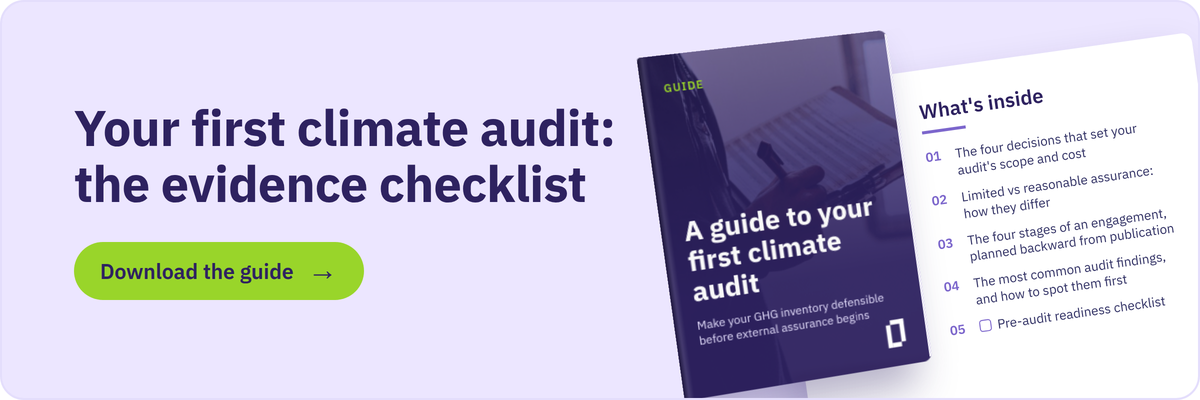
Build assurance-ready processes early. Limited assurance applies from the very first Scope 1 and 2 report (proposed), with reasonable assurance four years later. Methodology documentation, source-data traceability and review controls have to exist during measurement, because an assurance provider asks "where did this number come from?" for every figure.
-
Build on the frameworks you already use. SB 253 filings, CDP responses, ISSB-aligned reports and EU Corporate Sustainability Reporting Directive work all rest on the same GHG Protocol inventory, and the bill accepts reports prepared for other regimes.
How Terrascope can help
Terrascope's AI-powered platform helps companies operating in the United States move from baseline emissions data to audit-ready disclosures, including Thoughtworks, the Chicago-headquartered global technology consultancy that replaced manual data uploads with automated integrations and built a Scope 1, 2 and 3 baseline across 48 locations in 19 countries.
-
Scope 1, 2 and 3 emissions measurement. Integrations pull emissions data from your source systems monthly, and Data in Any Format handles the spreadsheets and offline records, so your inventory stays current across every subsidiary the revenue test counts and every Scope 3 category the bill requires.
-
Audit-ready reporting. Audit Trail makes every figure traceable from data entry to disclosure, with assurance-provider access built in, so limited assurance in year one and reasonable assurance in 2032 run on evidence that already exists.
-
Supply-chain intelligence. Analytics shows you where your Scope 3 hotspots sit before the 2029 disclosure, so the extra year becomes reduction planning time.
-
Multi-framework alignment. Climate Reporting drafts your disclosures from your measured data, reviewed by your team, in a form New York's bill accepts alongside California and ISSB filings.
Frequently asked questions
Speak to an expert
Are you ready to get ahead of New York's Climate Corporate Data Accountability Act requirements? Speak to a Terrascope expert and see how we help companies move from baseline emissions data to audit-ready disclosures.