
Summary
-
A spreadsheet, a consultancy or a software platform will each get you a carbon number. Terrascope gets you one that passes audit first time, in weeks, with specialists doing the hard parts alongside your team.
-
Speed is only part of it. The routes also differ at audit time, when each figure has to trace back to its source, and every year after that, when the exercise is repeated.
-
We put nine questions to each route, from how long it takes to reach an audit-ready baseline to whether the number can carry you on to product footprints and a decarbonisation plan. The answers show what each gives you as part of the deal, and what you add yourself.
-
If a reporting deadline is in view, a 45-minute working session with a Terrascope specialist shows the gap between your current number and an audit-ready one, using your own data.
Companies typically measure their carbon footprint one of a few ways: a spreadsheet built in-house, a consultancy engagement, or a carbon management software. They differ on how fast you get to your number, what each annual refresh costs, whether figures trace back to source data when an auditor asks, and how far beyond disclosure the result takes you. Terrascope's combination of platform and experts gives you a unique path. The comparison below helps you weigh the options.
Each route can get you a number. The differences show up later: when an auditor asks to see the workings, when a regulator or a customer wants the figure by a fixed date, and when the whole exercise has to be repeated next year. Terrascope does all three inside a single subscription, with specialists on hand.
What each route does best
Each column is an option you have for carbon accounting; each row is a question to ask of your current setup. Filled dots mean coverage; fewer dots mean extra spend or manual work. Read down the column you use today to assess your options.

Nine questions to put to your current setup
The first four questions are about getting to a defensible number: how long it takes, whether it survives an audit, what it costs to repeat, and who you call when the methodology needs a judgment. The remaining five are about what the number lets you do next: bring in data in any format, engage suppliers, account for land and agriculture, footprint products, and turn measurement into a plan.
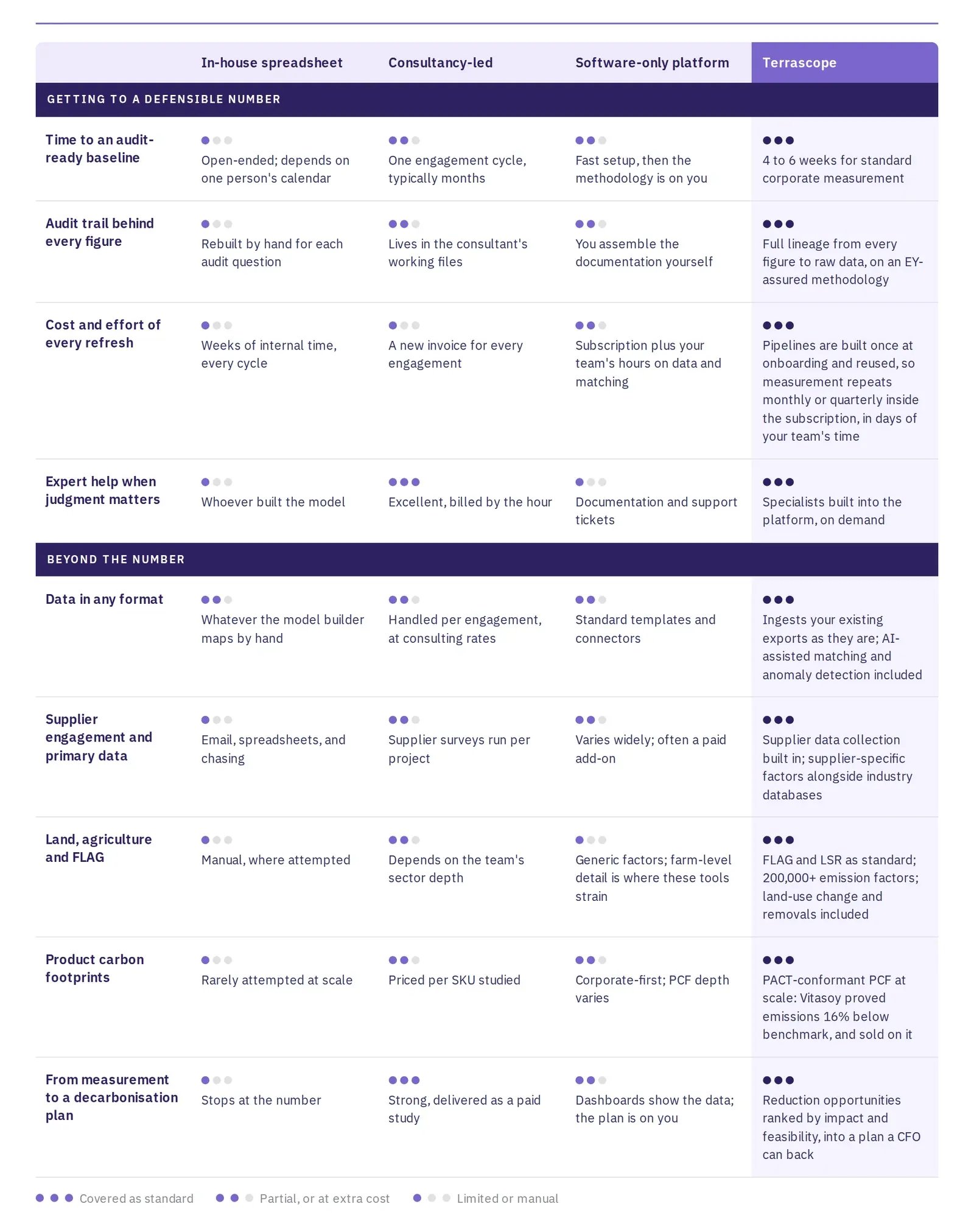
Ratings reflect what each route typically covers as standard for an enterprise with a complex supply chain; individual providers vary. Baseline timing applies to standard corporate measurement; supplier data collection takes longer.
On time to an audit-ready baseline, Terrascope delivers standard corporate measurement in 4 to 6 weeks, with full lineage from every figure to raw data on an EY-assured methodology. On the cost of a refresh, data pipelines are built once at onboarding and reused, so measurement repeats monthly or quarterly inside the subscription, in days of your team's time rather than weeks.
If land emissions sits anywhere in your supply chain, the GHG Protocol Land Sector and Removals (LSR) Standard covers accounting: from 1 January 2027 it applies to any company with significant land sector activities in its value chain, even one doesn't directly control land. Not sure if it applies to you, then start with: Does the Land Sector and Removals Standard apply to your company?
What customers achieve after switching
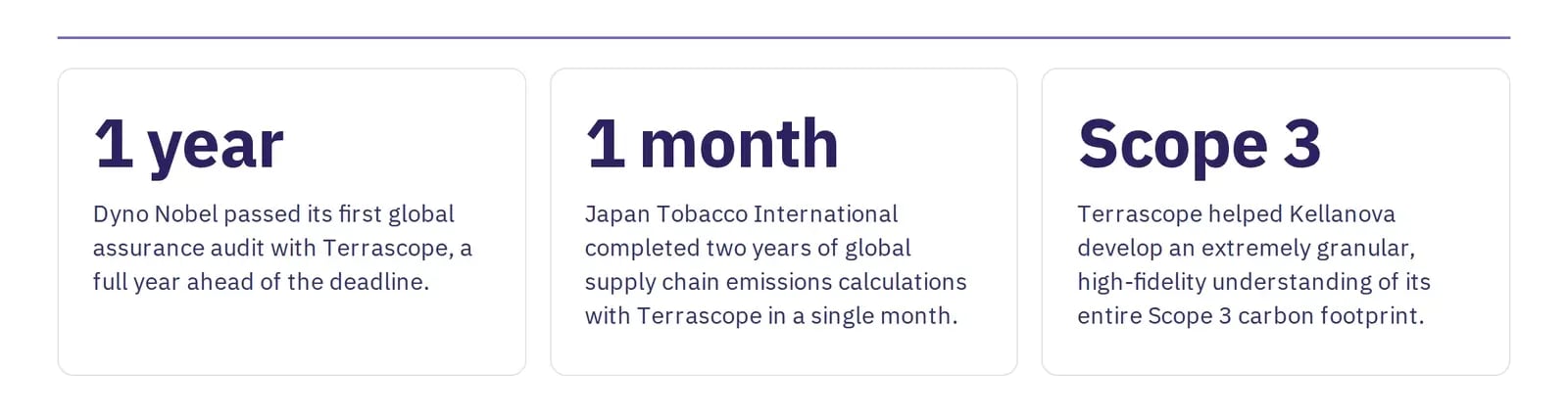
Every Terrascope customer that has gone through external assurance and SBTi validation has passed. If your next milestone is an SBTi submission, SBTi Corporate Net-Zero Standard V2: what's changed for large companies sets out what the validators will be looking for.
Related comparisons: Best Watershed alternatives for food supply chains · Best agri-food carbon accounting platforms compared · The 10 best carbon management platforms for enterprise supply chains (2026)
See your gap in 45 minutes