Major hotel groups are in scope.
“Terrascope helped us categorise and measure emissions for over 130K line items in two weeks, expediting our time to act on a robust emissions reduction plan. [...]”
Cindy Lee
Head of Group Project Services,
Banyan Group
4-6 Weeks
vs. 6-12 months traditional typical FLAG submission time frame.
100% Pass Rate
for audit and SBTi Approvals
600M+
tonnes of CO₂ measured across customers
92%
Accuracy vs. actual supplier data when estimating
200K+ Emission Factors
with FLAG, LUC, & LM breakdowns
80%
reduction in measurement cycles
50x Faster
than traditional LCAs for product emissions
5x Faster
faster measurement and savings of up to USD160k
10 years
of sustainability experience Terrascope is an Olam venture.
| Before Terrascope | After Terrascope | |
|---|---|---|
| F&B supply chain visibility | Minimal | Full FLAG and commodity data |
| Property-level tracking | Manual, inconsistent | Automated, comparable |
| Guest-facing data | Marketing claims |
Verified carbon footprints |
| Franchise reporting | Fragmented | Consolidated,auditable |
| Time to baseline | 6-12 months | 4-6 weeks |
F&B is 30-40% of your footprint but probably unmeasured
- Food and beverage emissions are complex and agricultural
- Property-level data is inconsistent across owned and franchised locations
- Guest-facing sustainability claims need substantiation
- Energy efficiency is mature but Scope 3 is underdeveloped
Turn multi-property complexity into strategy
- FLAG and agricultural expertise for F&B operations (our core strength)
- Property-level tracking that rolls up to portfolio view
- Guest-facing carbon data you can stand behind
- Franchise and owned property consolidation
- Refrigerant and equipment lifecycle tracking
Easily collect, measure, and decarbonize in weeks, not months
- MUI Group found 56% cost savings on refrigerants while cutting emissions
- FLAG expertise from 10 years inside Olam's supply chain
- 100% SBTi validation pass rate
- Full audit trail from property to portfolio
Real Results from Industry Leaders
Tailored solutions for different company profiles
If you Have Data,
But Need Compliance
"We measured Scope 3 with industry averages or third-party tools. Now LSR regulations require land-specific breakdowns we don't have."
Land Sector EF Disaggregation
- Auto-tagging of proprietary emissions factor databases into LSR-specific requirements
- Monthly office hours with LSR Expert
Facing Customer/SBTi Pressure
"Customers want product-level carbon footprints. broken out by land emissions categories. Our industry-average numbers make us look worse than competitotrs with farm-level data."
"We need to quantify progress vs our SBTi targets."
Farm-level emissions calculation to prove lower impact and win contracts
- Proprietary, commodity-specific templates for farm-level data collection
- Scalable across owned farms and suppliers
- Monthly expert office hours included
- Monthly office hours with LSR Expert
Real Results from Industry Leaders
16% Lower Emissions vs Industry Benchmark Custom EF development
130K line items in 2 weeks at 92% accuracy
Measured 5,000 SKUs in 100 minutes
16% Lower Emissions vs Industry Benchmark Custom EF development
130K line items in 2 weeks at 92% accuracy
Measured 5,000 SKUs in 100 minutes
Regulatory Requirements for Hotels and Hospitality Companies
See which regulation applies to your jurisdiction, and what it means for your business.
Europe
| Regulation | Deadline | What It Means |
|---|---|---|
| CSRD | 2025-2028 | Large hotel groups in scope. F&B supply chain requires FLAG methodology. |
| EU Green Claims | 2026 | Guest-facing sustainability claims must be substantiated. |
United States
| Regulation | Deadline | What It Means |
|---|---|---|
| California SB 253 | Aug 2026 | Major hotel groups with $1B+ revenue in scope. |
Australia
| Regulation | Deadline | What It Means |
|---|---|---|
| AASB S2 | Jan 2025+ | Hotel groups with Australian presence. Scope 3 from year 2. |
Singapore/APAC
| Regulation | Deadline | What It Means |
|---|---|---|
| SGX Requirements | FY2025 | Listed hospitality companies need climate disclosure. |
FAQ
How does Terrascope streamline multi-property data collection? Can we submit spend-based data if activity data isn’t available?
Yes. Terrascope runs structured Data Campaigns by cluster and property, with task assignment, drag-and-drop uploads, tagging, and real-time progress tracking. You get role-based access (including upload-only custodians) and Microsoft SSO for easier onboarding.
A standardized workbook prevents template drift (locked formats, validated units/dates/BU names), while built-in QA flags anomalies and variances before deadlines. When activity data isn’t available, we accept spend-based inputs and help standardize categories to keep reporting consistent.
How does Terrascope handle hospitality-specific emissions like occupied-room intensity, F&B/FLAG, and property development?
Terrascope calculates occupied-room intensity automatically by ingesting occupancy files and generating portfolio + property views (e.g., kg CO₂e per occupied room).
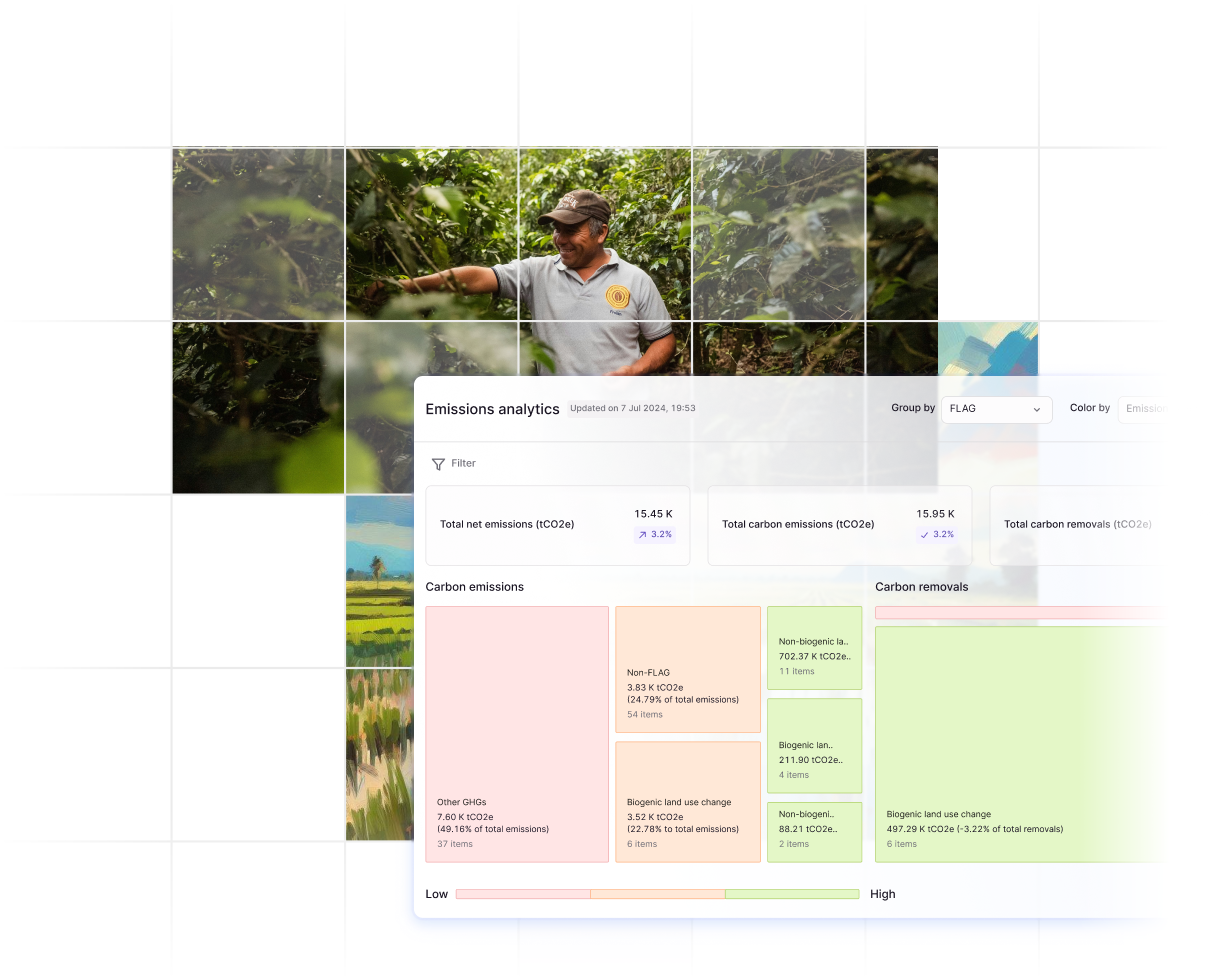
For F&B/FLAG, it disaggregates land-use change vs. land management (and biogenic vs. non-biogenic) with intelligent emission-factor matching, and supports commodity/country-specific treatment—improving accuracy as supplier data matures.
For property development, it separates construction vs. operations reporting and supports Scope 1–2 tracking during construction (under operational control), plus Scope 3 “use-of-sold-products” calculations post-sale.

Are we audit- and SBTi-ready with Terrascope? How do you support auditors and documentation?
Terrascope supports audit-ready reporting with traceable methodology and documentation, including a Functional Specifications pack (assumptions, factors, methods, omissions) and live auditor walkthroughs on request.
For SBTi, we support the end-to-end flow—screening, measurement (including FLAG), inventory consolidation, submission support—plus decarbonization lever identification.
Resources