
Emission factors often structure any assessment of a company's carbon footprint. But, how are they relevant to something like material plastic waste? Read more below.
When selecting plastic waste treatment activities on emission factor databases like ADEME & DEFRA, you may notice that carbon emission estimates for disposal of plastic in landfills is notably lower than others. If recycling is indeed the more ecologically sound approach for dealing with plastic waste, why are emission factors higher for recycling than landfilling, which is considered less eco-friendly?
To answer this question, we need to understand:
-
Emission factor use and limitations
-
Emissions factors for landfilled vs. recycled plastic waste
-
How emissions are allocated when recycling waste
-
Benefits of recycling
What is an EF? Purpose and function
An emission factor (EF) is a representative value that attempts to relate the quantity of a greenhouse gas (GHG) released to the atmosphere with an activity associated with the generation of that gas. Emission factors may be quantified using an understanding of chemical process reactions, or they can be developed empirically through statistical sample measurements. Emission factors are typically converted into carbon dioxide equivalent (CO2e).
However, EFs do not account for:
-
Non-GHG pollutants, such as leachate and micro-plastics
-
Wildlife and biodiversity hazards resulting from plastic waste
But how is this relevant to plastic waste in general?
A simplified diagram of the plastic life cycle:
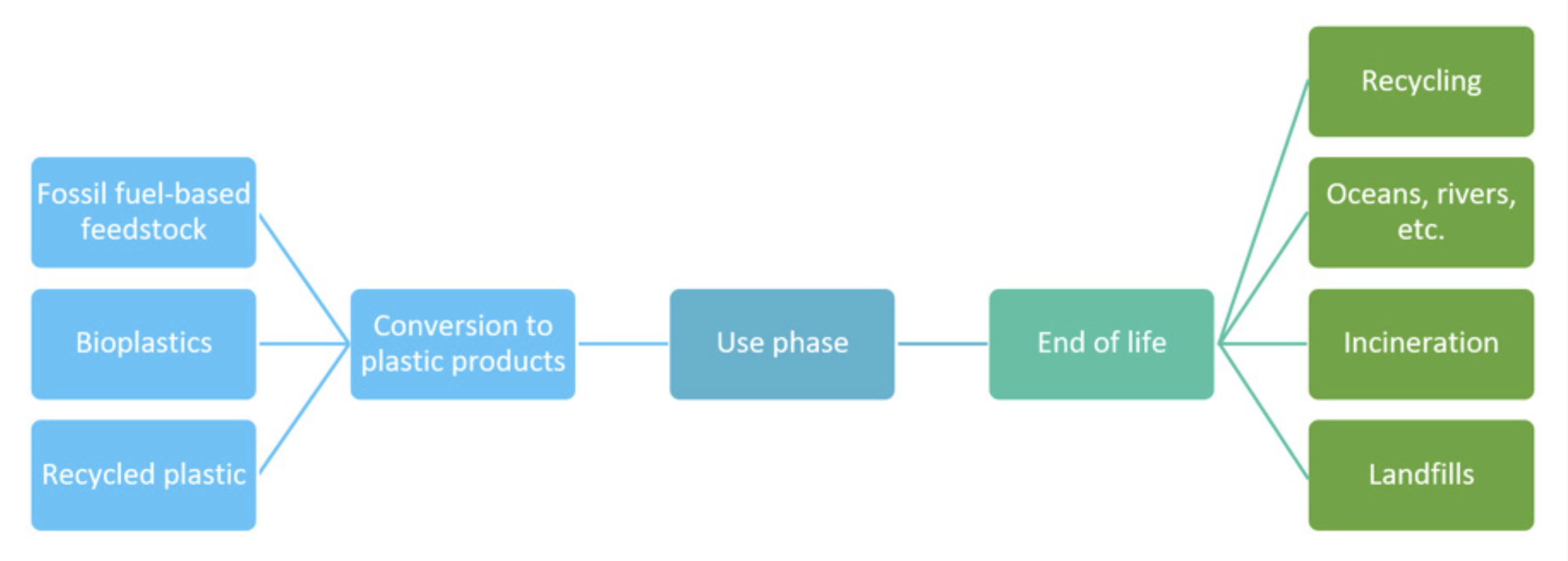
The main relevance comes when understanding why EFs are so different for landfilled and recycled plastic waste. Numerous studies have been published for most emission sources in the peer-reviewed scientific literature to inform EFs. As shown below, one tonne of plastic waste disposed in the landfill will result in 33 kg CO2e. If that tonne of plastic is instead processed to produce one tonne of recycled material to be re-manufactured, 202 kg CO2e is produced - almost 6 times more emissions!
|
Emissions per tonne of plastic disposed in the landfill |
Emissions per tonne of closed-loop recycled plastic |
|
33 kg CO2e per unit |
202 kg CO2e per unit |
Source: ADEME
Why is this the case?
Over time, plastic waste in landfills fragments into microplastics and nanoplastics, which disrupt habitats and natural processes, and damage ecosystems. This impacts livelihoods, food production capabilities, and social well-being of living organisms. Since plastic does not decompose, plastic that is disposed in the landfill emits very little greenhouse gas emissions.
In contrast, recycling plastic involves a 6-step process: Collection and distribution; Sorting and categorising; Washing; Shredding; Identification and separation; Extruding and compounding. This produces carbon emissions from electricity needed to run recycling plants, wastewater and more.
How emissions are allocated when recycling waste
The emissions from recycling plastic are attributed to the user of the recycled materials, not to the producer of the waste. To give some colour to this example, say that Company A disposes of one tonne of plastic waste to the landfill. Company A would report emissions totalling 33 kg CO2e in Scope 3, category 5: waste generated in operations.
In contrast, if Company A sells that tonne of plastic to Company B, then Company A would report 0 kg CO2e, or zero emissions. Instead Company B, which processes that plastic for closed-loop recycling, would report 202 kg CO2e in Scope 3, category 5: waste generated in operations.
Since emissions from the recycling process are accounted for by the company that purchases the recycled material, the appropriate benchmark is to compare emissions of recycled plastic versus the production of virgin plastic:
|
Plastics: Closed-loop recycling (tonne) |
Plastics: Virgin material (tonne) |
|
202 kg CO2e per unit |
2,383 kg CO2e per unit |
Company B’s emissions footprint is therefore 10 times lower as a result of using recycled plastic instead of virgin plastic, in this illustrative example using industry averages.
Benefits of recycling
Lower carbon footprint than producing from scratch
Recycled plastic has a lower carbon footprint than that of producing plastics (at least 50%). That is because much less energy is required to recycle plastic than to make new resin.
Protecting our natural resources
The main ingredient in most plastic material is a derivative from crude oil and natural gas. Recycling plastic waste reduces the need to extract new, raw materials from the earth as it reuses material that has already processed, therefore protecting our natural resources.
While recycling does indeed generate carbon emissions through its processes, it produces far less emissions than producing virgin plastic material from scratch. In addition, the implications of plastic waste in landfills extend beyond emissions, impacting ecosystems, habitats, and human well-being over time. Understanding the intricate balance between these factors helps us make informed choices in our efforts to manage plastic waste responsibly and mitigate its environmental impact.