Summary
-
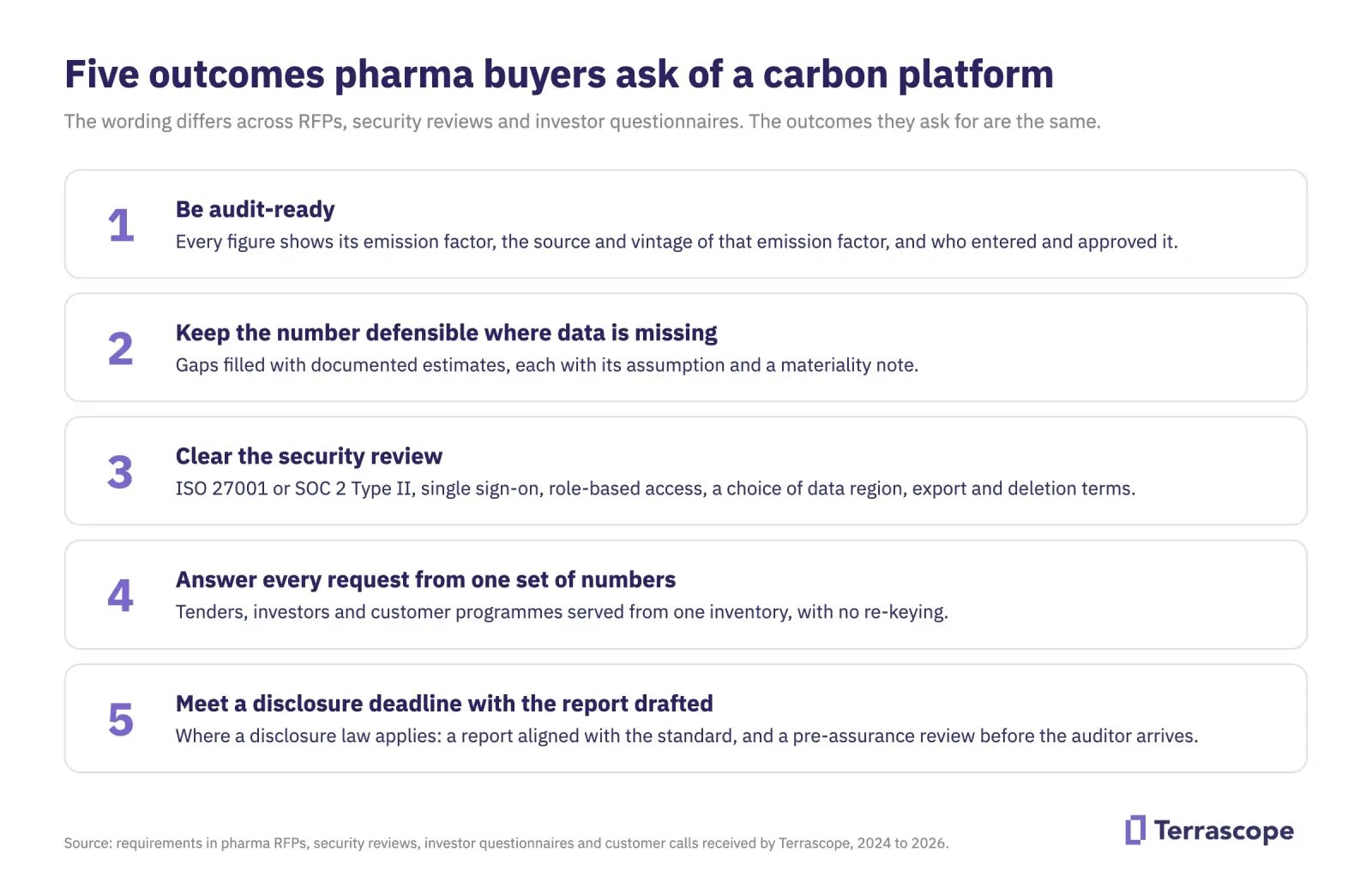
Pharma buyers ask a carbon platform for the same five outcomes: be audit-ready, keep estimates defensible, clear the security review, answer every request from one set of numbers, and meet disclosure deadlines.
-
What differs by position is the starting point: the data you already hold, where your emissions sit and who is asking.
-
In the originator RFP we answered, the inventory already existed and the gap was modelling and integration. Companies that outsource manufacturing usually need supplier data and product estimates first.
-
CROs facing a first climate disclosure, mandatory in some markets, often have no sustainability specialist; wholesalers need to focus effort across thousands of suppliers; contract manufacturers are judged by what they can hand to a customer.
-
Each checklist starts from one real buyer's requirements at that position (anonymised), so treat it as a starting point: your priorities may differ.
Pharma companies buy carbon accounting software for one of four reasons: a law requires them to publish their emissions, a large customer has asked for them, an investor has, or they need to put a number on a target. Which reason applies, and what data they already hold, depends on where they sit in the value chain. An originator with its own plants, a consumer health company that outsources its manufacturing, a clinical research organisation, a wholesaler and a contract manufacturer face different deadlines and different gaps.
This page draws on what pharma buyers have asked Terrascope for between 2024 and 2026: global request for proposals (RFPs), clinical research security reviews, and calls with consumer health and wholesale companies. Each checklist starts from one real buyer's requirements, anonymised, since priorities differ: many originators, for example, put supplier data and product footprints first. The page starts with the five outcomes these buyers ask for, explains why the route to them differs by position, and then gives a checklist for each position.
Five outcomes pharma buyers ask of a carbon platform
The documents differ in wording. The outcomes they describe are the same five.
- Be audit-ready. Whether a statutory assurance provider, a private equity owner or a customer's LCA team reviews the numbers, they ask the same first question: "where did this number come from?" The platform must show, for every figure, which emission factor you used, where it came from and how old it is, and who entered, changed and approved the entry. Without that, the audit turns into a reconstruction exercise. One investor questionnaire we have seen asks a portfolio company outright whether its data has been or will be assured, and whether it will keep using the same tool next year.
- Keep the number defensible where data is missing. Every pharma supply chain has gaps: a small office with no utility bill, a contract manufacturer that cannot give product-level data. The platform must fill the gap with a documented estimate and record the assumption and why the gap is immaterial, so an assurance provider sees a judgment rather than a hole.
- Clear the security review. Many pharma companies run supplier security reviews built for clinical and patient data. A carbon platform holds no patient data, but it often faces the same questionnaire: ISO 27001 or SOC 2 Type II, single sign-on, role-based access, encryption, a choice of data region, a list of sub-processors, and defined terms for export and deletion at contract end. A platform that cannot answer these stalls in procurement regardless of its carbon features.
- Answer every request from one set of numbers. Sales teams answering tenders, finance teams answering investors and sustainability teams answering customer programmes all need the same inventory, in their own format, without re-keying. The originator RFP asked for exactly this: emissions data its commercial teams could pull for customer surveys.
- Meet a disclosure deadline with the report drafted. For a company facing its first mandatory disclosure, the deliverable is a report aligned with the standard and a pre-assurance review before the statutory assurance provider arrives, often run by a team with no sustainability specialist.
Why the route differs by position
Every position wants the same five outcomes. What differs is which data a company already holds, where its emissions sit and who is asking. An originator usually has an inventory already and needs to model a path to a target. A company that outsources its manufacturing has little primary data for most of its footprint, because that footprint sits with contract manufacturers. A clinical research organisation has small emissions and, in some markets, a first disclosure deadline. A wholesaler has thousands of suppliers and little room to negotiate on regulated prices. A contract manufacturer is judged by what it can hand to a customer.
| Position | What you already hold | The gap in front of you | Evaluate first | Then |
|---|---|---|---|---|
| Originator with its own plants | Scope 1 and 2 from an EHS system; Scope 3 calculated in your own data warehouse; a published net zero target | A path from baseline to target, by site and business unit, that you can defend to the board and to regulators | Scenario modelling: a business-as-usual forecast, reduction levers mapped to emissions, and targets at company, country and site level | Batch integration with your ERP and data warehouse |
| Consumer health, OTC or generics company with contract manufacturers | Supplier site totals gathered once a year by spreadsheet survey; little at product level | Most of your footprint sits with contract manufacturers who can share site totals but not product figures | A supplier portal that sends, collects and scores the questionnaire, replacing manual review | Product footprints modelled from the bill of materials where suppliers cannot supply them |
| Clinical research organisation (CRO) | Office and travel data across many small sites; often a finance team with no sustainability specialist | A disclosure due on a fixed date, and an owner asking whether the numbers are or will be assured | Disclosure support: gap analysis, a draft report and a pre-assurance review | Centralised upload for small offices with no utility bills |
| Wholesaler or distributor | Scope 1 and 2 across business units, sometimes already assured; a Scope 3 boundary still being set | Thousands of suppliers, regulated product prices, and almost all emissions in goods you resell | Supplier segmentation by emissions exposure | Freight emissions modelled where you choose the route |
| Contract manufacturer (CDMO) or active ingredient (API) supplier | Site energy, wastewater and refrigerant data for multi-product plants | Large pharma customers asking for primary data on your processes, compatible with PAS 2090 clause 5.1.1, so they can build their product footprints by 2028 | Site energy allocated to each product with a documented key, exported in PACT format | One record that answers SMI, PSCI, EcoVadis and CDP questionnaires |
Originators: modelling the path to a target
Who you are. You run your own manufacturing sites across several regions. You already measure Scope 1 and 2 in an environmental, health and safety (EHS) system and calculate Scope 3 in your own data warehouse. You have published a net zero target and now have to show a path to it, by site and by business unit, to your board and, where disclosure laws such as CSRD, SB 253 or AASB S2 apply, to regulators.
What you ask for. The originator RFP we answered marked supplier surveys, disclosure templates and product footprints out of scope. It wanted one tool to model the path from baseline to target. Its must-haves:
- Batch integration with the data warehouse, spreadsheets, SQL databases and the ERP (SAP or JDE), with two or more years of history migrated. Real-time feeds were optional. Integration was conditional on a security review of how data moves and where it sits.
- Separate baseline years for Scope 1 and 2 and for Scope 3, with targets at company, operating unit, country and site level, and Scope 3 sliceable by category and region now and by business unit and product later.
- Scenario modelling on cost, impact, feasibility and timing: a business-as-usual forecast, a hierarchy of reduction levers mapped to emissions, and the ability to track a few hundred suppliers' intensity changes, spend shifts, technology switches and logistics changes.
- Documented estimation for sites without data and for spend-based Scope 3, with every assumption and every materiality exclusion recorded in the tool.
- Roles and workflow for a few dozen users, with some restricted to final figures only, and review and approval before anyone publishes model outputs.
- Platform terms: vendor-hosted, 99 percent uptime or higher, input in more than one language, and a scoring model that ranks must-haves above should-haves above nice-to-haves.
What this means. At this position the inventory usually exists, so the evaluation is about modelling depth, integration and governance. Buyers that already subscribe to CDP, EcoVadis or similar services for supplier data may rule supplier modules out of scope.
Consumer health and generics: getting supplier data
Who you are. You own brands, formulations and distribution. Third parties make your products. Scope 3 is almost your whole footprint, and most of it sits with manufacturers who can give you their site totals and little at product level. You sell in several countries and face packaging and reporting rules in each. Often a quality or supply chain manager does the sustainability work alongside their main job, and the annual supplier survey is a spreadsheet reviewed by hand.
iNova Pharmaceuticals is a public example. It manages more than 1,100 SKUs and partners with third-party manufacturers to supply over 75 markets. Scope 3 is 99 percent of its footprint. Before Terrascope, it relied on spend-based estimates and static datasets, which gave only high-level insight.
What helps at this position.
- A supplier portal in place of the annual email survey. Terrascope's Supplier Engagement distributes the questionnaire, collects and scores the answers and ranks suppliers by exposure, so the person who reviewed every answer by hand runs the cycle on the platform.
- Product footprints that do not wait for suppliers. Where a manufacturer cannot supply a product footprint, Product Carbon Footprint models one from the bill of materials, the site totals and an emission factor library, labelled as modelled. For iNova, Terrascope used AI-powered matching of activity data to more than 50,000 emission factors and mapped emissions across 700+ SKUs, minimising the need for extensive primary data collection.
- Data from PDFs, with no one keying it in. Data in Any Format extracts activity data from invoices, utility bills and spreadsheets with AI, so country managers for whom sustainability is a side task do not enter numbers one by one.
- One packaging dataset for the footprint and the packaging rules. With its partner Ricardo, Terrascope helped iNova prepare FY24 sales and packaging data for regulatory reporting in Singapore, Vietnam and Australia, from records that also feed the footprint.
What matters less here. Scenario tools built around owned energy and fleet decisions. Companies at this position often lease their offices and outsource their plants. The levers that matter are supplier choices, packaging formats and transport; for iNova, the platform modelled a cost-benefit analysis of decarbonisation levers on its FY23 baseline.
CROs: meeting a first disclosure deadline
Who you are. A clinical research organisation (CRO) runs trials for pharma companies. Your emissions are small and mostly from offices and travel. Your problem is often the calendar: a climate disclosure is due, mandatory under AASB S2 in Australia or comply-or-explain under UK SRS for UK-listed companies from 2027, your finance team owns it, you have no sustainability specialist, and a private equity owner asks for the same numbers every year.
What you ask for. One CRO preparing for its first mandatory disclosure, reporting through its group financial controller, set out these requirements in its purchase and in its owner's questionnaire:
- A disclosure aligned with the applicable standard: a gap analysis, a scenario analysis and a draft report, with a pre-assurance review before the assurance provider arrives. The team's reasoning: if the assurance provider's first look comes in the mandatory year, every comment lands when there is no time to fix it.
- Centralised upload instead of templates sent to dozens of offices, several of them small and without utility data, with per-head allocation for shared buildings documented.
- Scope 2 reported both ways, with the emission factor hierarchy written down: location-based grid emission factors, a market-based residual mix, and transmission losses included.
- A verification flag on every entry, so the same record answers the pre-assurance provider and the owner's annual greenhouse gas questionnaire. The owner asked for Scope 1 and 2 totals and method, which third-party tools are used, whether they will be used next year, and whether the data is or will be assured.
- Security answers at clinical-trial grade. The CRO's supplier assessment covered ISO 27001 scope, handling of protected health information, sub-processors, data residency, customer-managed encryption keys, a software bill of materials, penetration tests and data retention after termination.
What this means. For this buyer, the software is the smaller half of the purchase. The buyer pays for the report, the pre-assurance review and a team to run it with.
Wholesalers: focusing effort where it counts
Who you are. You buy medicines from manufacturers and resell them to pharmacies and hospitals. Almost all your emissions are in the products you resell. Governments set many of the prices, so you have little room to negotiate on product and little influence over the manufacturer's emissions. You may already report under a national climate standard with assurance on Scope 1 and 2. One ANZ pharmaceutical wholesaler's FY25 climate statement says many of its products carry a regulated price, that it has limited control and influence over the emissions of goods for resale, and that it is still establishing its Scope 3 boundary.
What you need.
- Supplier segmentation by exposure: an 80/20 cut, then the top 200 suppliers for engagement, then the top 15 for product footprints, so effort goes where the tonnes are.
- A materiality rule that decides which Scope 3 categories need measured data and which can carry a defensible estimate.
- Freight and logistics emissions modelled where you make the decisions, alongside the Scope 1 and 2 your operations team already manages.
- Assurance first, targets second. One inventory across business units that survives the assurance you already face. If you plan a science-based target, version 1.3 of the SBTi's standard remains available until 31 January 2028; after that, new submissions are assessed against its Corporate Net-Zero Standard V2.0. For larger companies, V2.0 replaces the old 67 percent Scope 3 coverage rule with a test based on every category at or above 5 percent of Scope 3.
- A single source of truth across business units, so the sustainability lead stops reconciling three spreadsheets.
Contract Manufacturing and API suppliers: data customers can use
Who you are. You make drug substance, finished product or packaging for larger pharma companies. Nine of them (AstraZeneca, Chiesi, GSK, Novartis, Novo Nordisk, Roche, Samsung Biologics, Sanofi and UCB) wrote to their suppliers on 21 November 2025 asking them to align with shared targets. For contract manufacturers and materials suppliers, that means primary data on your processes, compatible with standards such as PAS 2090 clause 5.1.1, so your customers can build footprints for their top 10 products by 2028. Your customer's LCA team will judge your platform by what it can hand over.
What you need.
- Site energy allocated to product with a documented physical or causal key, including multi-product sites, wastewater treatment and refrigerant losses.
- PACT-format data exchange, which both the SMI toolkit and the Pharmaceutical LCA Consortium point to, so the customer's team can use your figures without re-keying.
- Questionnaire export for SMI, PSCI, EcoVadis and CDP supply chain requests from one record.
- Chemical proxy support for purchased raw materials without supplier datasets, following the structure PAS 2090 sets out.

What Terrascope customers get at each position
Terrascope is a platform with experts built in. Customers get the software and a team of carbon specialists who stay until the outcome is reached: the audit passed, the deadline met, the customer's request answered. Dyno Nobel completed its first external global greenhouse gas audit a year ahead of its Australian reporting deadline. iNova Pharmaceuticals moved from spend-based estimates to its first complete, audit-ready baseline.
- Prepare for the audit from day one, with Corporate Carbon Footprint: every emission factor sourced and dated, every entry carrying its verification status, Scope 2 reported both ways.
- Replace the supplier survey, with Supplier Engagement: questionnaire distribution, scoring and segmentation across your contract manufacturers and suppliers.
- Footprint products before suppliers can, with Product Carbon Footprint: footprints per product, modelled where suppliers cannot supply data, packaging by layer and material, and exchange through PACT, where Terrascope is listed as conformant (Version 3).
- Meet the disclosure deadline, with Climate Reporting: gap analysis, a draft report aligned with standards such as AASB S2 and IFRS S2, and pre-assurance delivered by Terrascope's sustainability team.
- Stop keying data in, with Data in Any Format: batch upload, SFTP and API ingestion, and AI extraction from PDFs and spreadsheets.
Frequently asked questions
Speak to an expert
Tell us where your company sits in the pharma value chain and which deadline or customer request is driving the evaluation. Book a demo, and a Terrascope sustainability specialist will walk through the matching checklist against your current data.
Sources: requirements from one global originator RFP (2025), a CRO's supplier security assessment and its owner's investor questionnaire, and calls with consumer health companies, 2024 to 2026 (anonymised); a public FY25 climate statement from an ANZ pharmaceutical wholesaler; SMI Health Systems Task Force CPO letter and supplier targets toolkit; Pharmaceutical LCA Consortium Supplier FAQ; SBTi Corporate Net-Zero Standard V2.0; Terrascope case studies for iNova Pharmaceuticals and Dyno Nobel.