Sustainability teams reading the news about COP31 might be asking: the summit reportedly failed, does that change anything for me? The rules companies follow are the same as they were in October. What is missing is the shared direction on emissions that the Conference of the Parties, or COP, normally gives governments, and that affects how companies plan.
A response to 1.5°C overshoot
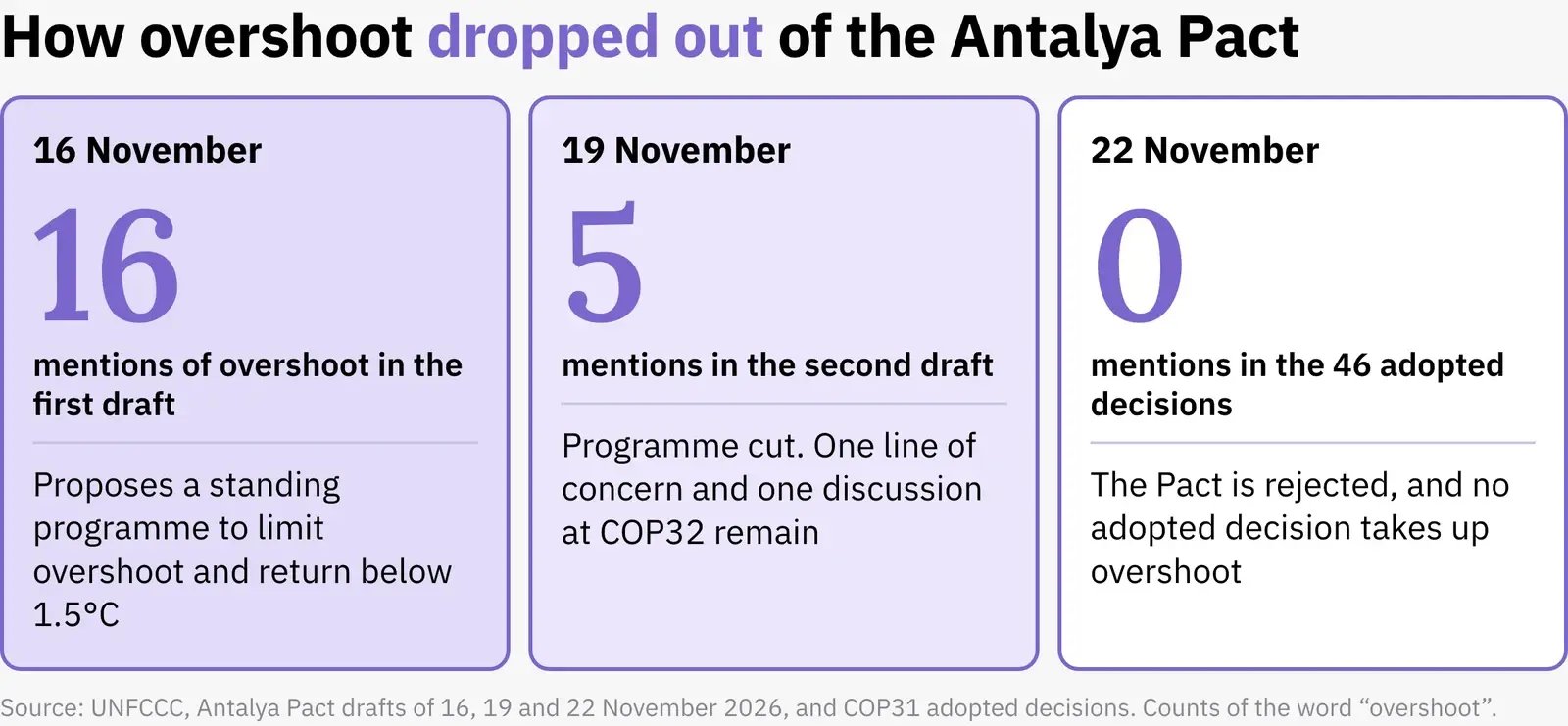
On 16 November the hosts shared the first draft of their summary decision, the Antalya Pact. It set out a response to 1.5°C overshoot, meaning warming that passes 1.5°C at least for a while, proposing a work programme, with an annual dialogue, to study how to limit overshoot, cope with its effects and bring temperatures back down by 2100.
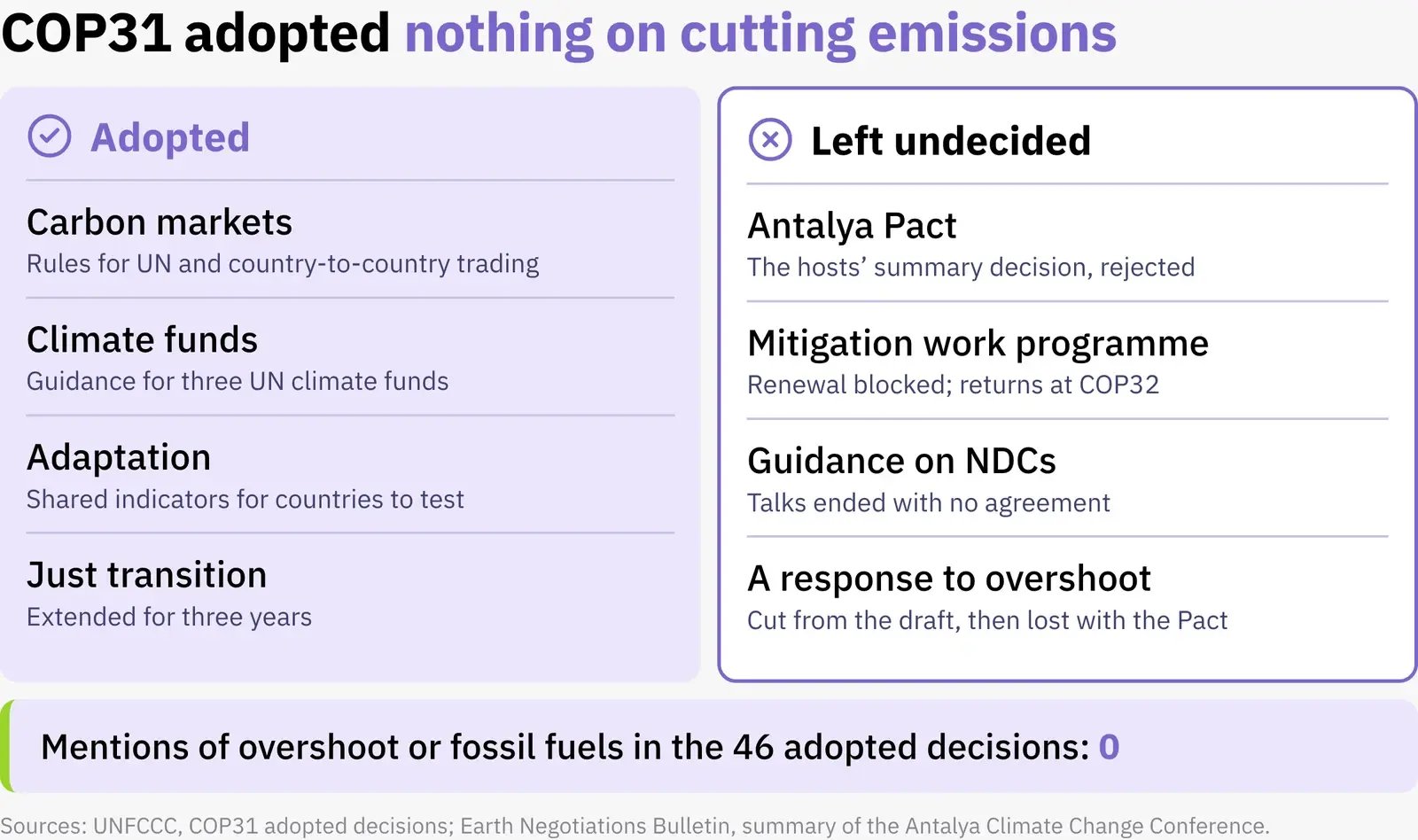
Three days later the programme had been cut. The final draft kept three passing references to overshoot, a sentence that peak warming is “expected to exceed 1.5 °C” in the next few years, and one discussion of overshoot at next year’s summit. Then the whole Pact was rejected. Governments adopted 47 other decisions: 46 on matters such as carbon markets, climate funds, adaptation and just transition, and one thanking the hosts. None of the 46 uses the word overshoot, and none mentions fossil fuels.
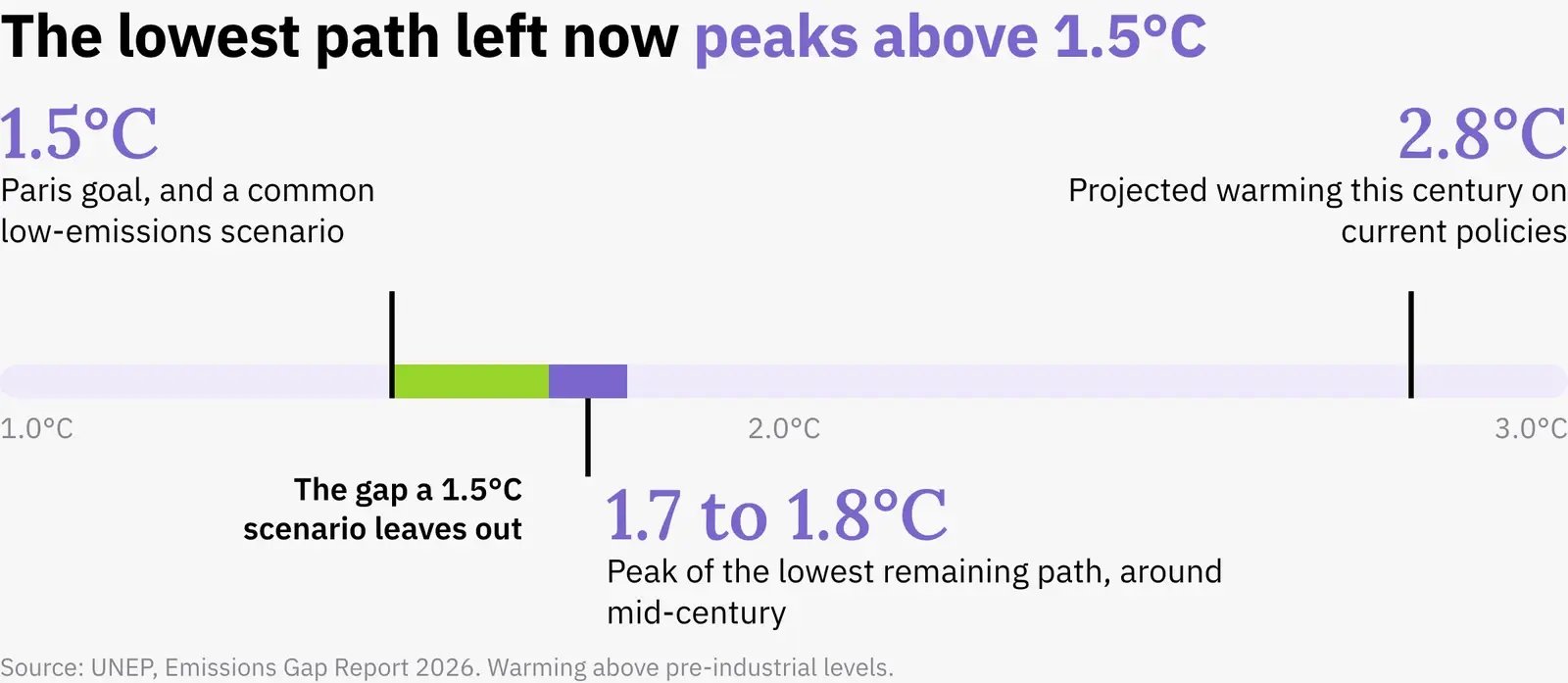
The science was already public. In October, the UN Environment Programme’s Emissions Gap Report said that holding warming to 1.5°C with no or only limited overshoot is no longer possible. Its best remaining path peaks at about 1.7 to 1.8°C around mid-century. On current policies it projects 2.8°C by 2100.
No country is on record opposing the overshoot language, according to the Earth Negotiations Bulletin, which keeps the detailed record of the talks.
What sank the Pact
The Glasgow Climate Pact was the first COP decision to name fossil fuels, calling for a phase-down of unabated coal power and a phase-out of fossil fuel subsidies. In Dubai in 2023, governments agreed to transition away from fossil fuels in energy systems. A mention of fossil fuels is now expected each COP by many governments and stakeholders.
Antalya’s first draft had one. It restated the Dubai agreement and urged countries to speed up the transition away from fossil fuels. By 19 November that paragraph was gone and delegates from EU, Norway, Panama, Vanuatu, Belize, the Marshall Islands and others objected. The EU said the text did not respond to the science and did not mention fossil fuels. With no consensus, the Pact was not adopted.
The planned work on emissions failed too
The Pact was optional. Two mandated items on the official agenda also failed.
The first is the mitigation work programme, a forum governments created in 2021 to speed up emissions cuts this decade. Each year it takes a sector, such as energy, transport or buildings, and brings governments, companies and investors together to compare what works. It sets no targets. Its mandate ran out at this summit, and Russia and the Arab Group blocked the decision to renew it.
The second is guidance on NDCs. An NDC, or nationally determined contribution, is the climate pledge each country files under the Paris Agreement. It does not bind a company. It reaches companies when a government passes laws to meet it: carbon prices, emissions caps, sector standards and reporting rules. Governments have been trying to agree what every NDC should contain, and those talks ended with no agreement.
Both items return at COP32 in November 2027. The Earth Negotiations Bulletin’s analysis traces the failure of the Pact and of the mitigation programme to the same dispute: some fossil fuel producing countries would not accept a reference to fossil fuels, and other countries would not accept a text without one. No decision on cutting emissions faster was adopted: the Pact and the mitigation work programme both fell.
Does it matter?
Losing the Pact matters little for what was in it. Much of it repeated decisions that stand anyway, and its new goals were not binding anyway. It matters for what it shows: the only text on the table that named overshoot failed over fossil fuels.
The delayed decisions do not change law. By September, 120+ countries covering about 75 per cent of global emissions had filed their NDCs for 2035, according to UNEP. What is lost is direction. Under the Paris Agreement each country sets its own target, and a COP adds a signal that all countries share, as Dubai did on fossil fuels. Antalya missed the mark in a record warming year. The next formal check on global progress ends in November 2028.
Where this reaches companies
Climate scenarios. Companies reporting under IFRS S2 use scenario analysis to test how their business holds up under different levels of warming. Many use 1.5°C as their low emissions pathway. UNEP now puts the lowest remaining path at a peak of 1.7 to 1.8°C, and Antalya did nothing to lower it. A best case built on 1.5°C with no or limited overshoot sits below what UNEP says is still possible.
Physical risk. More warming means more heat, drought, floods and storms. Sectors that depend on weather and on fixed routes feel this first. Farming faces harvest losses and price swings. Transport faces disrupted ports, roads and rail. A company with either in its supply chain carries that risk too.
Uncertainty about policy. Planning for new climate rules is easier when governments move in the same direction. Antalya left that picture less clear. With no agreed guidance, NDCs will keep varying from one country to the next. A company working with customers or suppliers across ten countries has ten policy paths, with less to tie them together. That uncertainty is a setback in itself, because it makes long-term investment in cutting emissions harder to justify.
Just transition asks who bears the cost of climate action and who gains from it. It calls for value chains that keep more value in the countries that produce raw materials, naming critical minerals and farm products.
Governments extended the just transition work programme for three years and agreed to set up the just transition mechanism for cooperation and technical help in phases, with its design due for adoption at COP32.
None of this is binding. But it is now the shared language of governments in the countries many companies source from, and it widens the question from how fast a company cuts emissions to how it treats workers, suppliers and communities along the way. In Antalya, governments could not agree on the speed of the transition. They did agree to keep working on its fairness.
A view on cover decisions
The Antalya Pact was a high-risk choice by the hosts, and a bet that didn’t pay off. Future hosts may decide to skip the cover decision. That would mean fewer last-minute showdowns and a clearer record of what was agreed. It would also have a cost. Fossil fuels and overshoot have no agenda item of their own, and a cover decision has been the place to raise topics like this in past COPs.
Recommended reading
-
How carbon standards are changing: inside the GHG Protocol and ISO merger
-
The EU Carbon Border Adjustment Mechanism: What You Need to Know
-
SBTi Corporate Net-Zero Standard V2: what's changed for large companies
-
ISSB vs CSRD vs GRI: how the three sustainability reporting frameworks differ (2026)
Frequently asked questions
Sources
UNFCCC, COP31 adopted decisions (advance unedited versions): unfccc.int
UNFCCC, Antalya Pact drafts of 16, 19 and 22 November 2026, including FCCC/CP/2026/L.14 and FCCC/PA/CMA/2026/L.25
Earth Negotiations Bulletin, summary report of the Antalya Climate Change Conference: enb.iisd.org
UNEP, Emissions Gap Report 2026: unep.org