- Challenge: To meet its operational target of halving Scope 1 and 2 emissions by 2030, FairPrice Group needed to overcome a legacy manual data collection process. Tracking data across hundreds of locations and various business formats was time consuming, inefficient and prone to errors.
- Solution: Terrascope unified Scope 1 (refrigerants) and Scope 2 (electricity) at the individual store level, combining automated PDF extraction, advanced analytics, and emissions driver analysis.
- Key finding: Refrigerant emissions are a dominant Scope 1 driver, and electricity intensity varies meaningfully across store formats, clarifying where conversion and efficiency investments deliver the greatest impact.
- Result: Months of manual measurement replaced by consistent, automated tracking, with year-on-year change decomposed into actionable drivers: refrigerant conversions, maintenance improvements, portfolio changes.
- Business value: A reliable, multi-year measurement base to track progress of FairPrice Group’s Scope 1 and 2 emissions.
About FairPrice Group
COMPANY SIZEClose to 13,000 employees |
HQSingapore |
INDUSTRYGrocery and food retail |
TERRASCOPE SOLUTIONBill & Invoice Extraction |
FairPrice Group is Singapore’s largest retailer operating across multiple formats including supermarkets, convenience outlets, food courts, and pharmacies. The Group serves a million customers daily and has publicly committed to halving its Scope 1 and 2 greenhouse gas emissions by 2030, with a target of operational net-zero by 2045.
The Group’s emissions profile is shaped by two dominant forces. Within Scope 1, fugitive emissions from refrigerant gases represent the majority of the Group’s direct operational emissions. Scope 2 (purchased electricity) accounts for roughly half of total operational emissions (Scope 1 + 2), driven by the energy demands of refrigeration, lighting, and HVAC across hundreds of locations.
As part of its decarbonisation strategy, FairPrice Group is equipping all new and renovated stores with low Global Warming Potential refrigerant systems such as R744 that runs on carbon dioxide (CO2), a natural refrigerant with a GWP of just 1, compared to the existing R404A refrigerant systems that use synthetic Hydrofluorocarbons (HFCs) with a Global Warming Potential of nearly 4,000 times that of CO2. Carbon dioxide refrigeration systems also deliver lower energy consumption and significantly reduced refrigerant costs, reinforcing the environmental and commercial case.
With both scopes requiring store-level granularity to manage effectively, FairPrice Group partnered with Terrascope to build a unified measurement and prioritisation capability across its full portfolio.
Confidence in the numbers to act on what they tell you
"Speed matters, and so does confidence in the numbers. We now trust the numbers enough to act on them, and the store-level detail tells us exactly where action will deliver the biggest reduction. These details are what our stakeholders need."

The Challenge: Manual and Inefficient Process
FairPrice Group’s legacy manual data collection process, spanning hundreds of locations, diverse business formats, and multiple data owners, was time-consuming, inefficient, and compromised data veracity.
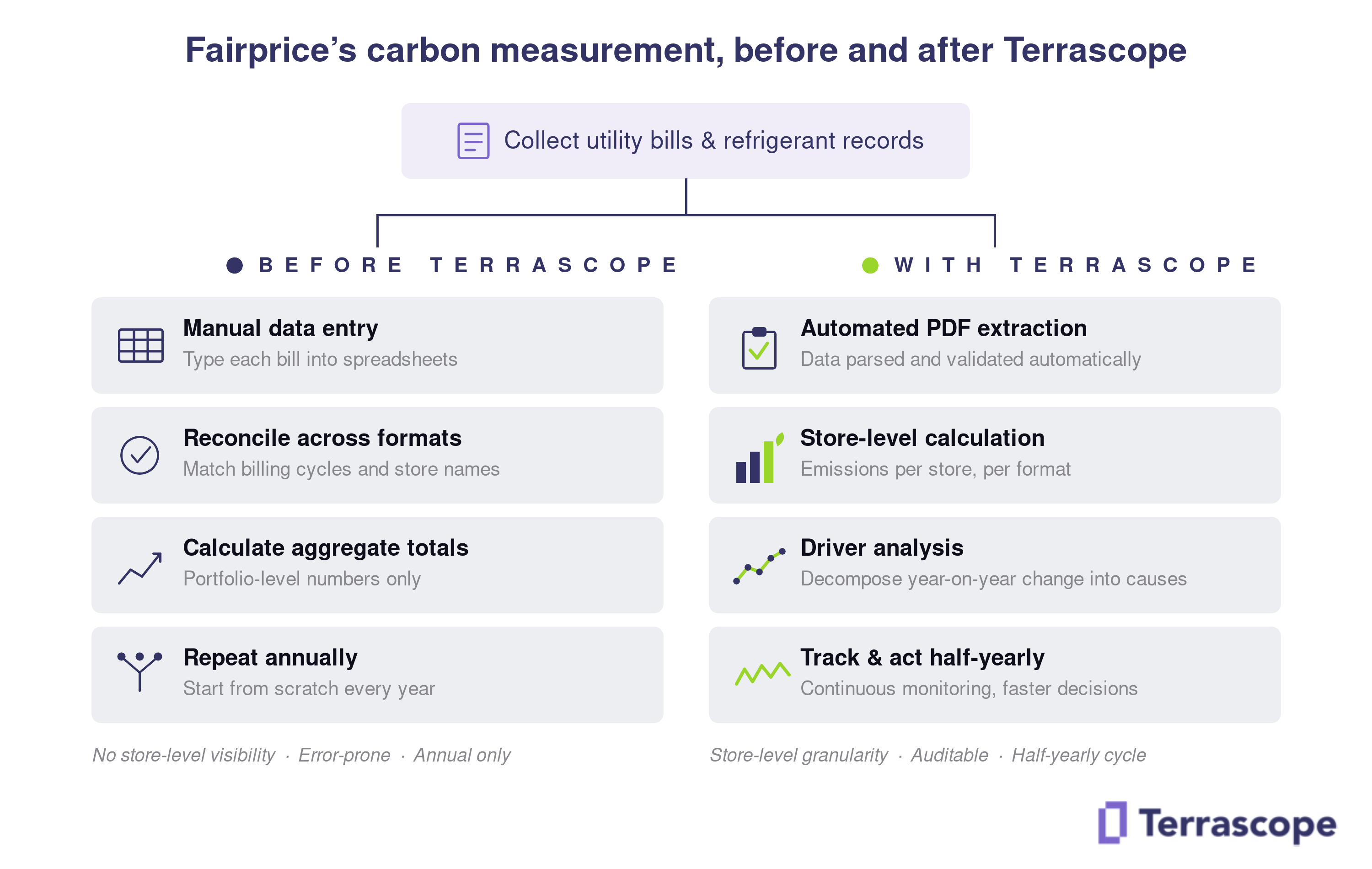
Before Terrascope, the sustainability team was building its emissions baseline manually. Staff were reading individual utility bills, entering totals into spreadsheets, and reconciling data across formats and billing cycles. The process took months, was prone to human error, and had to be repeated year after year across a growing store portfolio.
On the refrigerant side (Scope 1), FairPrice Group needed year-on-year clarity on how its refrigerant reduction actions were translating into measurable impact, but the data was scattered across multiple maintenance contractors, each with their own reporting formats, spanning different refrigerant types, equipment configurations, and hundreds of locations.
On the electricity side (Scope 2), each store’s consumption was documented in individual utility bill PDFs, issued across different billing cycles and formats.
The sustainability team needed a platform that could bring both scopes together at the store level, continuously and accurately, so that public commitments could be tracked with operational precision.
Free checklist
Still tracking emissions manually? See how to choose the right carbon platform
The Terrascope Solution
Terrascope capability 1: Automated PDF extraction for Scope 2
Terrascope collaboratively built its Bill & Invoice Extractor feature with FairPrice Group to ingest thousands of utility bill PDFs from across the Group’s entire portfolio and automatically extracted consumption data to calculate electricity emissions at the individual store level. What had previously taken months of manual spreadsheet work was replaced by a repeatable, auditable, automated process.
The parser achieved high accuracy across the portfolio, significantly reducing the risk of human error in manual data entry.
Manual utility bill processing, now made easier through automation
"Extracting and reconciling utility bills used to be tedious and prone to error due to the amount of manual work required. With automation, we have streamlined the process and reduced manual effort, allowing the team to focus more on insights and action."
This automation saved time, and more importantly, it changed what was possible. With store-level Scope 2 data available consistently and accurately, the operations team could compare energy intensity across every store format and location, identifying where efficiency efforts would deliver the greatest returns.
FairPrice Group is now moving from annual to 6-monthly Scope 2 measurements, enabled by Terrascope’s automated extraction. More frequent measurement means faster identification of efficiency opportunities and operational decisions, a shift from retrospective reporting to proactive emissions management.
Terrascope capability 2: Advanced analytics for store-level insights
With both Scope 1 and Scope 2 data unified at the store level, Terrascope’s advanced analytics gave FairPrice Group a view of its emissions that hadn’t existed before.
For Scope 1, the platform consolidated multi-year refrigerant top-up records from FairPrice Group’s maintenance vendors, mapped each record to its individual store, and calculated emissions using gas-specific emission factors. The platform distinguished between high-GWP synthetics like R404A and low-impact alternatives like CO2, applying the correct warming potential factor to each. This granular approach made it possible to identify which stores were contributing most to refrigerant emissions, and where to focus the conversion programme.
For Scope 2, the platform revealed the concentration of electricity emissions across the portfolio, making it clear which store formats and locations were consuming the most energy, and where investment in efficiency would have the greatest impact.
What set Terrascope apart for FairPrice Group was the ability to unify emissions across electricity and refrigerants into a single store-level view, with the granularity needed to inform operational decisions rather than just report aggregate numbers.
Terrascope capability 3: Year-on-year tracking
FairPrice Group’s public sustainability targets require year-on-year tracking of whether reduction actions are translating into measurable impact.
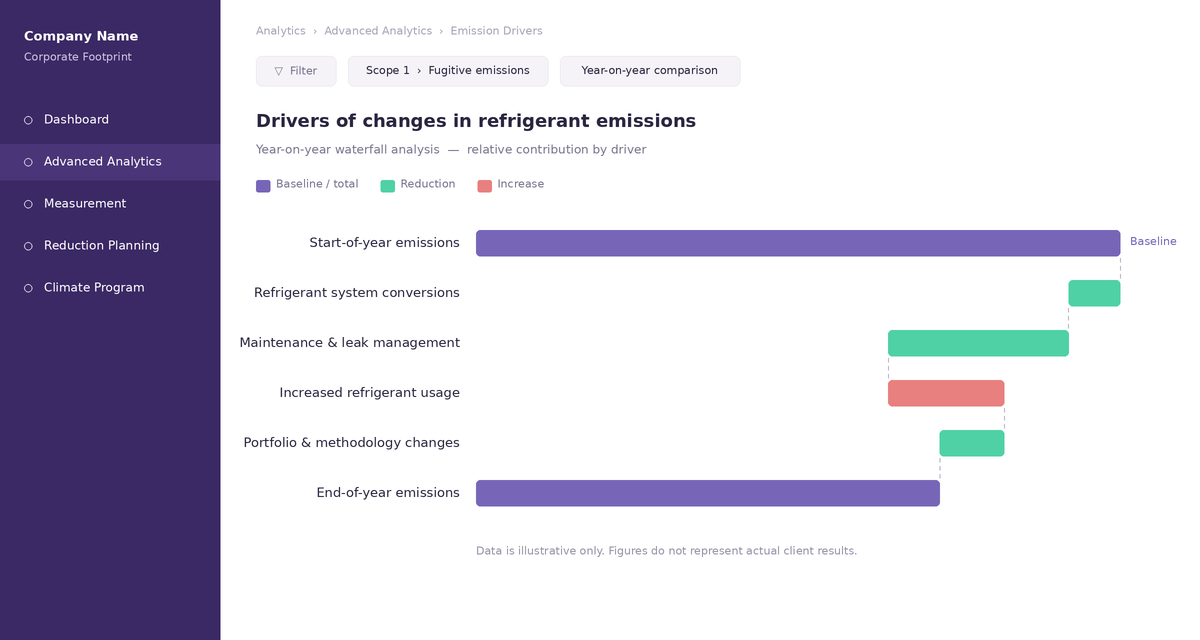
Rather than reporting a single emissions number from one year to the next, Terrascope decomposed the change into its component drivers: the impact of refrigerant conversions from R404A to CO2, maintenance improvements that reduced leakage rates, portfolio changes from store openings and closures, and the effect of higher top-ups at specific locations.
This driver-level visibility allowed FairPrice to distinguish between systemic improvements and one-off variations and, critically, to validate whether their reduction actions were working or needed adjustments.
With store-level emissions data showing which stores had been converted and the emissions impact of each conversion, the team could track the rolling programme against its targets with precision.
R404A and other high-GWP refrigerants are facing tightening regulation. Singapore’s National Environment Agency (NEA) has consulted on proposed restrictions limiting the Global Warming Potential of new refrigerants in commercial refrigeration to 150. For FairPrice, converting now positions the Group ahead of these requirements.
The Impact: From Accounting to Action
With Terrascope, the FairPrice Group has a multi-year dataset that enables trend analysis, restatement when emission factors are updated, and year-on-year comparability as the store portfolio evolves.
Terrascope’s platform capabilities enabled FairPrice Group to:
Move from months of manual measurement to automated, continuous tracking. Thousands of utility bill PDFs are now processed automatically, with a very high degree of accuracy, replacing a process that previously took the sustainability and finance teams months to complete manually.
See emissions at the store level for targeted action. Advanced analytics unified Scope 1 and 2 data across every store format and location, giving the operations team a comparable view of energy intensity and refrigerant impact that didn’t exist before.
Understand the drivers behind year-on-year change. Emissions driver analysis decomposed the annual change into actionable components, showing exactly how much of the improvement came from refrigerant conversions, how much from maintenance improvements, and where higher top-ups at specific locations were offsetting gains.
Track carbon emissions with operational precision. A comparable multi-year dataset built from FairPrice Group’s 2023 verified baseline onward now supports emission tracking against the Group’s operational net zero target.
Key Results
FairPrice Group went from months of manual baseline measurement to consistent, store-level tracking across its full retail portfolio, and used that visibility to build a data-driven emissions reduction programme.
| Automated PDF extraction | Store-level analytics | Emissions driver analysis | Half-yearly measurement |
| Thousands of utility bills processed automatically, replacing months of manual data entry | Scope 1 and 2 emissions calculated and compared at the individual store level across every format | Year-on-year changes decomposed into actionable drivers, enabling prioritisation | FairPrice Group is shifting from annual to half-yearly Scope 1 & 2 tracking to support operational decisions |
Scope 1 and 2 in hand? Your product range is next
The grocery retailer's guide to land emissions hotspots in each category.
If your organisation is managing emissions across a complex retail or operational portfolio, Terrascope can help you identify where to act first and track the impact of every decision.