
Summary
-
Construction products companies can report under the EU's Carbon Border Adjustment Mechanism (CBAM) with real supplier data. BBR VT, a member of the Tectus Group, screened every supplier, got primary data from half of them and calculated supplier-specific emissions for 80% of its imported goods.
-
A short list of activities drives most emissions. At PropertyGuru, five business activities produced over 93% of the footprint, and Thoughtworks found five drivers behind the majority of its emissions.
-
Embodied carbon data can shape products and projects. Tectus Group uses it to design lower-carbon building materials, and a Terrascope study with group member BBR VT found that renovating a damaged building cut embodied carbon by 81% compared with rebuilding it.
-
The work pays off in deadlines met and faster cycles. BBR VT submitted its CBAM report within the EU's reporting deadline, and PropertyGuru measured five times faster than before, which sped up internal buy-in for change.
Your clients want the embodied carbon of the materials you supply. The EU's CBAM makes importers of iron, steel, cement and aluminium report the emissions embedded in those goods, and the EU is moving from reporting that carbon to pricing it. Most of your footprint sits with suppliers, and their data arrives late, in different formats, if at all.
These four companies in construction, property and services faced the same gap. Each one built a baseline from data it already held, found the few activities or suppliers behind most of its emissions, and acted on them.
The four at a glance
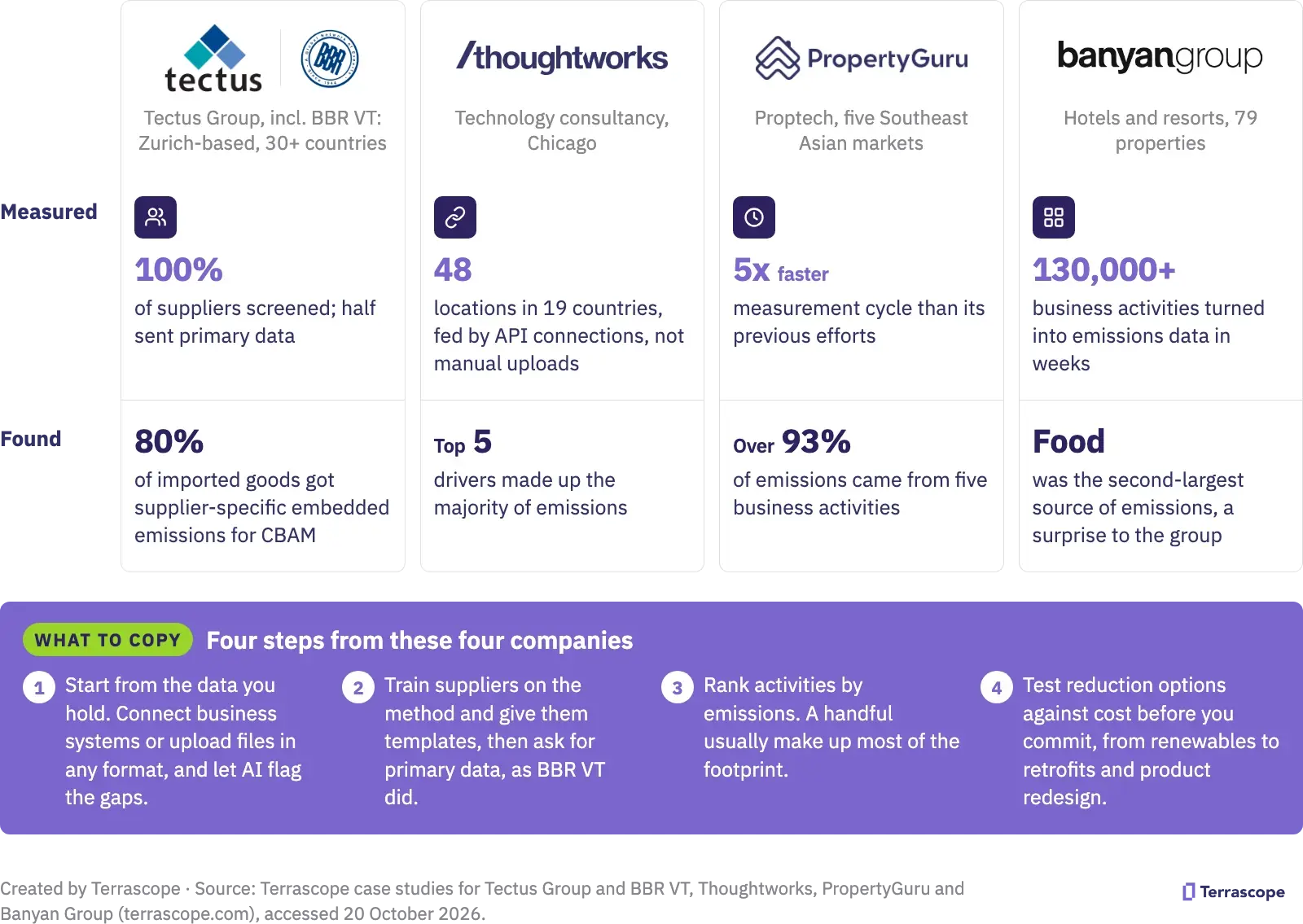
Which example matches your situation?
- Iron or steel goods exported to the EU, and suppliers to engage → BBR VT (Tectus Group)
- Clients asking about the embodied carbon of your building materials → Tectus Group
- Offices or markets in many countries, with data in several systems → Thoughtworks and PropertyGuru
- Hotels or many properties, with food in the supply chain → Banyan Group
Tectus Group and group member BBR VT
How Tectus Group and group member BBR VT are designing lower-carbon materials and reporting under CBAM
Tectus Group
Result: a detailed view of the embodied carbon in its building materials, now shaping its product design and supply chain.
Business outcome: Tectus Group is optimising its supply chain for lower emissions and redefining its product design and strategy to develop building materials with lower embodied emissions. A Terrascope study with BBR VT also gave the group's post-tensioning technology a business case: strengthening a damaged building instead of rebuilding it achieved 30% higher net present value, through lower costs, shorter timelines and faster cash flow.
Tectus Group is a Zurich-based group with a presence in over 30 countries. BBR VT International, whose CBAM work follows, is a member of the Tectus Group.
- The problem: Tectus Group wanted to find the key emission hotspots in its products and technologies.
- What Terrascope did: measured the group's emissions on the platform, including the embodied carbon of its building materials. Embodied carbon is the emissions from making and moving materials, as opposed to running a building.
- What it found: in the study with BBR VT, renovating an earthquake-damaged 14-unit complex in New Zealand cut embodied carbon by 81%, well above the 32% saving from low-carbon materials. Post-tensioned tendons lifted the building's seismic compliance from 34% to 100%.
Watch the Tectus video case study · Read the retrofitting whitepaper
BBR VT
Result: supplier-specific embedded emissions for 80% of imported goods, and a CBAM report submitted within the EU's reporting deadline.
Business outcome: BBR VT achieved full compliance under the EU's transitional phase in an accelerated timeline. Its supply chain teams now run future CBAM cycles themselves through a defined workflow, and suppliers trained on the method can now supply better product-level data for more accurate Scope 3 reporting. As the EU moves from reporting carbon to pricing it, that early readiness equips BBR VT to manage certificate costs across its value chain.
BBR VT International is a Swiss-headquartered engineering group that specialises in post-tensioning and structural systems.
- The problem: BBR VT makes iron and steel products in several countries, and some fall under CBAM when exported to the EU. It needed a repeatable way to report their embedded emissions, with data from its suppliers.
- What Terrascope did: Terrascope had measured BBR VT's corporate carbon footprint every year since 2023. For CBAM, Terrascope's experts and RESET Carbon, specialists in supplier engagement, ran an expert-led programme: a readiness review, supplier training with bilingual data templates, a review of supplier data with modelled values where data was missing, and the submission to the CBAM registry.
- What it found: the programme screened 100% of suppliers and collected primary data directly from 50% of them. That gave BBR VT supplier-specific embedded emissions for 80% of its imported goods.
- Quality check: a data model with over 20 CBAM validation rules checks the data against the EU schema. Modelled values follow EU transitional guidance, and the report passed quality control checks and BBR VT's internal sign-off before submission.
“The EU’s carbon border tax marks a major shift for our industry. We see it as a catalyst for supplier education, collaboration, and operational excellence across our value chain.”
Olivier Forget, Chief Executive Officer, BBR VT
Thoughtworks found the five drivers behind its emissions
Result: a detailed 2022 emissions baseline, Scope 3 included, and the top five drivers responsible for the majority of emissions.
Business outcome: Thoughtworks spends less time and effort getting precise emissions figures across the business and its value chain. It now puts its decarbonisation resources into the activities and business units with the highest emissions, and into areas where emissions have started to rise, so it can act early. Teams set reduction goals with stakeholders and track progress in one platform.
Thoughtworks is a global technology consultancy headquartered in Chicago, with over 10,000 employees across 48 locations in 19 countries.
- The problem: Thoughtworks is committed to its Science Based Targets, but it lacked a granular view of its emissions, particularly Scope 3 emissions from its value chain. Collecting and centralising business data, prioritising action and tracking progress took a lot of time.
- What Terrascope did: replaced manual file uploads with automated API connections and added automated version management and data tracking (data management). It then built a corporate carbon footprint with a multi-year view of direct and indirect emissions.
- What it found: five drivers made up the majority of emissions. The analysis also pointed to the reduction opportunities with the largest impact.
- Quality check: the baseline improved data coverage and quality over previous efforts, and the API connections reduced the risk of data entry errors.
“Partnering with Terrascope has helped us set up a roadmap for meeting our sustainability goals. Their platform seamlessly integrates with our business data, converting thousands of activity lines into actionable insights on our climate footprint.”
Lisa McNally, Global Head of Sustainability, Thoughtworks
Read the Thoughtworks case study
PropertyGuru traced 93% of its emissions to five activities
Result: five business activities produced over 93% of emissions, and the measurement cycle ran five times faster than before.
Business outcome: The time saved and the finer detail gave the sustainability team the insights and simulations it needed to speed up internal buy-in for change. Country teams can now see the emissions intensity of their own operations and take ownership of their footprints. PropertyGuru also has a repeatable measurement and reporting process for future disclosure requirements.
PropertyGuru Group is Southeast Asia's leading property technology (proptech) company, operating in Singapore, Indonesia, Malaysia, Thailand and Vietnam.
- The problem: PropertyGuru wanted to see its emissions market by market and carry what worked in one country to the others. Its data sat in several systems and formats, some of it offline.
- What Terrascope did: the platform used AI to flag data quality issues, estimate gaps and match each activity to an emission factor. With Terrascope's experts, the team then modelled reduction levers in the Reduce module, such as more renewable energy, building retrofits and fewer long-haul flights, and tested “what if” scenarios against costs.
- What it found: five business activities produced over 93% of emissions. The analysis covered purchased goods and services, employee commuting, business travel and product use, and compared the hotspots across markets.
“The Terrascope platform identified PropertyGuru's emission hotspots and simulated potential reduction opportunities, helping us build an actionable decarbonisation plan.”
Disha Goenka Das, CMO, PropertyGuru Group
Read the PropertyGuru case study
How a hotel group measured 79 properties in weeks
Banyan Group
Result: a first full Scope 1, 2 and 3 footprint, built from over 130,000 business activities in weeks rather than months.
Business outcome: Banyan Group can measure and report its Scope 3 emissions in line with the Task Force on Climate-related Financial Disclosures (TCFD), and its leaders now own their part of the footprint. The baseline feeds a marginal abatement cost curve, which ranks reduction options by cost and emissions saved.
- The problem: this was Banyan Group's first emissions measurement. Data for its 79 resorts and hotels sat across 76 entities in 14 countries, with no central system.
- What Terrascope did: used AI to categorise over 130,000 business activities, match emission factors and estimate missing data.
- What it found: the top five activities made up over 70% of emissions, and food came second, which surprised the company. Terrascope showed hotel teams which ingredients mattered most and the effect of cutting food waste.
Read the Banyan Group case study
Get your footprint in weeks
Terrascope pairs the platform with climate and carbon experts who work with your team from data collection to supplier engagement, regulatory reports and audit.
- Engineering and architecture: embodied carbon data for the materials and projects your clients ask about
- Corporate Carbon Footprint: Scope 1, 2 and 3 in one inventory
- Data management: one validated inventory from ERP extracts, utility PDFs and supplier files
- Decarbonise with AI: model reduction scenarios and compare their costs
Further reading
- Retrofitting for resilience and net zero: carbon and financial savings for Tectus (whitepaper)
- CBAM: a guide to understanding the Carbon Border Adjustment Mechanism
- Engaging suppliers on Scope 3 reductions: best practices and tips
- Switzerland's climate disclosure rules: what you need to know
- UK climate disclosure rules: what you need to know
- Spreadsheet, consultancy, software or Terrascope?
FAQs
Sources: Terrascope case studies for Tectus Group (video), BBR VT (a member of the Tectus Group), Thoughtworks, PropertyGuru and Banyan Group, and the Terrascope whitepaper Retrofitting for Resilience and Net Zero (terrascope.com, accessed 20 October 2026).