INDUSTRY
Automotive & industrial equipment
retail, distribution and servicing
HQ
Petaling Jaya, Selangor, Malaysia
COMPANY SIZE
~29,000 employees across 18 countries
and territories, and ~600 sites
PRODUCTS IMPLEMENTED
Corporate Carbon Footprinting (CCF)
Energy, Waste & Water Dashboards
- Starting point: Sime's sustainability team managed emissions across 18 countries and territories, and over 600 sites through manual, Excel-based processes, maintaining 24 separate emission factor databases, a time-consuming exercise.
- Solution: Terrascope consolidated the 24 databases into 4 centralised, reputable sources (NGA, IPCC, IEA, DEFRA), automatically versioned and updated, and standardised data collection with templates across all scopes. Water, waste, and energy dashboards were co-developed with Sime to meet disclosure requirements beyond carbon.
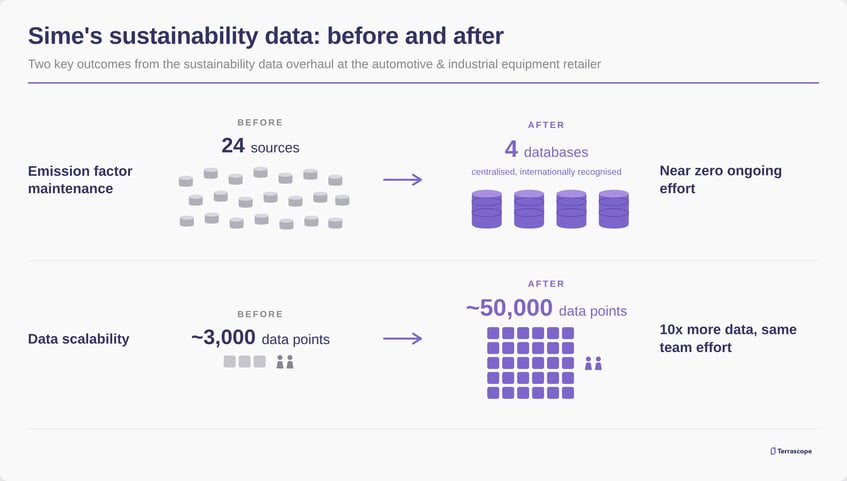
- Impact: Sime's emissions dataset is scaling from ~3,000 data points in FY25 to ~50,000 expected in FY26: over 10x the data, with the same team effort. Emission factor maintenance dropped to near zero, month-level granularity replaced half-year consolidated figures, and stronger data quality and decision-readiness delivered a positive ROI.
About Sime
Sime is a multinational conglomerate headquartered in Petaling Jaya, Malaysia, operating primarily in the automotive & industrial equipment sectors. Listed on Bursa Malaysia, the company operates across 18 countries and territories with approximately 600 sites.
Sime has committed to a 30% reduction in Scope 1 and 2 emissions from its FY2020 baseline and net zero by 2050. The company reports under multiple regulatory frameworks including Australia’s NGER scheme, Bursa Malaysia’s Sustainability Reporting Requirements, and the emerging Australian Sustainability Reporting Standard on climate change (AASB S2).
The Starting Point
Before adopting Terrascope, Sime’s sustainability team managed emissions measurement through Excel-based calculations, drawing on 24 separate emission factor databases and manual country-by-country research. Scope 2 market-based emissions were tracked through spreadsheets, a time-consuming process that limited how frequently the team could report.
With operations across 18 countries and territories and reporting obligations in both Australia and Malaysia, the manual approach constrained the team’s ability to focus on what mattered most: decarbonisation strategy.
“Terrascope has enabled us to consolidate, track and manage our GHG emissions in a more structured and consistent way.
The platform is intuitive, easy to navigate, and grounded in strong sustainability expertise, supporting our reporting requirements and decarbonisation efforts. As with any new platform implementation, there were some challenges during onboarding; however, these were addressed through a structured and collaborative implementation process.
The support team was responsive, collaborative and committed to making the entire process as seamless as possible. We look forward to continuing to leverage its capabilities as we advance our decarbonisation journey.”
Angus Thompson
Executive Manager - Sustainability & Strategy, Sime

The Terrascope Solution
From 24 Databases to 4: Less Maintenance, Greater Consistency
Maintaining accurate emission factors was one of the most important parts of Sime’s measurement process. The team sourced factors from 24 different databases, company reports, and public utility disclosures: researching, validating, and updating them country by country, year after year. The sheer volume required extensive time spent on maintenance.
Through the onboarding process, Terrascope’s team worked alongside Sime to ask a critical question: which emission factor databases are truly needed? Across the 24 initial emission factor databases, there were overlaps and difficulties with tracking and tracing. Terrascope guided the consolidation to several centralised, internationally recognised databases:
-
NGA: Australia's National Greenhouse Accounts factors, a government-published reference for estimating greenhouse gas emissions across a broad range of corporate and national reporting contexts.
-
IPCC: The Intergovernmental Panel on Climate Change's emission factor guidelines, the global scientific benchmark for national and corporate GHG inventories.
-
IEA: The International Energy Agency's country-specific electricity and energy emission factors, covering 100+ countries.
-
DEFRA: The UK Department for Environment, Food & Rural Affairs' annual conversion factors, a common default for corporate Scope 1, 2, and 3 calculations worldwide.
Each database is subscribed, maintained, versioned and automatically updated by Terrascope.
The impact was threefold. First, time savings: the team’s emission factor maintenance burden dropped effectively to zero, with Terrascope managing version control and updates on their behalf, leaving Sime’s team to handle only a small set of custom emissions factors .
Second, compliance: every factor is now quickly traceable to a recognised, reputable source, strengthening audit readiness.
Third, repeatability: with centralised, locked emission factors, year-on-year comparisons are consistent and defensible. Fewer databases meant rigour without the manual overhead.
From Spreadsheets to Scalable, Standardised Data Collection
Before Terrascope, Sime’s data collection relied on bespoke spreadsheets that varied across divisions and years. The semi-annual reporting cycle created a bottleneck where data processing consumed the majority of the sustainability team’s capacity, leaving little time for the decarbonisation strategy work that actually drives progress.
Terrascope replaced this with standardised data templates across all emission scopes, as well as water and waste. The templates eliminate manual data cleaning, enforce consistent formatting and units, and enable automated validation on upload. As one team member put it: “The new carbon calculator workbook layout is very clear and user-friendly, making data entry straightforward.”
The result is more data, captured better: Sime expects to manage ~50,000 emissions data points in FY26 compared to ~3,000 in FY25; a 10x increase, with the same team effort. The sustainability team can now focus on understanding the emissions profile and building their decarbonisation strategy, rather than data quality issues.
The platform also brought Sime’s Scope 2 market-based reporting onto a structured framework. Terrascope offers both location-based and market-based Scope 2 reporting in line with GHG Protocol, applying location-based emission factors (NGA for Australia, IEA for other markets) alongside a market-based hierarchy that accounts for PPAs, RECs, and supplier-specific contracts. The result is a clearer view of the real impact of Sime’s renewable energy procurement.
Beyond Carbon: Energy, Waste & Water
Listed companies in Sime’s markets face additional disclosure requirements, including IFRS S1, that go beyond emissions to cover total waste generated (diverted and disposed) and total water volume used. Many carbon accounting platforms stop at GHG measurement. Sime needed a solution that went further.
Terrascope co-developed its water and waste measurement capabilities in partnership with Sime. The result is a purpose-built module of custom data templates and Advanced Analytics dashboards designed to meet disclosure requirements beyond carbon emissions.
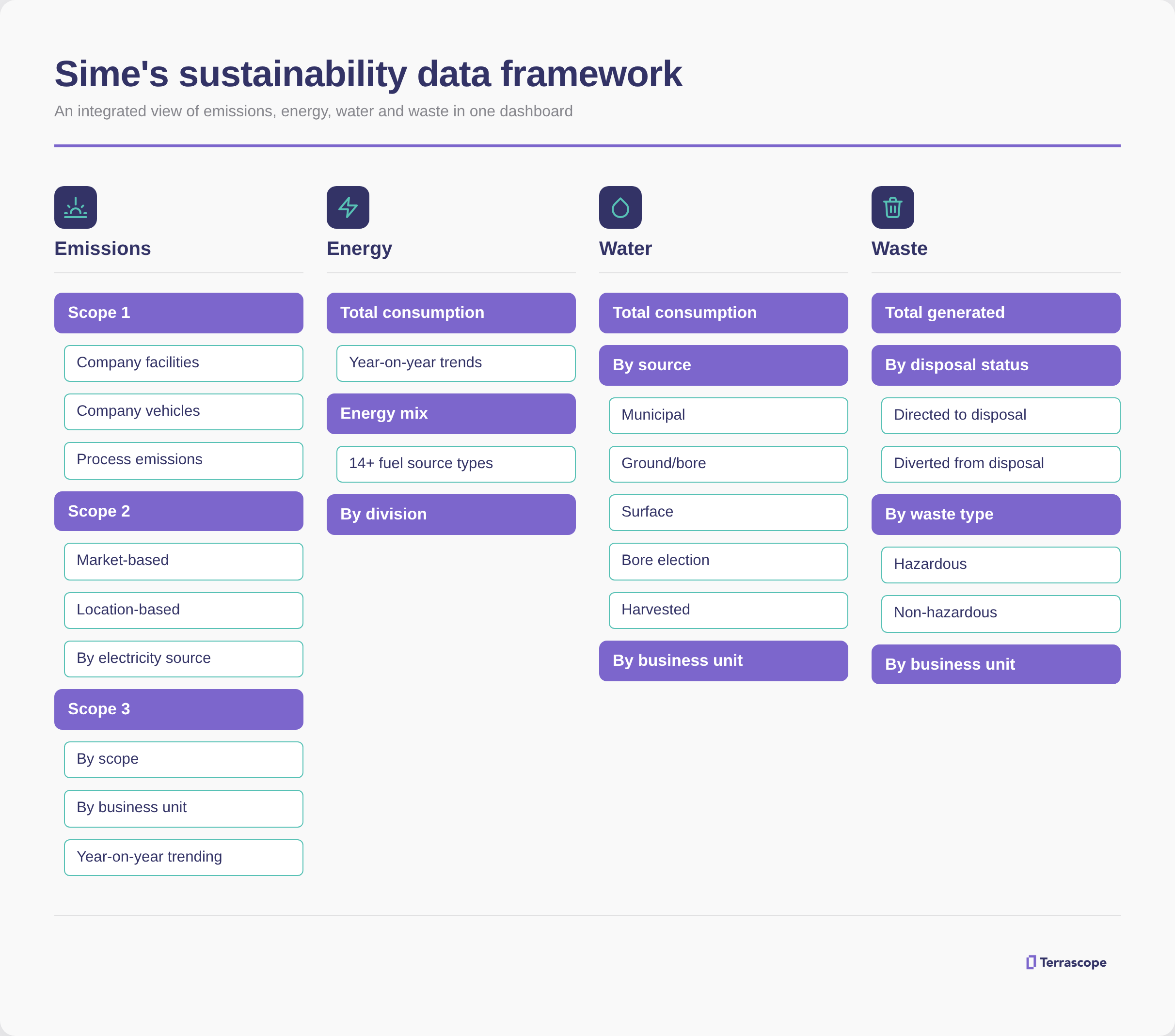
The Waste dashboard tracks total waste generation with year-on-year trends, broken down by disposal status (diverted vs disposed) and waste type (hazardous/scheduled and non-hazardous/general), with division-level drill-downs to identify hotspots.
The Water dashboard monitors withdrawal volumes by source, including town/municipal water, ground/bore water, and surface/recycled water, across time periods and divisions.
The Energy dashboard provides a consolidated view of total and renewable energy consumption, tracking progress toward renewable adoption with year-on-year trends and proportion breakdowns by energy type (grid electricity, purchased renewable, self-generated) and by division.
These dashboards give Sime’s executive leadership quarterly visibility into environmental performance beyond carbon, directly supporting their Bursa Malaysia reporting obligations and internal sustainability governance.
What's Next
Rather than spending months on data collection and processing, the sustainability team can distribute the work throughout the year and dedicate more time to decarbonisation strategy and stakeholder engagement.
The shift from a manual, biannual exercise to a continuous, platform-driven process is the underlying story of Sime’s journey with Terrascope: better data, more often, with more time to act on it.
The Impact: Positive ROI
- Near zero emission factor maintenance effort, with 24 databases consolidated into 4 centralised, reputable sources: NGA, IPCC, IEA, DEFRA. All automatically versioned and updated by Terrascope each new release, reducing ongoing maintenance to near zero.
- Comprehensive energy, waste & water measurement, with dedicated dashboards tracking total waste by disposal method, water withdrawal by source, and energy consumption by type, supporting additional disclosure requirements beyond carbon.
- Stronger data quality and decision-readiness led to a positive return on investment (ROI) for Sime, driven by thorough quality assurance and quality control processes, increased confidence in reported data, and insights that inform and drive decarbonisation initiatives.