Summary
-
Product carbon footprint (PCF) software calculates the greenhouse gas emissions of each product you sell, from raw materials to the factory gate or beyond, across a whole range at once.
-
Five tests separate the options: the data a footprint starts from, the standards it follows, independent proof of method, data exchange over the PACT network, and who does the modelling.
-
All seven platforms in this guide say they scale beyond one-off life cycle assessments (LCAs). They differ most on where footprints start and who models them: you, an LCA expert, AI, or a platform with experts built in.
-
PACT conformance is the clearest public test of data exchange. Terrascope is listed at Version 3 on the PACT network, alongside food platforms Carbon Maps and HowGood.
-
Every vendor claim here comes from the vendor's own website, checked in October 2026, and we applied the same rule to Terrascope.
A packaging buyer at your largest customer emails on a Monday. They need product carbon footprints for the 400 products you sell them, by the end of the quarter, in a format their system can read. Some of those products you make yourself. Others are made for you by contract manufacturers, and only a handful of your suppliers have shared emissions data.
A traditional LCA can take months for one product. That suits a flagship launch. A range of 400 products, which changes every time a recipe, supplier or pack format does, needs a faster and repeatable method. Product carbon footprint software exists to close that gap. This guide compares seven platforms on the five tests that matter at scale. Terrascope is one of them, and every claim, ours included, comes from each vendor's own website.
The PCF job at a glance
Which option matches your situation?
- One flagship product, or an environmental product declaration (EPD) → a one-off LCA study or LCA software
- A small range and an in-house analyst → a self-serve PCF tool (Climatiq, or Mondra in food) or a platform with experts built in (Terrascope)
- Hundreds, or thousands, of products, limited supplier data, and a deadline → a platform with experts who model recipes, processes and packaging (Terrascope; see Pokka below)
- Engineered products with detailed bills of materials in ERP or PLM systems → PCF software that imports them (Tanso, Makersite, SAP)
- Customers asking for footprints over the PACT network → a platform listed on the PACT network (Terrascope)
PCF or LCA?
An LCA measures a product's environmental impacts across its life cycle, under ISO 14040 and 14044. It can cover water, land use, toxicity and more alongside climate. A product carbon footprint is the climate part on its own: the greenhouse gas emissions of one unit of product, usually cradle-to-gate (raw materials to the factory gate) or cradle-to-grave (through use and disposal). PCFs follow ISO 14067 or the GHG Protocol Product Standard, and sector rules such as Together for Sustainability (TfS) for chemicals and Catena-X for automotive. LCA software is built for an expert studying one product in depth. PCF software is built to produce comparable footprints for a full range and keep them current.
Five tests for PCF software at scale
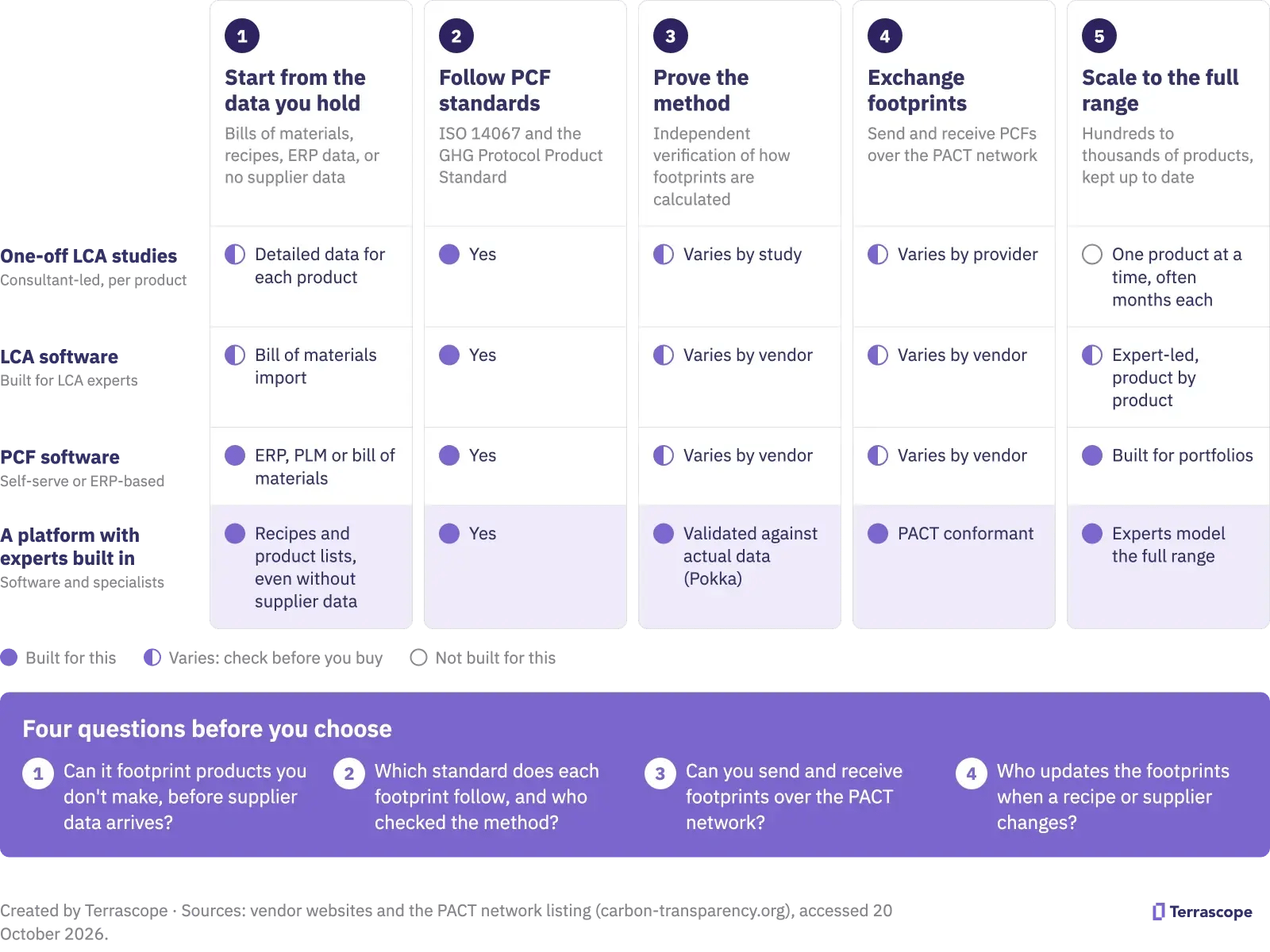
1. Start from the data you hold. Footprints start from bills of materials, recipes, ERP or PLM data, or a product list. The test is how the platform handles gaps in supplier data, which most ranges have. Ask whether it can footprint products made for you by contract manufacturers.
2. Follow PCF standards. Check which standard each footprint follows: ISO 14067, the GHG Protocol Product Standard, the Product Environmental Footprint (PEF) or a sector rule such as TfS or Catena-X. Your customers may ask for a specific one.
3. Prove the method. Following a standard is the vendor's statement. Independent verification is a third party's check. Look for independent verification of the PCF method, such as a TÜV certification or an ISO 14067 verification, and for testing against actual data.
4. Exchange footprints. The Partnership for Carbon Transparency (PACT), convened by the WBCSD, sets a common format for sharing PCFs between companies. On its network listing, "Every solution here has passed automated conformance testing for the version shown." Version 3 is the current version.
5. Scale to the full range. Count the products the platform has footprinted for customers, and ask who models each one: your team, an LCA expert, AI, or the vendor's specialists. Ask too who updates the footprints when a recipe or supplier changes.
Quick comparison
| Option | Type | How footprints start | Independent proof of method (stated) | PACT network listing (20 Oct 2026) | Who models |
|---|---|---|---|---|---|
| Terrascope | Platform + in-house experts | Recipes, processes and packaging, even without supplier data; bills of materials | PACT conformance testing | Version 3 | Experts + platform |
| SAP Sustainability Footprint Management | ERP-based platform | Connected operational data and supplier information | Not stated | Listed for SAP Sustainability Data Exchange | Your team, on SAP |
| Watershed | Enterprise platform with AI | AI research of supply chains and manufacturing processes | Not stated for PCFs | Not listed | AI + climate scientists |
| Tanso | Industrial PCF software | Bills of materials, ERP, PLM and Excel | TÜV Rheinland-certified methodology | Not listed | Your team |
| Makersite | Product data and LCA platform | CAD, ERP and PLM files | Not stated | Earlier version; Mattermaps at Version 3 | Sustainability experts |
| Sphera | LCA software + consulting | Bill of materials import | DEKRA-verified datasets | Not listed | LCA experts |
| Climatiq PCF Studio | Self-serve PCF tool + API | Bill of materials, energy or process data | ISO 14067 verification | Not listed | Your team |
The seven PCF platforms
1. Terrascope
Terrascope is a carbon accounting platform with experts built in. Its specialists model product footprints from recipes, manufacturing processes and packaging, so a range can be footprinted before supplier data arrives, and the platform "automates supplier data ingestion through Bill of Materials handling, bulk-creating PCFs for supplier-provided goods." Footprints can be cradle-to-gate or cradle-to-grave, "built in alignment with leading industry standards". Terrascope is PACT conformant and listed at Version 3, so customers can send and receive PCF data across the PACT network, "even if their suppliers or partners use other platforms." For Pokka, it footprinted 4,980 products and checked the models against actual data. Terrascope states that its PCF capabilities are "50x faster than traditional LCAs"*, and it was featured in Verdantix's 2025 Smart Innovators in Product Carbon Footprinting.
Best for: food, beverage, consumer goods and manufacturing companies that need footprints for a full range quickly, including products made for them by others.
2. SAP Sustainability Footprint Management
SAP's footprint tool runs on SAP data. It aims to "Automate corporate and product carbon footprint calculations with standardized, audit-ready methodologies and scale across thousands of products and suppliers", and to "Automate the mapping of 45,000+ pre-delivered emission factors, including supplier-specific footprints, with AI." Its customer HARTING uses it for "the CO2 emissions calculation of 13,000 materials". SAP is positioned as a Leader in the 2026 IDC MarketScape for carbon accounting and management applications. Its PACT network listing covers SAP Sustainability Data Exchange, a separate SAP product for sharing footprints.
Best for: manufacturers running SAP that want product footprints calculated inside their ERP landscape.
3. Watershed
Watershed Product Footprints uses "AI agents trained to research supply chains and manufacturing processes as life cycle assessment (LCA) practitioners would". It states that "Every PCF is backed by a production graph that breaks down every input process and material", and that customers can "Pull PCFs into your corporate footprint". Its apparel page states that "Watershed is ISO 14067 compliant."
Best for: large enterprises already using Watershed for their corporate footprint that want product footprints in the same system.
4. Tanso
Tanso builds PCF software for industrial companies, mostly in German-speaking Europe. It takes footprints "From bill of materials to PCF report on one data foundation, in line with ISO 14067", importing from ERP, PLM and Excel or by API. Its methodology is "TÜV Rheinland-certified", it supports sector rules including Catena-X and TfS, and it says "700+ industrial companies trust Tanso". One case study is titled "5000 PCFs per day: Automated calculation at Norder Band AG".
Best for: industrial manufacturers with detailed bills of materials that need certified, sector-rule footprints for their own teams to run.
5. Makersite
Makersite connects "to CAD, ERP, and PLM systems to import bill of material or product files in multiple formats", and its AI "generates PEF and ISO-grade LCAs at scale". For Lenovo's ThinkPad range it reports "thousands of configurations now modelled". Makersite has an earlier-version listing on the PACT network, and Mattermaps, its data exchange platform, is listed at Version 3.
Best for: electronics and engineered-product companies whose product data lives in CAD and PLM systems, with sustainability experts to run the models.
6. Sphera
Sphera offers LCA software and consulting. Its LCA for Experts "delivers precision and flexibility for up to 25 LCAs", and LCA Automation offers "Enterprise-wide scalability and transparency across your entire operation". Its software follows ISO 14040 and 14044, it draws on DEKRA-verified datasets, and its consulting team cites "30 years of experience in conducting LCAs".
Best for: companies with in-house LCA practitioners that need detailed, multi-impact studies alongside carbon footprints.
7. Climatiq PCF Studio
Climatiq is a self-serve tool with an API. Users "Add your bill of materials, energy or process data", and "All calculations apply ISO 14067- and GHG Protocol-verified methodology". Its changelog states, "Our PCF methodology has been independently verified to meet ISO 14067", and it reports data quality indicators in line with the PACT framework. Its pitch is direct: "No consultants, no waiting – you control the process."
Best for: teams with an in-house analyst, or developers building footprints into their own products, that want to "Scale from one SKU to a full product range" themselves.
Food and beverage specialists
Food companies have specialist options too. Carbon Maps is listed at PACT Version 3, reports "2 000 000+ product and packaging LCAs calculated", and has its PCF methodology validated by TÜV Rheinland against PACT requirements and its calculations validated by Bureau Veritas against ISO 14040, 14044 and 14067. CarbonCloud built "More than 10,000 product footprint models" for Dole Nordic, each with a technical report to the GHG Protocol and ISO 14067. HowGood is also listed at PACT Version 3. Mondra offers a self-serve plan: "Upload a spreadsheet of your products. Get a footprint back for each one the next working day." Our guide to the best agri-food carbon accounting platforms compares them in more detail.
Case example: Pokka
Result: footprints for 4,980 products, including finished products made for Pokka by others, with about 92% accuracy against actual data.
Business outcome: Pokka has product-level footprints across its range before supplier data arrived, on a platform that turns business activity data into emissions data "5 times faster than their previous manual efforts".
Pokka is a Singapore beverage company whose products are sold in 60 countries.
- The problem: Pokka needed footprints for 4,980 SKUs, including finished products made for it by others, before any supplier data was available.
- What Terrascope did: modelled "the recipes, manufacturing processes and packaging of 1000s such SKUs" to estimate cradle-to-gate footprints. Machine learning flagged data errors and filled supplier data gaps.
- Quality check: "Terrascope's models managed to achieve ~92% accuracy when subsequently compared to the actual data of 700 product SKUs."
Vitasoy: footprints as a sales tool
Result: Barista's Choice soy, oat and almond milks footprinted cradle-to-gate, with soy 17%, oat 9% and almond 2% below industry benchmarks.
Business outcome: "Vitasoy now has quantified product-level emissions data to inform B2B customer conversations, support customers' sustainability reporting needs".
Terrascope built custom emission factors for Australian-grown soy, which "produces up to 90% lower emissions than global averages". The study followed the principles of ISO 14067 and ISO 14044. Its industry benchmarks are illustrative, and the case study notes that its data and assumptions have not been independently verified. Read the Vitasoy case study
For Tetra Pak in Japan, Terrascope produced "Granular product carbon footprints for 16 SKUs in one month". Fifteen of the 16 came out 2% to 88% lower than industry-standard packaging. Read the Tetra Pak case study
Footprint your product range with Terrascope
Terrascope pairs the platform with PCF experts who model your products, check the results against your data, and keep the footprints current as recipes and suppliers change.
- Product Carbon Footprint: footprints for a full range, cradle-to-gate or cradle-to-grave, shared over the PACT network
- Supplier Engagement: collect supplier data to replace modelled estimates over time
- Corporate Carbon Footprint: Scope 1, 2 and 3 in one inventory, alongside your product footprints
- ROI calculator: estimate the return for your own company
Further reading
- Terrascope achieves WBCSD PACT conformance
- Best agri-food carbon accounting platforms compared
- How food and beverage companies calculate and cut their emissions: 5 examples
- How manufacturing and mining firms cut emissions: 5 examples
FAQs
Sources: vendor websites for SAP, Watershed, Tanso, Makersite, Sphera, Climatiq, Carbon Maps, CarbonCloud and Mondra; PACT network listing (carbon-transparency.org/network); Terrascope Product Carbon Footprint page, PACT conformance post and case studies for Pokka, Vitasoy and Tetra Pak (terrascope.com).